The Government launched the first batch of low-altitude economy (LAE) Regulatory Sandbox pilot projects in March and these projects are being rolled out progressively.
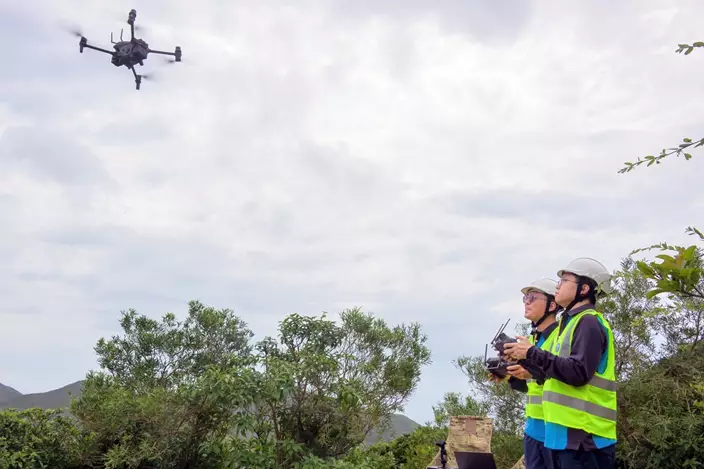
Greater efficiency: The application of drone inspections significantly improves the efficiency of inspecting overheads lines and towers.
Drone drill
Click to Gallery
Greater efficiency: The application of drone inspections significantly improves the efficiency of inspecting overheads lines and towers.
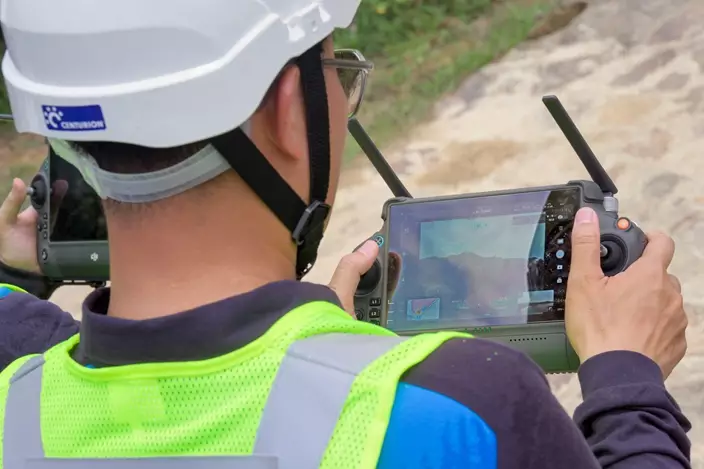
Smart inspection: With the use of beyond-visual-line-of-sight operations, engineering staff can quickly assess the equipment and components in remote or hazardous areas under inclement weather conditions.

Efficiency boost: CLP Power Principal Manager - Logistics & Transport Edward Chan says they expect the pilot project to bring a more than four-fold increase in the efficiency of inspections.

Legal facilitation: Civil Aviation Department Operations Officer Nicole Law says amendments to the Small Unmanned Aircraft Order and the Air Navigation (Hong Kong) Order 1995 are expected to come into effect in mid-July 2025.
Under the framework of the sandbox pilot projects, CLP Power’s drone team began a beyond-visual-line-of-sight (BVLOS) pilot scheme to inspect overhead lines at a test site in Sai Wan in Sai Kung.
CLP Power Principal Manager - Logistics & Transport Edward Chan said under the LAE Regulatory Sandbox pilot projects, the Civil Aviation Department (CAD) has relaxed the existing restriction on BVLOS operations to allow a drone to fly beyond a pilot's line of sight.
“We submitted four inspection routes to the Government, covering overhead line facilities in some sparsely populated areas and also urban districts.
“In April, we began the BVLOS operation in one of the pilot sites, which is in Sai Wan of Sai Kung. We carried out a test flight under different scenarios, including manual operation by remote pilots and also automated inspection of our outdoor power facilities. Although Sai Wan is relatively remote, but the signal reception during the trial was smooth.”
Smart inspection: With the use of beyond-visual-line-of-sight operations, engineering staff can quickly assess the equipment and components in remote or hazardous areas under inclement weather conditions.
Safety first
The company has an extensive power transmission and high-voltage distribution network. Overhead lines are in particular more vulnerable to extreme weather and environmental conditions.
In view of increasing extreme weather events, the company has stepped up drone inspections of outdoor power facilities to ensure a stable power supply.
Mr Chan explained that most of the company’s outdoor transmission lines and towers are located in remote areas. Each team of engineering staff used to carry out inspections by patrols, covering an average of only around 5km a day, but with the use of drones, they expect a more than four-fold increase in the efficiency of inspections.
“For emergencies and severe weather conditions, BVLOS operations are particularly crucial because a fallen tree, landslides or road blockages might prevent our engineering staff from reaching the affected area.
“With the use of BVLOS operations, our engineering staff can operate drones from a safe location, quickly assess the equipment and components in remote areas and hazardous areas, so it can significantly improve the efficiency of maintenance work and also reduce the impact on customers.”
Efficiency boost: CLP Power Principal Manager - Logistics & Transport Edward Chan says they expect the pilot project to bring a more than four-fold increase in the efficiency of inspections.
Law change
To promote the development of Hong Kong's low-altitude economy, the Government has started work in various areas, including legislative amendments.
CAD Operations Officer Nicole Law noted that to tap into the potential of heavier small unmanned aircraft (SUA) the Government is now working to amend the current SUA Order to add a new Category C aircraft to cover unmanned aircraft weighing more than 25kg but not more than 150kg.
“At the same time, provisions will be introduced in the Air Navigation (Hong Kong) Order 1995 to facilitate the trials of various unconventional aircraft in Hong Kong, such as unmanned aircraft weighing over 150kg, so that the emerging technologies for LAE can be trialled under specified conditions, provided that aviation safety requirements are met.”
The amendments to the Small Unmanned Aircraft Order and the Air Navigation (Hong Kong) Order 1995 were published in the Gazette on May 23 and the legislative amendment proposals were tabled in the Legislative Council on May 28. It is expected that both amendments will come into effect in mid-July 2025, she added.
Legal facilitation: Civil Aviation Department Operations Officer Nicole Law says amendments to the Small Unmanned Aircraft Order and the Air Navigation (Hong Kong) Order 1995 are expected to come into effect in mid-July 2025.