AI-powered robots are having a transformative effect across various sectors in China but they are now playing a pivotal role in saving lives, with their advanced ability and precision proving crucial in highly-complex medical situations and surgical procedures.
With rapid adoption and government support, China has become the world's most important testing grounds for AI robotics with a number of notable breakthroughs being seen in recent months.
While the robots are already known for wide-ranging uses such as helping boost productivity in Chinese factories, the highly-developed robots are now being deployed in the healthcare and medical sector, where their high accuracy is being trusted by surgeons to help complete challenging operations.
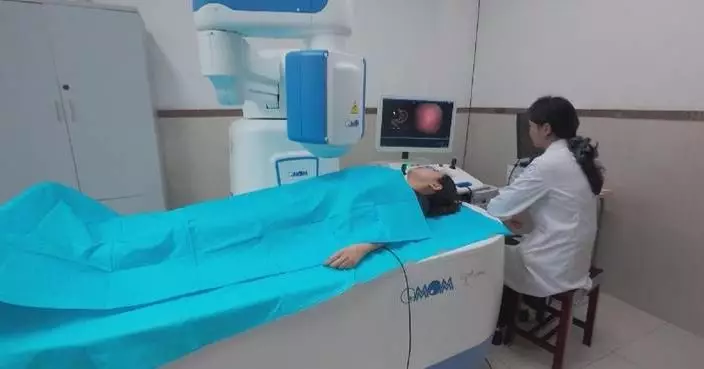
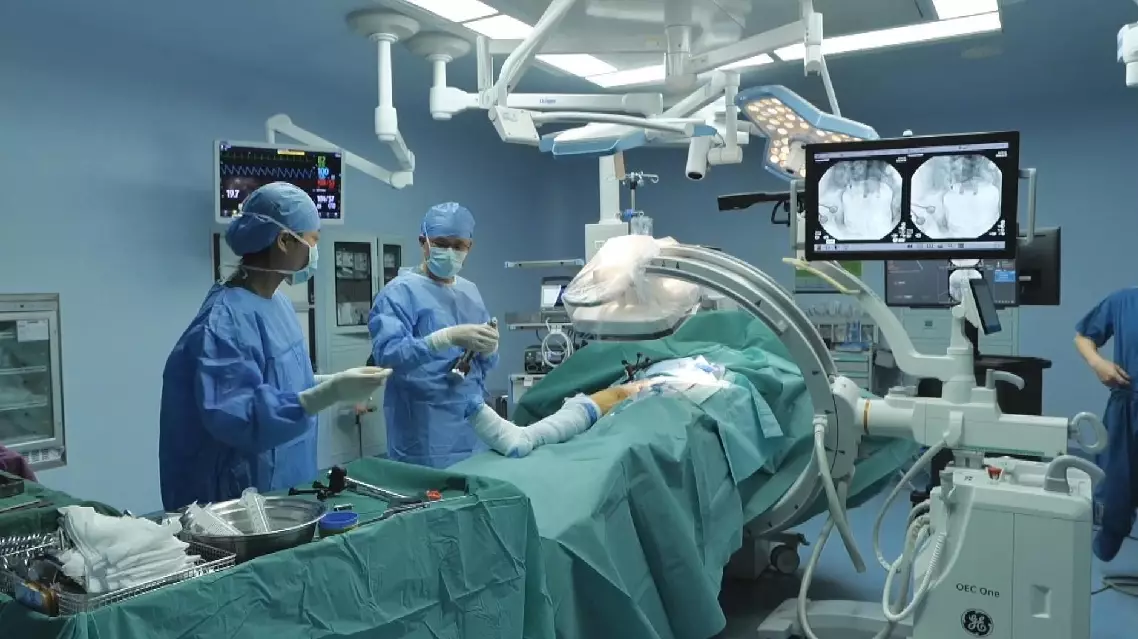
Dr. Fan Shicai at the Third Affiliated Hospital of Southern Medical University in south China's Guangzhou City said a Chinese robot can perform complex orthopedic surgeries much faster and with striking precision. A procedure that once took five hours can now be done in just 30 minutes.
"You can match the scale exactly. It’s accurate to 0.1 millimeters," he said.
The benefits are already being felt by patients like Ms. Wu, who underwent emergency surgery after a traffic accident crushed her pelvis. Thanks to this less-invasive, robot-assisted surgery, she may now be able to go home just a few days after the procedure.
"I felt fine after the surgery. Just three days later, I feel full of energy again," she said.
The global market for surgical robots is booming and is expected to hit 60 billion U.S. dollars by 2030, highlighting the vast potential for growth.
The industry's development is welcome news for China's healthcare sector, where the demand for operations is high given the size of the population. But with these robots being expensive, switching from imported to domestic models in the long run will also help cut costs.
"This one is imported, but we also have domestic models – and they are very good. Patients pay more - around 20,000 yuan extra. But they heal faster," said Liu Cundong, director of Urology of the hospital.
Now, training centers are helping doctors across southern China to master the new technology.
"Some local hospitals rarely handle complex surgeries. But with robotic aid, their doctors can operate like seasoned specialists," said Li Cheng, director of the Third Affiliated Hospital of the Southern Medical University.
Robotic technology is saving more lives than ever, and they may also help keep us out of hospitals altogether in the future through their various applications.
For instance, while normally climbing steep steps on mountains wears you out, a hiking-assist exoskeleton may ease the strain on your joints, with these wearable devices now becoming smarter and lighter.
A top-of-the-range exoskeleton can weigh as little as two kilograms and, more importantly, it can be packed with smart censors that track your every move, providing support in real time.
With dual batteries, it has enough power to complete 20,000 steps and is also expected to have huge potential for uses in warehouses, firefighting, and in physical therapy.
This tech also offers another feasible longer-term solution to assist China's aging population. By the end of 2024,the country had over 310 million people aged 60 and above, with around 35 million facing mobility issues, which is why the government is encouraging the use of exoskeletons in elder care.
Elsewhere, the emergence of humanoid robots could prove a game-changer in the jobs which are deemed too dangerous, repetitive, or unpredictable for humans. From building cars to saving lives, these robots aren't just solving China’s challenges — they’re collecting the training data that could boost productivity worldwide.
One such example comes at the ZEEKR Intelligent Factory in east China's Zhejiang Province, where the world's first solely humanoid team collaborate across tasks in a real factory setting. Developed by the UBTech Robotics based in southern China's Shenzhen City, the robots learn on the job, and talk to their teammates via an advanced AI "brain network."
It's believed this innovation could help fill a significant labor shortage in the manufacturing sector, where such robots can take on repetitive tasks or carry out risky inspections.
Amid their rapid development, many insiders expect these robots will soon be on par with their human counterparts, and without the need to eat or sleep, it may only be a matter of time before we are overtaken.
"Humanoids today can already run at 12 km per hour — enough to finish a half marathon. Our goal this year is 50 percent of human efficiency. Since robots don’t rest, they'll eventually outperform us," said Tan Min, chief brand officer of UBTech Robotics.
China's rapid robotics development transforms surgical procedures, improves mobility, productivity
The latest speech on cross-Strait relations by Xi Jinping, general secretary of the Communist Party of China (CPC) Central Committee, in which he called for peaceful development, closer exchanges and greater unity, has drawn a warm response from across society at home and abroad.
Meeting Cheng Li-wun, chairwoman of the Chinese Kuomintang (KMT) party, in Beijing on Friday, Xi, also general secretary of the Communist Party of China Central Committee, called for closer cross-Strait ties by fostering a shared sense of identity, safeguarding the common homeland through peaceful development, improving people's well-being through exchanges and integration, and working together to achieve national rejuvenation. His remarks further clarified the direction of cross-Strait relations and provided important guidance for their development.
He said that people on both sides of the Taiwan Strait hope for peace and tranquility, improved cross-Strait relations, and better lives, stressing that it is a responsibility that the CPC and the KMT cannot shirk, and also a driving force for the two parties to work together.
Figures from the Chinese mainland and the Taiwan region said Xi's heartfelt remarks demonstrated his care and concern for compatriots in Taiwan and highlighted the mainland's sense of mission and historical responsibility in pursuing peace across the Taiwan Strait, the well-being of Taiwan compatriots, and the rejuvenation of the Chinese nation.
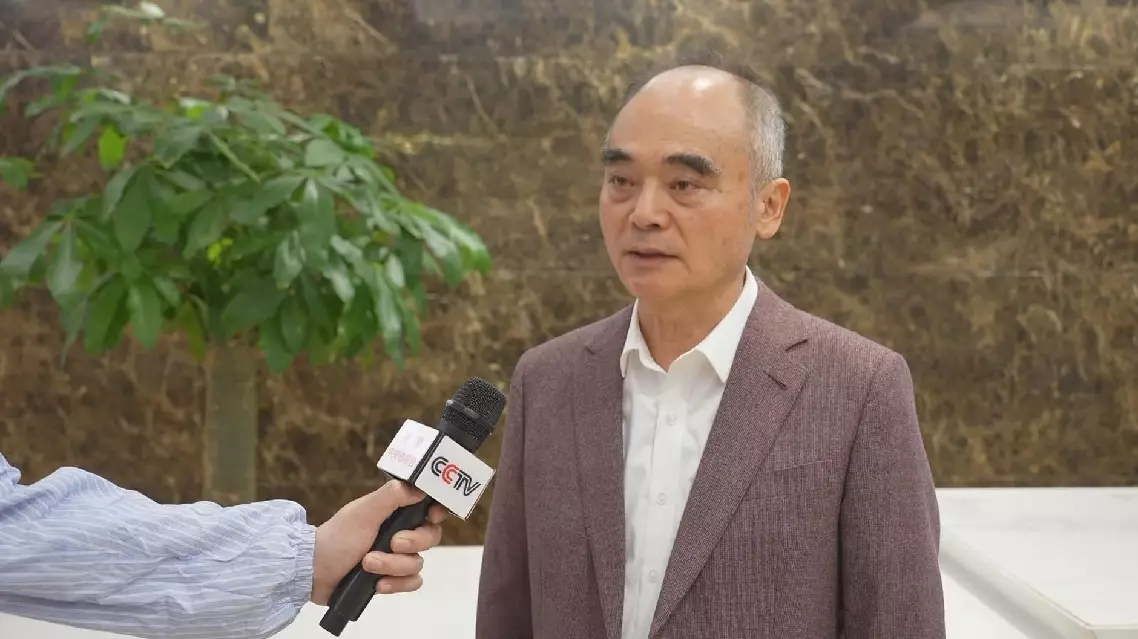
"General Secretary Xi emphasized that the overarching trend toward the great rejuvenation of the Chinese nation will not change, and the prevailing momentum for the Chinese on both sides of the Strait to come together will not change. The situation across the Taiwan Strait is currently complex and grave, and the secessionist policy of Taiwan's Democratic Progressive Party (DPP) is undermining peace in cross-Strait relations. Therefore, we must achieve a win-win outcome of peaceful cooperation across the Strait on the basis of the common political foundation of adhering to the 1992 Consensus and opposing Taiwan secession," said Zhu Weidong, deputy director of the Taiwan Research Institute at the Chinese Academy of Social Sciences.
"General Secretary Xi's speech holds epoch-making significance for promoting cross-Strait exchanges and peaceful development, and has elicited widespread, positive, and favorable responses in Taiwan. In his speech, the General Secretary emphasized that compatriots on both sides of the Taiwan Strait share the same roots, the same culture and ethnicity, and are one family bound by blood. When a family gets along, as long as they have calm discussions on matters of concern, there will be no conflicts or differences that cannot be resolved. This reflects the mainland's utmost goodwill toward our compatriots in Taiwan," said Chi Chia-lin, honorary chairman of Reunification Alliance Party in Taiwan.
"The general secretary showed great concern for Taiwan compatriots, which is truly heartwarming. He specifically mentioned that we are all part of the Chinese nation and that we must work together to promote our Chinese culture. I believe this is something we, as young people on both sides of the Strait in this new era, should strive to achieve together," said Chen Wen-cheng from Taiwan, who is now a teacher at Peking University in Beijing.
Xi said the future of cross-Strait relations should be firmly held in the hands of the Chinese people themselves, adding that Taiwan compatriots are welcome to visit the mainland and seek development opportunities.
"General Secretary Xi pointed out that this year marks the first year of the 15th Five-Year Plan, and expressed the mainland's willingness to share its development opportunities and achievements with Taiwan compatriots and jointly build a stronger Chinese economy. I am deeply moved and greatly encouraged by this. We have so many like-minded businesspeople and compatriots from Taiwan who have put down roots on the mainland, worked hard to build their businesses, and developed together. We are very proud, and we feel at home here," said Sun Teh-tsong, deputy head of the Association of Taiwan Investment Enterprises on the Mainland.
"In-depth exchanges and interactions between compatriots on both sides of the Strait are absolutely essential. I would like to take this opportunity to strongly urge my compatriots in Taiwan to visit the mainland more often, to see for yourselves, and to gain a deeper understanding and appreciation of the mainland," said Margaret Chiang, director of the Taiwan Compatriots Investment Enterprises Association of Fuzhou.
"I can clearly see how rapidly the mainland's economy and technology are advancing, and how life is becoming increasingly convenient. We traveled to several provinces, including Jilin and Shaanxi, to experience the vastness of our country and explore its land with our own feet. I also hope to show my true potential on this vast platform in the future," said said Gou J-hi, a youth from Taiwan.
Xi stressed that the great rejuvenation of the Chinese nation is unstoppable, and expressed his firm believe that more and more Taiwan compatriots will gain a correct understanding of the mainland's social system and development path, and they will recognize that Taiwan's development prospects hinge on a strong motherland, and that the interests and well-being of Taiwan compatriots are closely linked to the great rejuvenation of the Chinese nation.
"The general secretary's speech not only upholds the greater good of the nation but also resonates deeply with the hearts of compatriots on both sides of the Strait. We share the same language and heritage and trace our roots to the same source; we should not allow differences in political systems to divide us. In truth, we are all in this together, and we must work hand in hand toward the great rejuvenation of the Chinese nation," said Fan Jiangfeng, vice president of the Xiamen Taiwan Business Association.
"We, the Chinese people both at home and abroad, hold our motherland dear to our hearts. The motherland must be reunified. The people on both sides of the Strait are one family bound by blood ties, and we do not need outside interference," said Chen Heng, chairman of the Fukien American Association.
"As a Chinese living abroad, I deeply feel that the principles articulated by the General Secretary—that Chinese territory must remain intact, the nation must maintain order, all ethnic groups must remain united, and the civilization must be sustained—are the very foundation of the enduring vitality of Chinese civilization. We are committed to standing with our compatriots to safeguard our shared homeland," said Fu Shun, a Chinese expatriate living in Slovakia.
"The common conviction mentioned by General Secretary Xi in his important speech represents the core values and consensus forged by the Chinese nation through thousands of years of history, and they will undoubtedly provide powerful momentum as we work together to realize the Chinese Dream," said Lao Ngai Leong, chairman of the Macao Region China Council for Promotion of Peaceful National Reunification.
"The mainland's commitment to achieving complete national reunification and the rejuvenation of the Chinese nation is unwavering. Its strategic resolve and confidence are undeniably evident. After so many years, we are now immensely proud to witness the prosperity and flourishing of the mainland, which further strengthens our conviction that the spirit, dignity, and confidence of being a proud Chinese citizen are growing ever stronger. Our participation in the journey toward the rejuvenation of the Chinese nation is not only an expression of our love for our great homeland but also a very pragmatic step toward our own personal well-being and toward forging our own future," said Wang Bing-chung, a political commentator from Taiwan.
Xi's speech on cross-Strait relations draws warm response