NEW YORK (AP) — Leonard Lauder, a renowned philanthropist who expanded the family cosmetics business into a worldwide empire, has died at the age of 92.
Estee Lauders Cos. announced the news in a release on Sunday and said he died on Saturday surrounded by family.
Lauder, the oldest son of Estee and Joseph H. Lauder, who founded the company in 1946, formally joined the New York business in 1958. Over more than six decades, Lauder played a key role in transforming the business from a handful of products sold under a single brand in U.S. stores to a multi-brand global giant. He had held the title of chairman emeritus at the time of his death.
Estee Lauder's products are sold in roughly 150 countries and territories under brand names including Clinique and Aveda, according to the company's latest annual report. The company generated sales of nearly $16 billion in the fiscal year ended June 30, 2024, the filing said.
Estee Lauder went public in 1995, but members of Lauder family still have about 84% of the voting power of common stock, according to the latest annual filing.
Lauder served as president of The Estée Lauder Cos. from 1972 to 1995 and as CEO from 1982 through 1999. He was named chairman in 1995 and served in that role through June 2009.
Under his stewardship, Lauder created the company’s first research and development laboratory, brought in professional management at every level, and was the impetus behind The Estée Lauder Cos.’ international expansion, helping to spearhead the company’s sales and profits exponentially, according to the company.
Lauder led the launch of many brands including Aramis, Clinique, and Lab Series, among others. Until his death, he remained deeply involved in the company’s acquisition strategy, including the acquisitions of such brands as Aveda, Bobbi Brown, Jo Malone London and MAC, the company said.
During his years as chairman emeritus, Lauder was closely involved in the business and day-to-day operations and was a constant fixture at its global headquarters in New York and at its stores around the world until the time of his death, the company said.
“Throughout his life, my father worked tirelessly to build and transform the beauty industry, pioneering many of the innovations, trends, and best practices that are foundational to the industry today,” said William P. Lauder, son and chair of the board at The Estée Lauder Companies in a statement. “He was the most charitable man I have ever known, believing that art and education belonged to everyone, and championing the fight against diseases such as Alzheimer’s and breast cancer. ”
Lauder was a longtime patron of the Metropolitan Museum of Art and, in 2013, pledged his 78-piece collection of Cubist art to the museum in the largest single philanthropic gift in the museum's history. He later added five major works to that pledged gift, the company said.
In concert with his Cubist collection donation, he helped establish the Leonard A. Lauder Research Center for Modern Art at the Met to support a program of fellowships, focused exhibitions, and public lectures. He also was the Whitney Museum of American Art’s chairman emeritus and a trustee from 1977 to 2011.
Lauder was married to Evelyn H. Lauder, who had been the senior corporate vice president at the cosmetic company and the founder of the Breast Cancer Research Foundation, from 1959 until she passed away in 2011.
On Jan. 1, 2015, Lauder married Judy Glickman Lauder, a philanthropist and internationally recognized photographer.
Lauder was born in 1933 in New York City. He was a graduate of the Bronx High School of Science, the University of Pennsylvania’s Wharton School, and the Officer Candidate School of the United States Navy.
Lauder studied at Columbia University’s graduate school of business. He served as a lieutenant in the U.S. Navy and as a Navy reservist, for which the U.S. Navy Supply Corps Foundation later recognized him with its Distinguished Alumni Award.
In addition to his wife and son William, Lauder is survived by his other son Gary M. Lauder and wife, Laura Lauder; five grandchildren, two great-grandchildren, many stepchildren and step grandchildren, as well as his brother, Ronald S. Lauder, and wife, Jo Carole Lauder, and their daughters, Aerin Lauder and Jane Lauder.
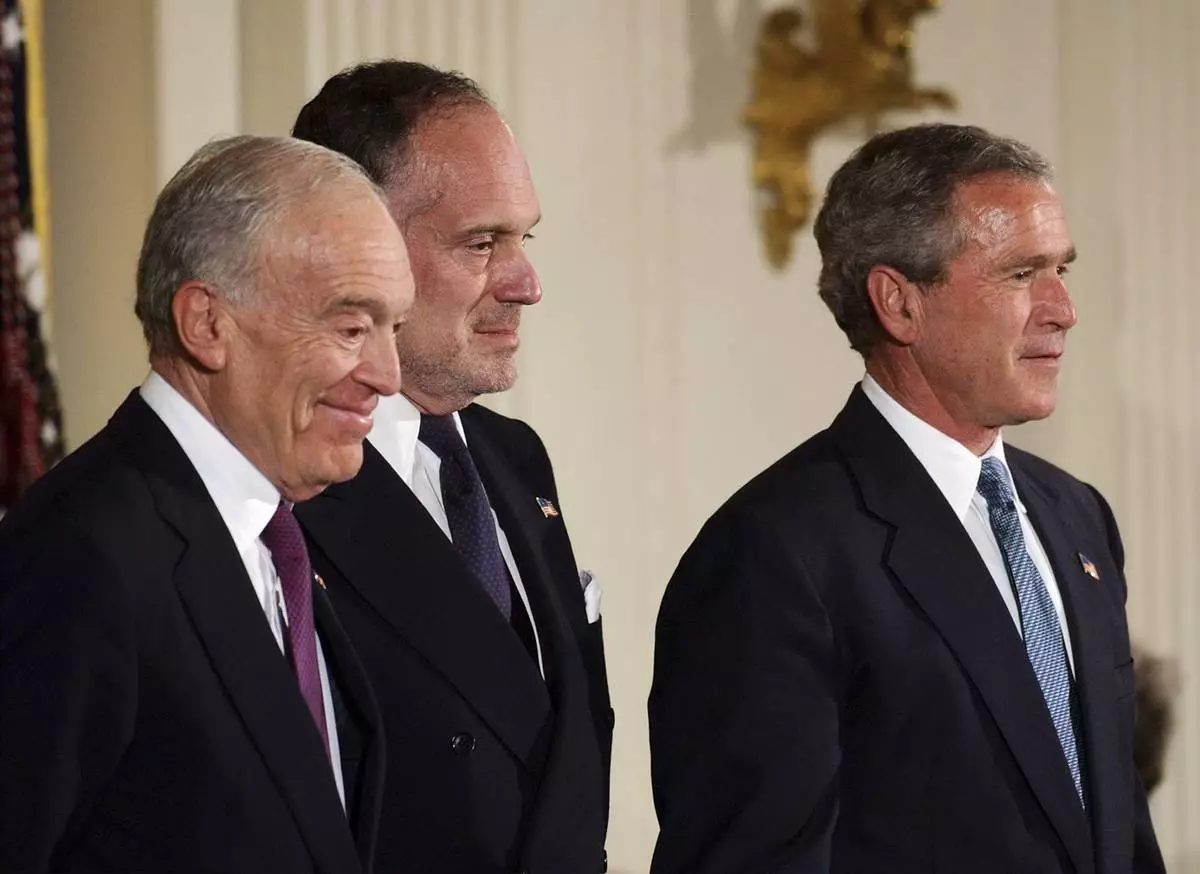
FILE- Leonard Lauder, left, and Ronald Lauder, sons of the late cosmetics mogul Estee Lauder, stand next to President Bush as they receive the Presidential Medal of Freedom on her behalf, which was awarded posthumously to her during a ceremony in the East Room of the White House in Washington Wednesday, June 23, 2004. (AP Photo/Gerald Herbert, file)
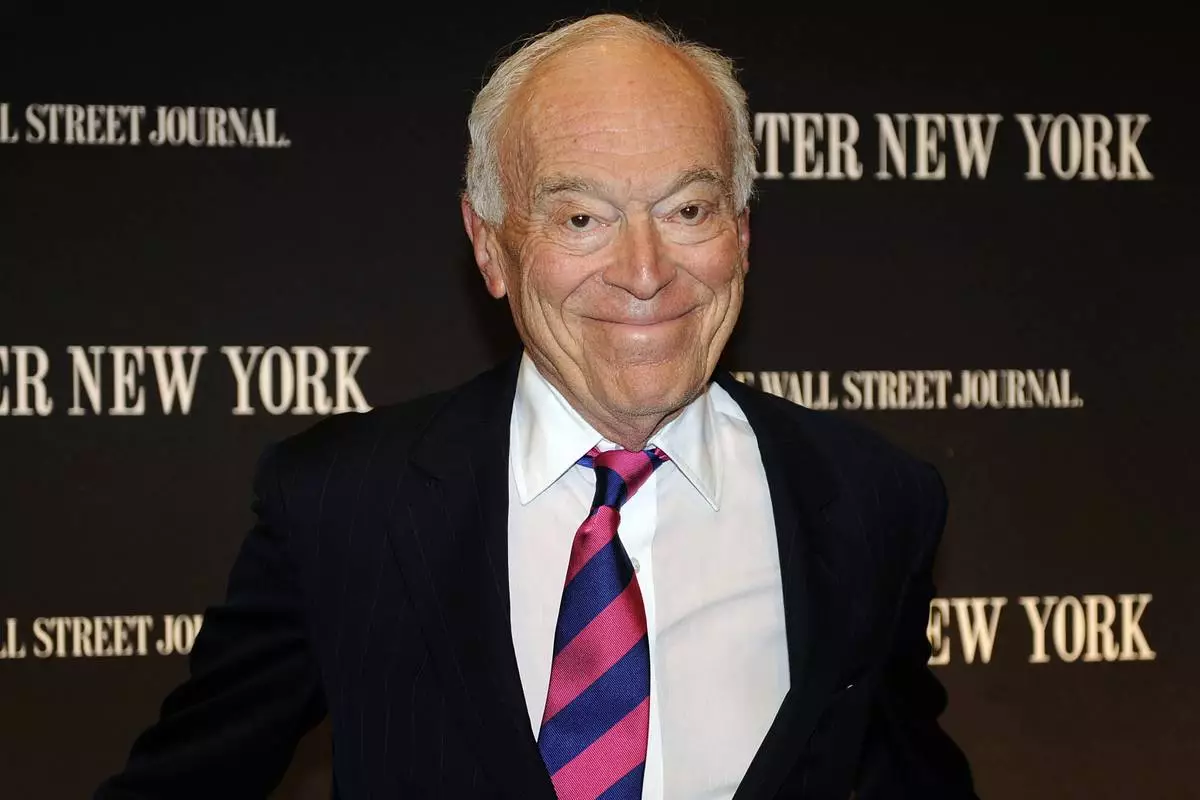
FILE - Leonard Lauder attends a gala launch party in New York, April 26, 2010. (AP Photo/Stephen Chernin, File)
WASHINGTON (AP) — A federal judge Thursday cleared the way for a New York offshore wind project to resume construction, a victory for the developer who said a Trump administration order to pause it would likely kill the project in a matter of days.
District Judge Carl J. Nichols, an appointee of President Donald Trump, ruled construction on the Empire Wind project could go forward while he considers the merits of the government’s order to suspend the project. He faulted the government for not responding to key points in Empire Wind’s court filings, including the contention that the administration violated proper procedure.
Norwegian company Equinor owns Empire Wind. Spokesperson David Schoetz said they welcome the court's decision and will continue to work in collaboration with authorities. It’s the second developer to prevail in court against the administration this week.
The Trump administration froze five big offshore wind projects on the East Coast days before Christmas, citing national security concerns. Trump has targeted offshore wind from his first days back in the White House, most recently calling wind farms “losers” that lose money, destroy the landscape and kill birds.
Developers and states sued seeking to block the order. Large, ocean-based wind farms are the linchpin of plans to shift to renewable energy in East Coast states that have limited land for onshore wind turbines or solar arrays.
New York Gov. Kathy Hochul applauded the court decision, telling reporters the projects had been “stopped under the bogus pretense of national security.”
“When I heard this I said one thing: I’m the governor of New York, if there is a national security threat off the coast of New York, you need to tell me what it is. I want a briefing right now. Well, lo and behold, they had no answer,” she said.
On Monday, a judge ruled that the Danish energy company Orsted could resume its project to serve Rhode Island and Connecticut. Senior Judge Royce Lamberth said the government did not sufficiently explain the need for a complete stop to construction. That wind farm, called Revolution Wind, is nearly complete. It’s expected to meet roughly 20% of the electricity needs in Rhode Island, the smallest state, and about 5% of Connecticut’s electricity needs.
Orsted is also suing over the pause of its Sunrise Wind project for New York, with a hearing still to be set. Dominion Energy Virginia, which is developing Coastal Virginia Offshore Wind, plans to ask a judge Friday to block the administration’s order so it can resume construction, too.
Trump has also dismissed offshore wind developments as ugly, but the Empire project is about 14 miles (22.5 kilometers) offshore and the Sunrise project is about 30 miles (48 kilometers) offshore.
The fifth paused project is Vineyard Wind, under construction in Massachusetts. Vineyard Wind LLC, a joint venture between Avangrid and Copenhagen Infrastructure Partners, joined the rest of the developers in challenging the administration on Thursday. They filed a complaint in District Court in Boston.
In contrast to the halted action in the U.S., the global offshore wind market is growing, with China leading the world in new installations. Nearly all of the new electricity added to the grid in 2024 was renewable. The British government said Wednesday it secured a record 8.4 gigawatts of offshore wind in Europe’s largest offshore wind auction, enough clean electricity to power more than 12 million homes.
Robin Shaffer, president of Protect Our Coast New Jersey, said the Trump administration was right to stop construction on national security grounds. He urged officials to immediately appeal the adverse rulings and seek to halt all work pending appellate review. Opponents of offshore wind projects are particularly vocal and well-organized in New Jersey.
Empire Wind is 60% complete and designed to power more than 500,000 homes. Equinor said the project was in jeopardy due to the limited availability of specialized vessels, as well as heavy financial losses.
During a hearing Wednesday, Judge Nichols said the government’s main security concern seemed to be over operation of the wind turbines, not construction, although the government pushed back on that contention.
In presenting the government’s case, Associate Attorney General Stanley Woodward, Jr. was skeptical of the perfect storm of horrible events that Empire Wind said would derail their entire project if construction didn’t resume. He disagreed with the contention that the government’s main concern was over operation.
“I don’t see how you can make this distinction,” Woodward said. He likened it to a nuclear project being built that presented a national security risk. The government would oppose it being built, and it turning on.
Molly Morris, Equinor’s senior vice president overseeing Empire Wind, said in an interview that the company wants to build this project and deliver a major, essential new source of power for New York.
McDermott reported from Providence, Rhode Island. Associated Press writer Anthony Izaguirre contributed to this report from Albany, New York.
The Associated Press’ climate and environmental coverage receives financial support from multiple private foundations. AP is solely responsible for all content. Find AP’s standards for working with philanthropies, a list of supporters and funded coverage areas at AP.org.
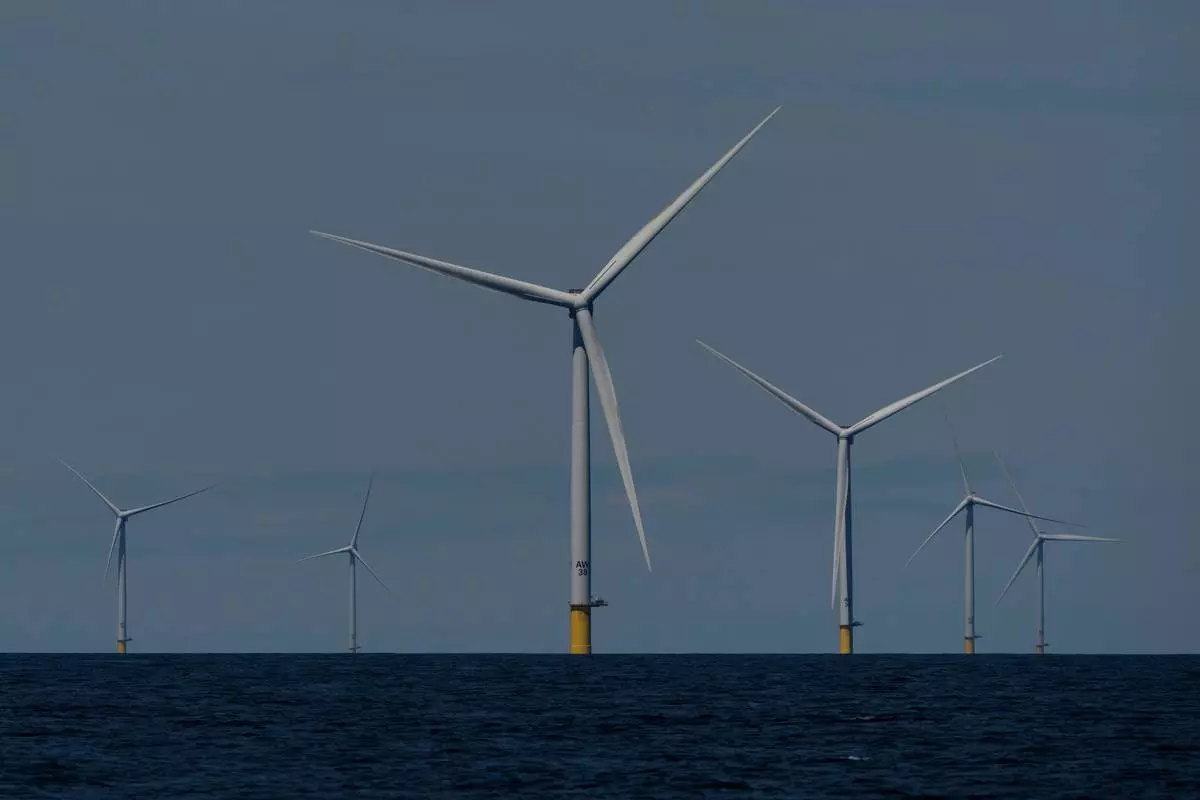
FILE - Wind turbines operate at Vineyard Wind 1 offshore wind farm off the coast of Massachusetts, July 19, 2025. (AP Photo/Carolyn Kaster, File)
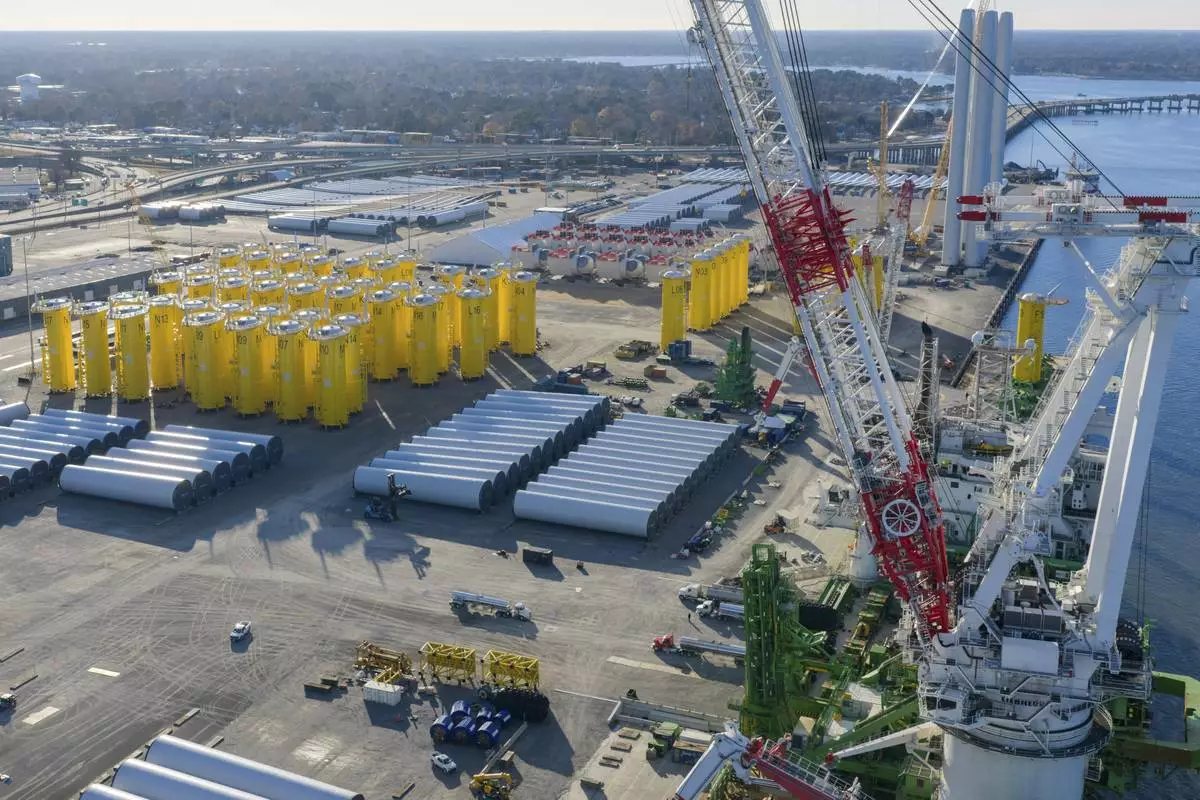
FILE - Wind turbine bases, generators and blades sit along with support ships at The Portsmouth Marine terminal that is the staging area for Dominion Energy Virginia, which is developing Coastal Virginia Offshore Wind, Dec. 22, 2025, in Portsmouth, Va. (AP Photo/Steve Helber, File)
FILE - A sign for the company Equinor is displayed on Oct. 28, 2020, in Fornebu, Norway. (Håkon Mosvold Larsen/NTB Scanpix via AP, File)
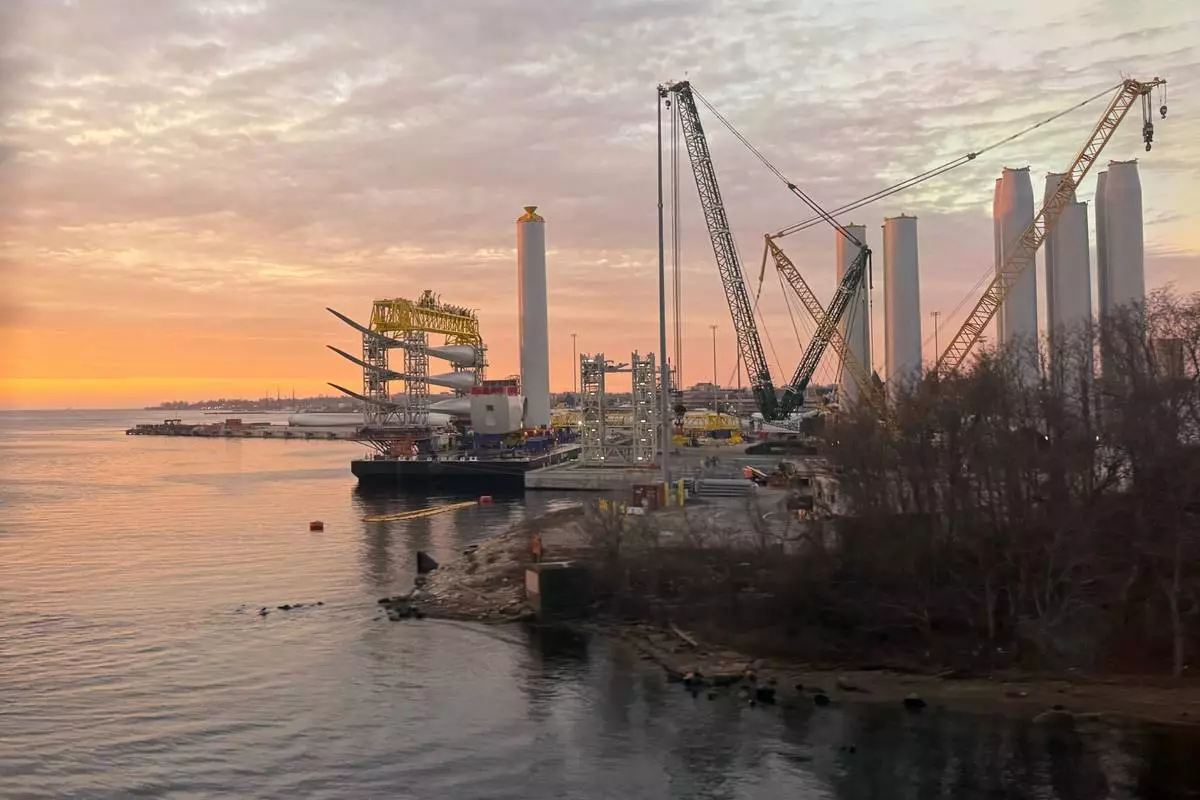
Blades and turbine bases for offshore wind sit at a staging area at New London State Pier, Wednesday, Jan. 14, 2026, in New London, Conn. (AP Photo/Matt O'Brien)