As north China's Tianjin Municipality prepares to host the Shanghai Cooperation Organization (SCO) Summit this year, a global media delegation visited the Tianjin Port to see the world's first Smart Zero-carbon Terminal.
Leveraging its strategic location, the Tianjin Port has focused on facilitating economic ties among SCO member states by enhancing logistics networks, connectivity, and functional synergy -- propelling cooperation to a new level.
The Tianjin Port Smart Zero-Carbon Terminal, located in the North Jiang Port Area (Section C), commenced operations on October 17, 2021. As the world's first integrated "smart and zero-carbon" container terminal, it was completed in 21 months, overcoming 13 global technical challenges and generating 76 patented innovations.
The Tianjin Port pioneered the global retrofitting of existing terminal yards with smart technologies, achieving an 88 percent automation rate for large container handling equipment. It has established China's first government-approved port autonomous driving demonstration zone, realizing the world's initial "5G+BeiDou" integrated innovation that delivers all-weather, all-condition, and all-scenario ubiquitous intelligence.
Aiming to build a world-leading smart and green automated container terminal, this project adopted a "Smart Zero-Carbon" philosophy to design and construct a new-generation terminal.
"This is the first time I see the wind power and solar energy using in the port. And also automation is really huge in here. You can see a lot of vehicles, [but] there's no driver -- full automation. It is really good for the zero-carbon I think," said Ozgur Altinbaa, Aydınlık Newspaper Chief of Foreign News Service, Türkiye.
"This is my first time to Tianjin. Very innovative. I've never seen like driverless autonomous cars would be like shipping cargos off. I've never thought of that. But yeah it is super mind-blowing, super high-tech and I like it," said Isu Tuvshin, staff member from News.mn Agency, Mongolia.
"I would say the same as well. It is really mind-blowing to actually see the amount of innovation and automation that a single port can have. I mean, literally, this smart technology is everywhere, [which] truly makes it more efficiently and more timely. We were told in introduction that the processing time before was two hours, and now it has been cut down to 10 minutes, which is really remarkable. And this automation can actually improve productivity, in time of shipping and [in terms of] port facilities. So yes, truly remarkable," said Nikhil Kumar, Multimedia Broadcast Journalist of FBC News, Fiji.
It has integrated multiple cutting-edge technologies with independent Chinese intellectual property rights, achieving the world's most advanced fully automated and intelligent container operations, while maintaining zero carbon emissions throughout terminal operations.
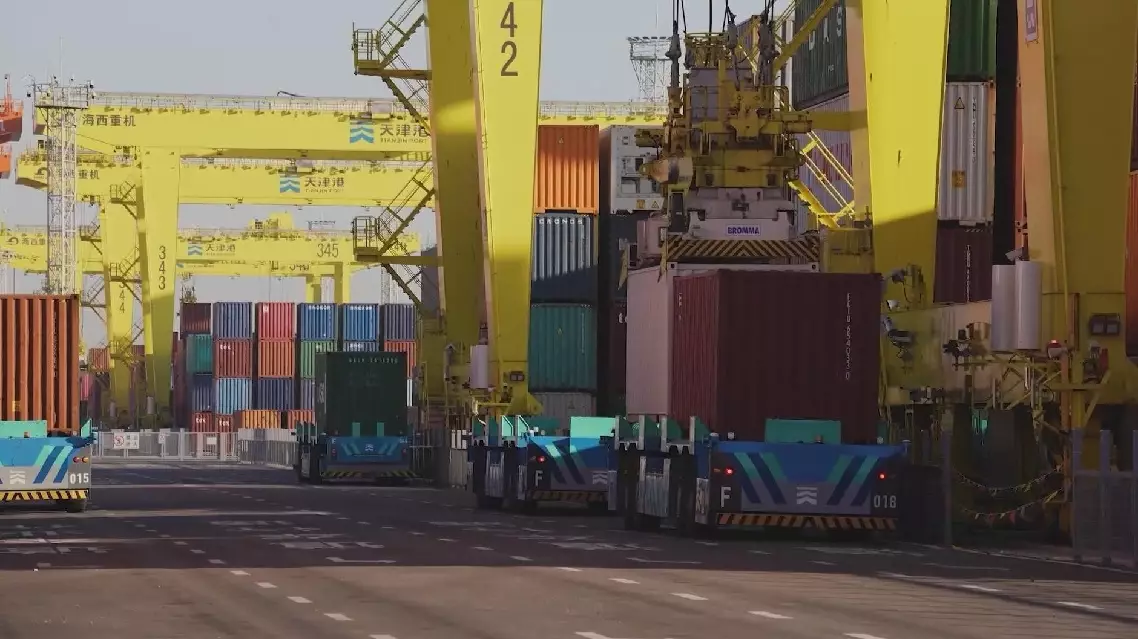
International media delegation explore world's first zero-carbon intelligent container terminal in north China's Tianjin