The People's Bank of China (PBOC), the country's central bank, said on Friday that the cross-border payment connect linking users in the Chinese mainland and the Hong Kong Special Administrative Region will go into operation on June 22.
By linking the mainland's Internet Banking Payment System and Hong Kong's Faster Payment System, the payment connect will support participating institutions to provide efficient, convenient and safe cross-border payment services for residents in both the mainland and Hong Kong, the PBOC said in a statement.
The launch of the payment connect system is yet another important measure unveiled by the central government to support Hong Kong's development, enhance the people's livelihoods, and promote cooperation between the mainland and Hong Kong, according to the statement.
Through the system, users will be able to initiate cross-border remittances in the Chinese yuan and the Hong Kong dollar in both locations via mobile and online banking channels, improving the efficiency of cross-border money transfers.
Additionally, the costs of cross-border money transfers will be lowered after the relevant payment infrastructures are connected directly within the system.
The introduction of the system is also expected to facilitate economic and trade activities in the mainland and Hong Kong, and to strengthen Hong Kong's status as an international financial center, per the statement.
A launch ceremony for the payment connect was held on Friday, attended by PBOC Governor Pan Gongsheng and Eddie Yue, chief executive of the Hong Kong Monetary Authority (HKMA).

China's central bank says mainland-Hong Kong payment connect will go into operation soon

China's central bank says mainland-Hong Kong payment connect will go into operation soon
China closed 2025 with a record of 92 space launches and major breakthroughs were made in manned space launches, deep space exploration and commercial launches, according to the China National Space Administration.
"In 2025, we created a new launch record, sending more than 300 satellites into planned orbits. Both the number of launches and the number of payloads placed in orbit have achieved qualitative leapfrog development," said Zhu Haiyang, an engineer with the China Aerospace Science and Technology Corporation.
In 2025, the Shenzhou-20 crew spent 204 days in orbit, setting a new record for the longest single mission duration in the history of China's manned space program. Following the Shenzhou-20, the Shenzhou-21 achieved the fastest rendezvous and docking in the history of the Shenzhou mission in just three hours and a half.
Facing an unexpected technical situation with the Shenzhou-20 spacecraft, China immediately activated emergency plans. Within 16 days, a series of maneuvers were accomplished including the launch of the Shenzhou-22 backup vehicle, presenting a "textbook model" for the international space community in effectively responding to unexpected emergencies.
In deep space exploration, the Tianwen-2 probe embarked on its journey for China's first asteroid exploration and sample-return mission in 2025.
Last year also saw intensive launch activities from multiple commercial rocket types, injecting strong momentum into the country's commercial space development.
As China has kicked off the first year of its 15th Five-Year Plan (2026–2030), a new blueprint for the country's space program is unfolding. Multiple tests are planned in preparation for future lunar exploration, as Chang'e-7 lunar probe is scheduled to be launched for the lunar south pole to search for evidence of water ice. The industry is also preparing for the maiden flights of several new rocket types, which will include the challenges to test rocket recovery and reusability technologies.
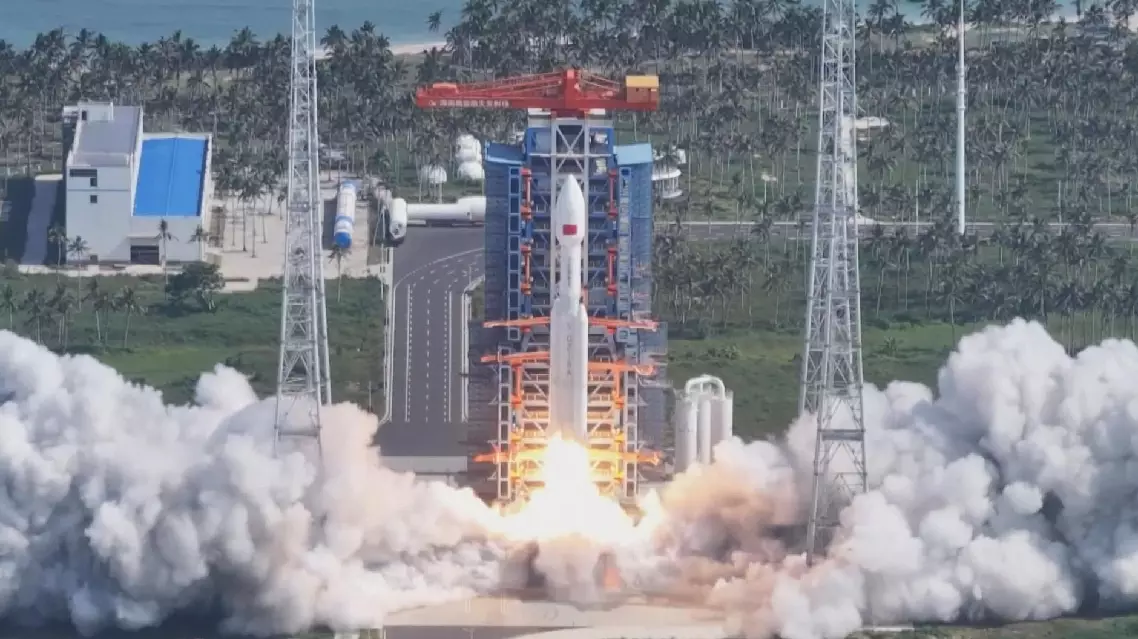
China closes 2025 with record 92 space launches