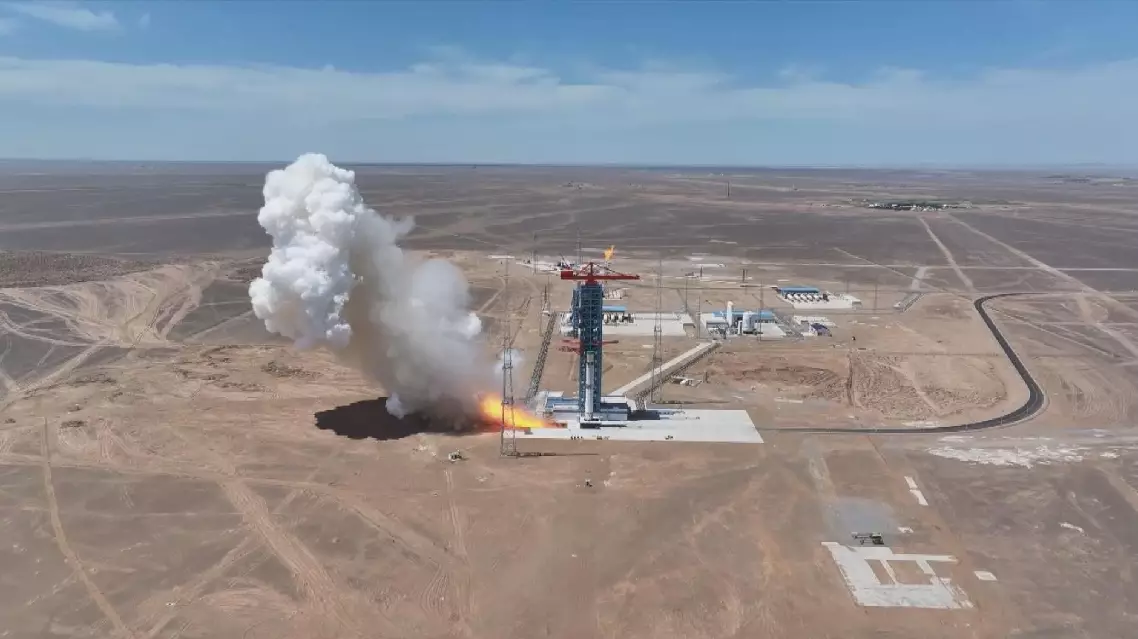
China's commercial rocket firm LandSpace successfully conducted a crucial ground ignition test of the first-stage propulsion system for its reusable Zhuque-3 rocket on Friday.
This significant milestone propels the rocket toward the project's planned 2025 debut flight.
Conducted at the Dongfeng commercial space innovation pilot zone near the Jiuquan Satellite Launch Center in northwest China, the test featured China's largest and most automated nine-engine parallel cluster hot-fire test to date, announced LandSpace.
The test utilized a first-stage structure that is consistent with the technical status of the Zhuque-3's maiden flight mission, said the Beijing-based rocket firm.
"This test achieved an exceptionally high degree of fidelity to actual flight conditions and replicated exactly how the system will fly in space during the test on the ground," said a press release of LandSpace.
The comprehensive trial rigorously simulated the entire pre-launch and flight sequence, covering propellant loading, tank pressurization, sequential engine ignition in batches, sustained stable operation and programmed shutdown procedures, according to the press release.
The 45-second test is powered by nine of LandSpace's self-developed liquid oxygen-methane engines, which generated a total thrust of 7,542 kilonewtons (kN).
It validated the compatibility between all major subsystems -- engines, pressurization and delivery systems, structures and avionics -- and verified the rational design of the ground support and launch control processes, LandSpace said.
"After the 40-second ignition test of our Zhuque-3's first-stage power system, we have fully verified the rationality of the design and the working compatibility of the rocket's subsystems of avionics, structure, engines, and power. At the same time, it also verified the coordination and rationality of entire rocket-ground testing procedure," said Dai Zheng, commander in chief of Zhuque-3 reusable rocket.
The Zhuque-3 rocket has a diameter of 4.5 meters and a total length of around 66 meters, with its first stage designed to be reused at least 20 times. It can launch multiple satellites at one time, such as flat stackable satellites.
Its storage tank is made of high-strength stainless steel, and it has the potential to reduce launch costs by 80 to 90 percent compared to single-use rockets.
The first-stage engine of Zhuque-3 can be checked without being separated from the rocket after it is recovered, and can fly again after refueling, much like plane flights, according to LandSpace.
China's reusable rocket Zhuque-3 completes major engine cluster test

The heartbreaking story of 96-year-old Peng Zhuying, one of the last living survivors from the Japanese military's "comfort women" system in the Chinese mainland, has been shared in a moving documentary produced by the China Global Television Network (CGTN).
Peng remains one of only seven registered survivors in the Chinese mainland of the Japanese military's "comfort women" system, a brutal a state-enforced regime of sexual slavery during World War II, victimizing over 400,000 women across Asia.
She is also the only living survivor who is officially documented as a victim of both sexual slavery and of Japan's chemical warfare during the Japanese militarists' war of aggression against China.
Eight decades on, Peng has bravely shared the story of her horrifying experiences in the CGTN original documentary "Last Daughters," which reveals the deep scars left by war and captures the quiet strength and warmth that endured, even in the darkest depths of human suffering.
Blinded by mustard gas at age nine and mutilated at 14 before being forced into a military brothel during the war, Peng was able to survive despite facing these unimaginable hardships in her young life.
Peng shared some of the artifacts and the stories behind them from those difficult days.
"This is a fortune slip, a divination note, meaning you need to be cautious in what you do. When I was 16, my father forced me to study fortune-telling. He told me if I didn't learn, I would not get any food. At that time, I wanted to care for children instead, but I could make the call myself. I had to listen to him to make a living," she said.
She memorized every incantation as part of the fortune-telling custom. For 80 years, it was her livelihood, and she has continued to show strength to overcome any challenges in her life.
"I've gone through so much hardship, and yet I'm still alive. Now, I'm only afraid of getting sick and dying from it. I was sick for most of last year, and have yet to recover until now," said Peng.
Though she survived all the tortures and survived from the atrocities conducted by the Japanese aggressors, Peng's health is never been too strong, as she suffered from severe gynecological injuries and became infertile, while also losing her sight as she fell victim to a chemical warfare attack.
"These are gallstones. She had them for several decades. But she lost her eyesight early on and never had toxic exposure. The only explanation is the mustard gas she inhaled. Life for her has been harsh, far harsher than it appears on the surface," said her nephew Peng Zifang.
Japan's "comfort women" system, a state-sponsored sexual slavery scheme by the military, was unprecedented in modern history. It enslaved at least 400,000 women across Asia and the Pacific, including Chinese, Korean, Filipino and many other victims.
Half of those who suffered were Chinese. The Japanese opened its first "comfort women station" in Shanghai and over 2,100 followed in other places they invaded. Girls, deemed "military supplies," were trafficked like weapons.
Later in life, aged 43, Peng married a fisherman 20 years older than her. Only after his death did she speak openly about what she faced.
"Before my father passed away, he told me the stories of my two aunts. I was deeply shaken. Both of my aunts revealed the truth about the 'comfort stations' only after their husbands died. The often-cited figure [of 400,000] known victims barely scratches the surface of the true scale. Many more endured in silence because of the conservative traditions of that era. To speak up meant risking scorn, oppression and even violence. So they bore it quietly," said Peng Zifang.
Documentary reveals life of Chinese survivor of Japan's sexual slavery during WWII