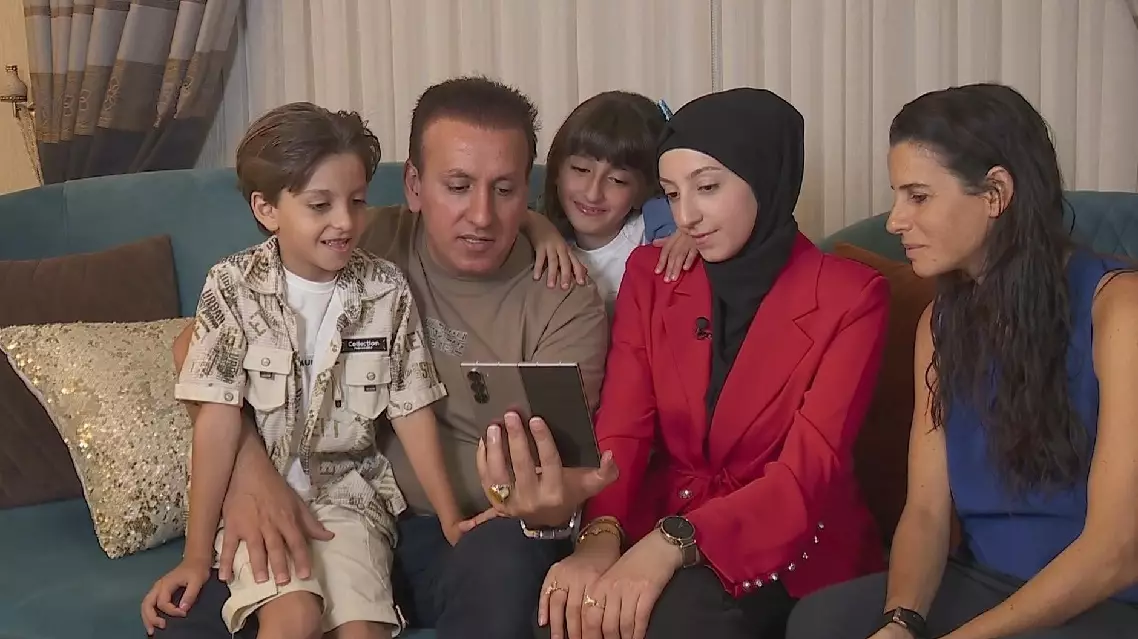
In Türkiye, a country which currently hosts over 2.7 million Syrian refugees, one family reflects on their journey and the difficult choice between rebuilding their lives abroad or returning home.
The Turkish city of Gaziantep - its people, its buildings and even its pistachio trees - all resemble the Syrian city of Aleppo. That's according to Huseyin Hendawi, a Syrian refugee who fled to Türkiye in 2013.
As the war dragged on, the family began building a new life in Gaziantep.
Huseyin Hendawi grew his business and his family. Two of his four children were born in Türkiye.
For the Hendawis, the southeastern city of Gaziantep soon became more than just a refuge -- it became home.
During a recent visit to Syria, Huseyin Hendawi returned to what was once his home, which was completely destroyed.
"Complete (destruction). It wasn't just my house. The whole neighborhood was destroyed," said Huseyin Hendawi.
"I found an old photo of myself. These are my old books. (This is my card from) university, Aleppo university," he said while showing videos filmed during the trip.
Since the ousting of former Syrian President Bashar al-Assad, many Syrians living in Türkiye face a difficult decision - whether to return home or remain here. While many long to go back, the situation on the ground has left them torn.
One of the biggest challenges to returning is access to basic services, like shelter, electricity and water.
"Out of 24 hours, there was only 2 hours of electricity. The other 22 hours, nothing. As for water -- it comes daily, but sometimes it's there, sometimes not. And even when it comes, it's only for about 1.5 hours a day," said Huseyin Hendawi.
Lama Hendawi is the eldest child in the family. Now a university student in Gaziantep, she is studying to become an English teacher, and hopes to one day return and serve her country.
"I want to be useful there. Syria needs a few more teachers, and I want to be one of them. I want to help them," said Lama Hendawi.
For now, the family's connection to Syria is through loved ones still there. When Internet and electricity allow, they gather for video calls.
"We - me and other Syrians - didn't come here for fun. We came out of necessity. Because of war. Whenever those reasons disappear, this whole issue will be over," said Huseyin Hendawi.
With new leadership in place, families like the Hendawis say they would consider returning, but many believe it could take years for Syria to recover enough to offer a secure, livable future.
Syrian refugees struggle to return home
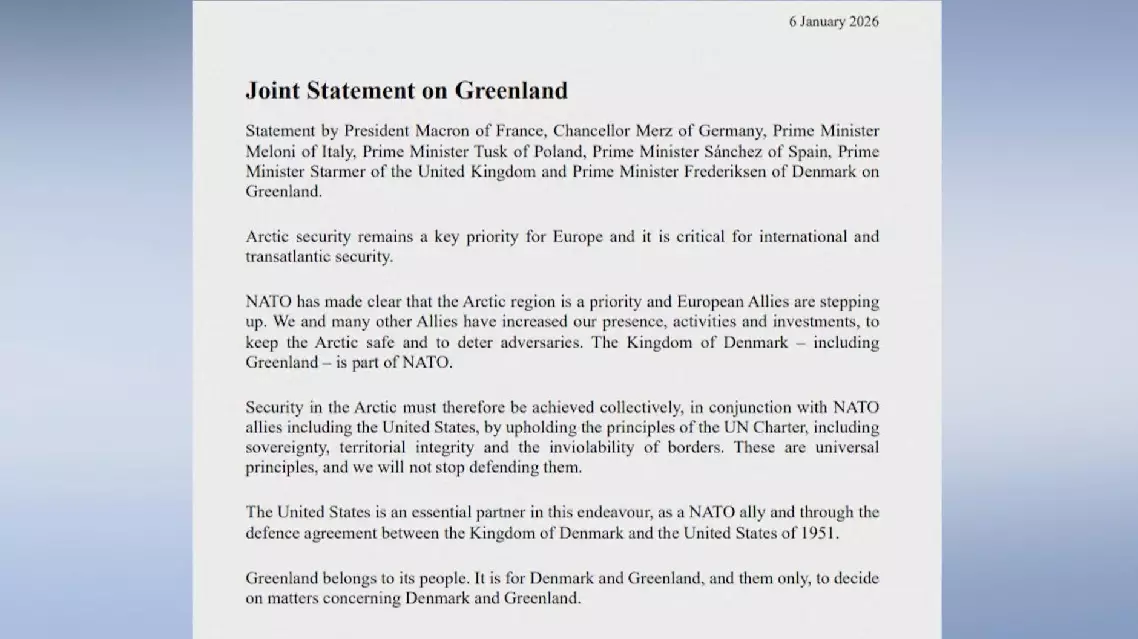
Leaders of seven European countries on Tuesday reaffirmed that Greenland "belongs to its people," stressing that issues concerning Denmark and Greenland must be decided solely by Denmark and Greenland, according to a joint statement.
The statement, released by Denmark's Prime Minister's Office, was signed by Danish Prime Minister Mette Frederiksen, French President Emmanuel Macron, German Chancellor Friedrich Merz, Italian Prime Minister Giorgia Meloni, Polish Prime Minister Donald Tusk, Spanish Prime Minister Pedro Sanchez and British Prime Minister Keir Starmer.
"Greenland belongs to its people. It is for Denmark and Greenland, and them only, to decide on matters concerning Denmark and Greenland," the statement said.
The leaders underscored that Arctic security remains a key priority for Europe and is critical for international and transatlantic security. They noted that NATO has made clear the Arctic region is a priority and that European allies are increasing their presence there.
The statement noted that the Kingdom of Denmark, including Greenland, is part of NATO, and said security in the Arctic must be achieved collectively with NATO allies, including the United States, by upholding the principles of the UN Charter, including sovereignty, territorial integrity and the inviolability of borders.
Calling the United States an "essential partner," the leaders also referred to the 1951 defence agreement between Denmark and the United States.
The Prime Minister of Greenland Jens-Frederik Nielsen said on Tuesday that Greenland is open to dialogue and discussions with the U.S., but "they must take place through the proper channels and in respect of international law."
The PM also urged respect from the U.S. side, saying "Our country is not an object in great power rhetoric." Louisiana Governor Jeff Landry, who was appointed by President Donald Trump last month as the U.S. special envoy to Greenland, said that Trump "supports an independent Greenland with economic ties and trade opportunities for the United States," Reuters reported.
Trump said in a telephone interview on Sunday with The Atlantic that the United States "absolutely" needs Greenland. He also discussed the U.S. intervention in Venezuela.
Since taking office in January 2025, Trump has repeatedly expressed interest in gaining control of Greenland, saying that he would not rule out using "military or economic coercion" to achieve that goal.
European leaders reaffirm Greenland sovereignty, stress Arctic security
European leaders reaffirm Greenland sovereignty, stress Arctic security