Skip to Content Facebook Feature Image

Alaska Native woman, 'everybody's helper,' is Orthodox church's first female North American saint

ENT

Alaska Native woman, 'everybody's helper,' is Orthodox church's first female North American saint
ENT

ENT

Alaska Native woman, 'everybody's helper,' is Orthodox church's first female North American saint

2025-06-26 19:01 Last Updated At:19:11

KWETHLUK, Alaska (AP) — It was in the dusty streets and modest homes of this remote Alaska Native village that Olga Michael quietly lived her entire life as a midwife and a mother of 13. As the wife of an Orthodox Christian priest, she was a “matushka,” or spiritual mother to many more.

The Yup’ik woman became known in church communities across Alaska for quiet generosity, piety and compassion — particularly as a consoler of women who had suffered from abuse, from miscarriage, from the most intimate of traumas. She could share from her own grief, having lost five children who didn’t live to adulthood.

More Images
Worshippers wait in long lines to view the remains of St. Olga following her canonization in her hometown of Kwethluk, Alaska, on June 19, 2025. The ceremony drew hundreds of faithful, including from nearby villages and across the world. (AP Photo/Mark Thiessen)
Worshippers wait in long lines to view the remains of St. Olga following her canonization in her hometown of Kwethluk, Alaska, on June 19, 2025. The ceremony drew hundreds of faithful, including from nearby villages and across the world. (AP Photo/Mark Thiessen)

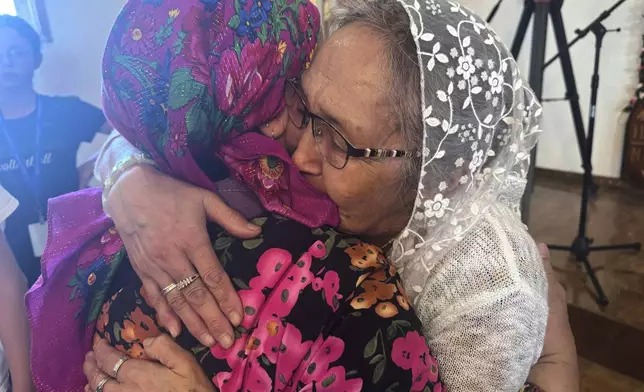
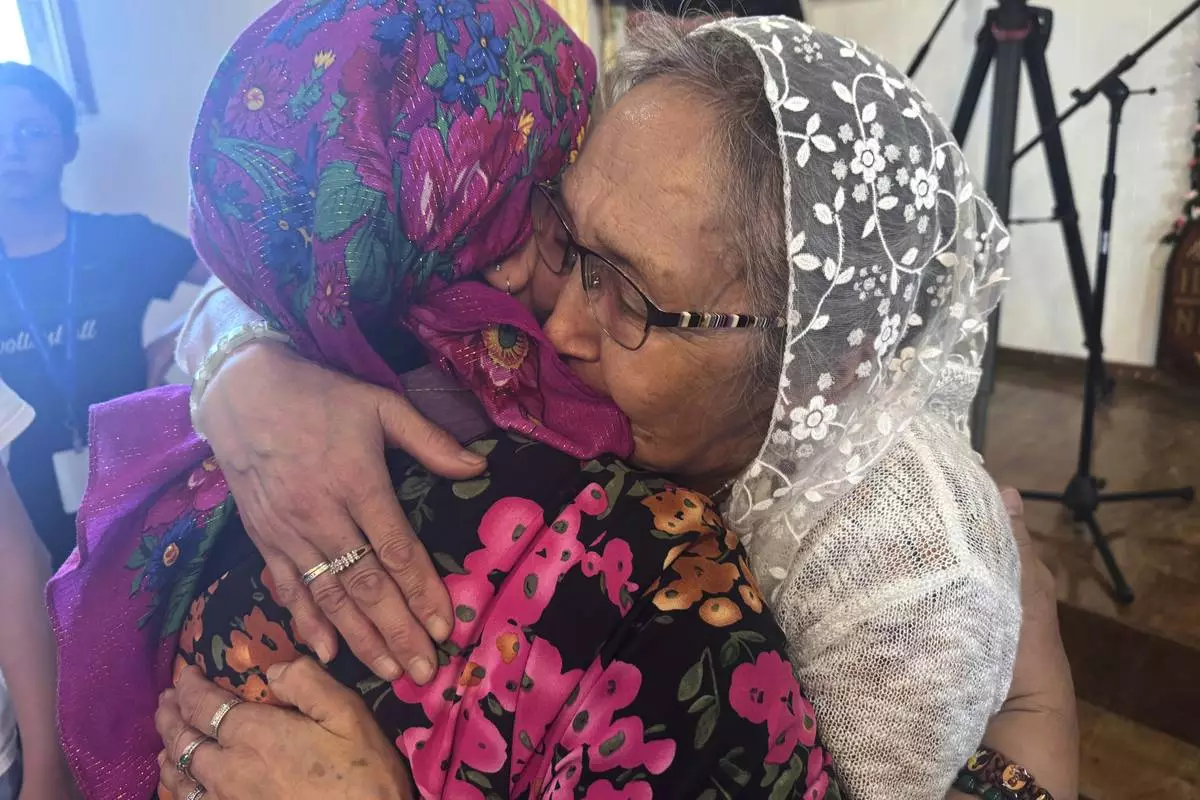
Two women embrace during the canonization ceremony of St. Olga in Kwethluk, Alaska, on June 19, 2025, which made her the first female Orthodox saint in North America. (AP Photo/Mark Thiessen)

Two women embrace during the canonization ceremony of St. Olga in Kwethluk, Alaska, on June 19, 2025, which made her the first female Orthodox saint in North America. (AP Photo/Mark Thiessen)

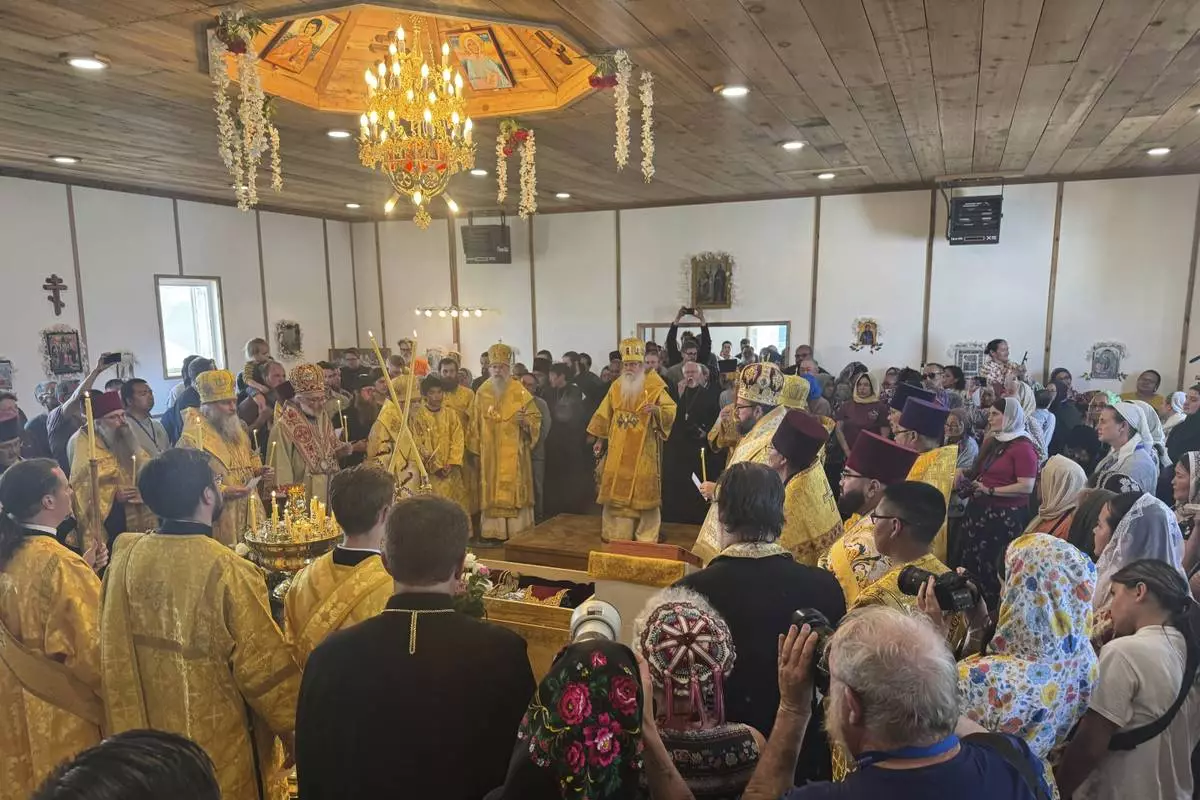
Worshippers fill St. Nicholas Orthodox Church in Kwethluk, Alaska, on June 19, 2025, for the canonization ceremony of St. Olga, the first female Orthodox saint in North America. (AP Photo/Mark Thiessen)
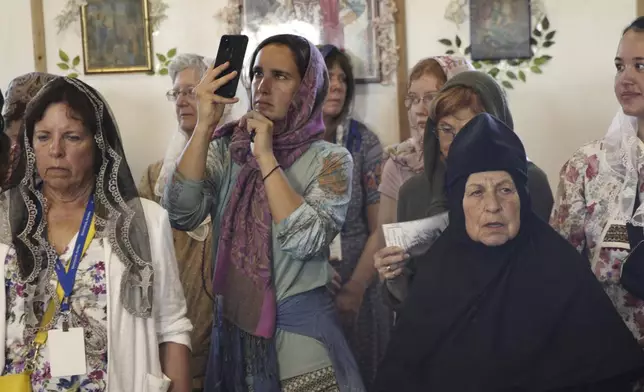
Worshippers fill St. Nicholas Orthodox Church in Kwethluk, Alaska, on June 19, 2025, for the canonization ceremony of St. Olga, the first female Orthodox saint in North America. (AP Photo/Mark Thiessen)

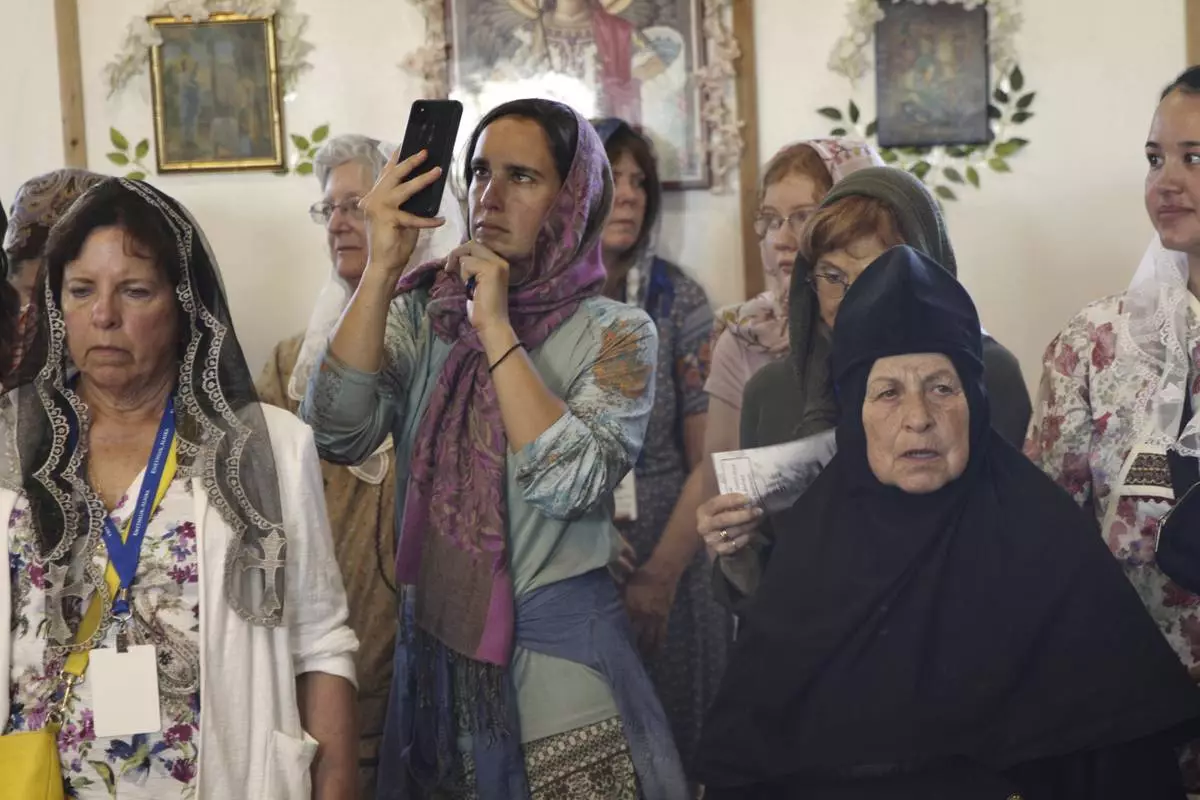
Worshippers fill St. Nicholas Orthodox Church in Kwethluk, Alaska, on June 19, 2025, for the canonization ceremony of Matushka Olga Michael, who became the first female Orthodox saint in North America. (AP Photo/Mark Thiessen)
Worshippers fill St. Nicholas Orthodox Church in Kwethluk, Alaska, on June 19, 2025, for the canonization ceremony of Matushka Olga Michael, who became the first female Orthodox saint in North America. (AP Photo/Mark Thiessen)

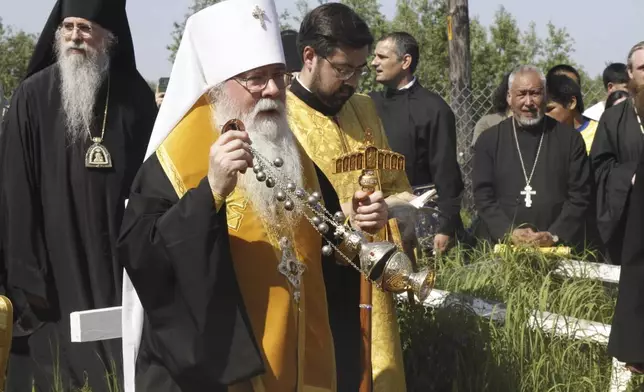
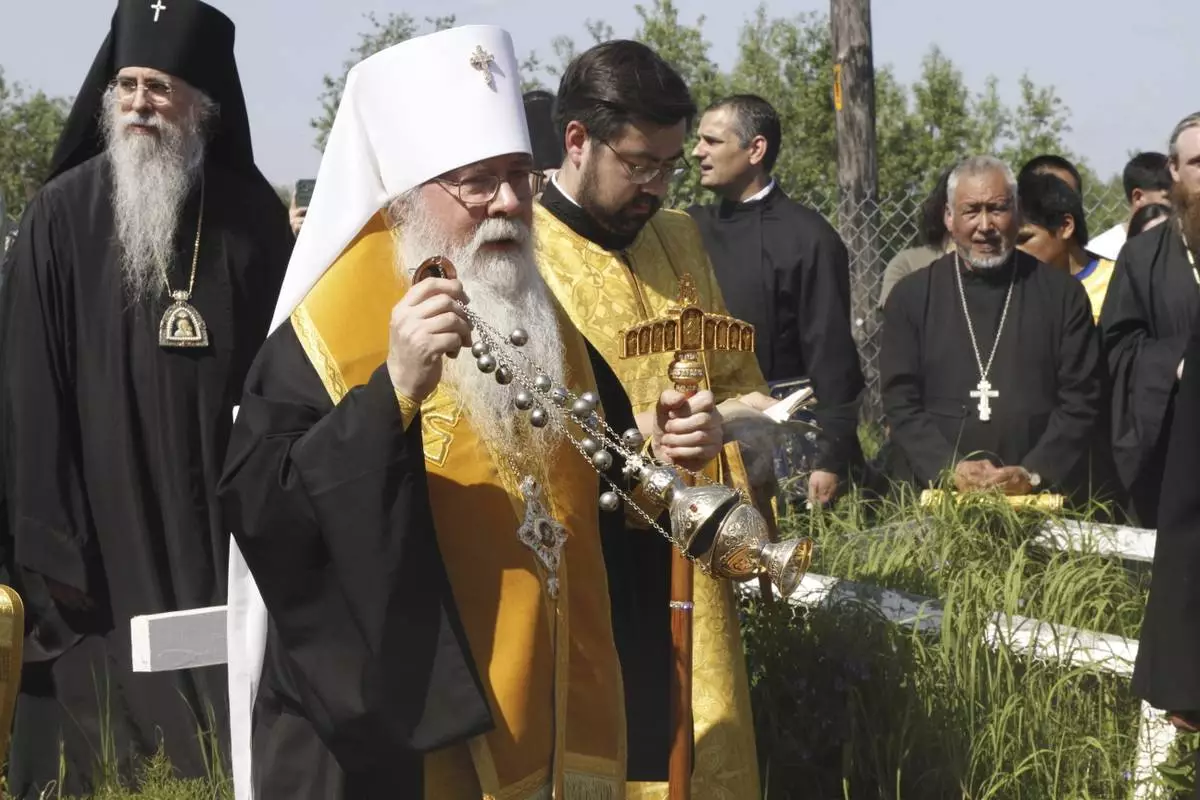
Metropolitan Tikhon, the head of the Orthodox Church in America, swings a censer as he blesses the remains of Matushka Olga Michael before a ceremony that made her the first female Orthodox saint in North America, in Kwethluk, Alaska, on June 19, 2025. (AP Photo/Mark Thiessen)
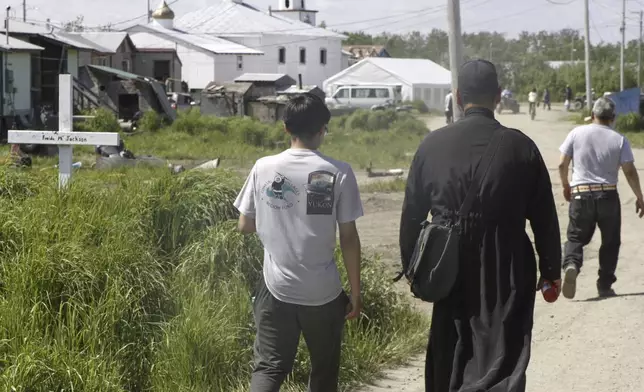
Metropolitan Tikhon, the head of the Orthodox Church in America, swings a censer as he blesses the remains of Matushka Olga Michael before a ceremony that made her the first female Orthodox saint in North America, in Kwethluk, Alaska, on June 19, 2025. (AP Photo/Mark Thiessen)

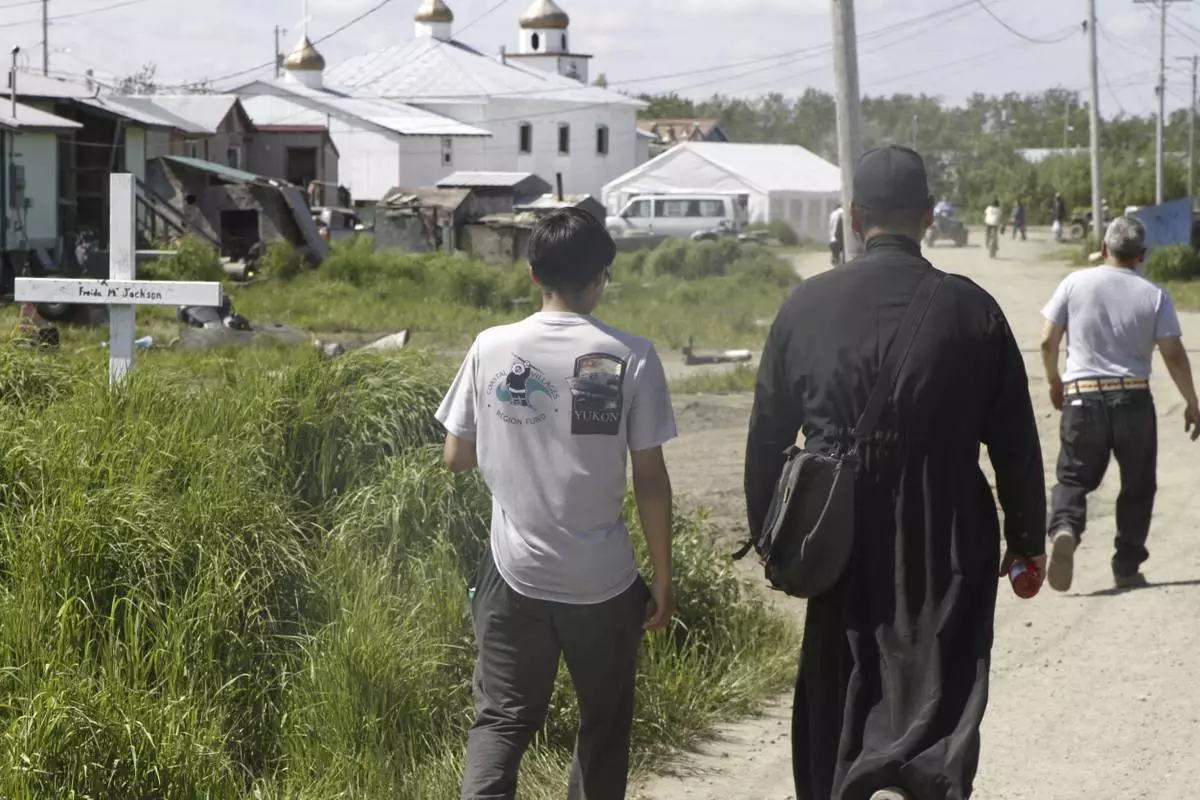
Worshippers, including an Orthodox priest wearing a black cassock, walk on the dusty streets of Kwethluk, Alaska, on June 19, 2025, heading to St. Nicholas Orthodox Church for the canonization ceremony of St. Olga, the first female Orthodox saint in North America. (AP Photo/Mark Thiessen)
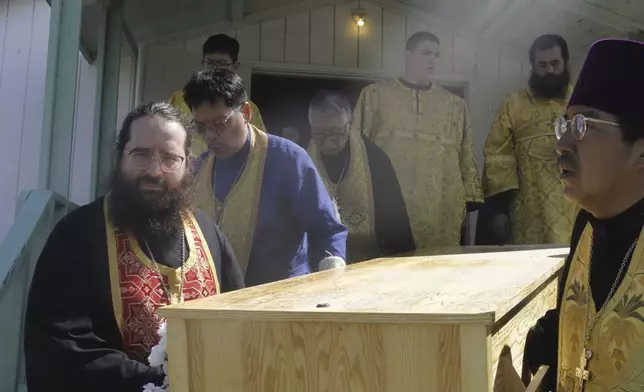
Worshippers, including an Orthodox priest wearing a black cassock, walk on the dusty streets of Kwethluk, Alaska, on June 19, 2025, heading to St. Nicholas Orthodox Church for the canonization ceremony of St. Olga, the first female Orthodox saint in North America. (AP Photo/Mark Thiessen)

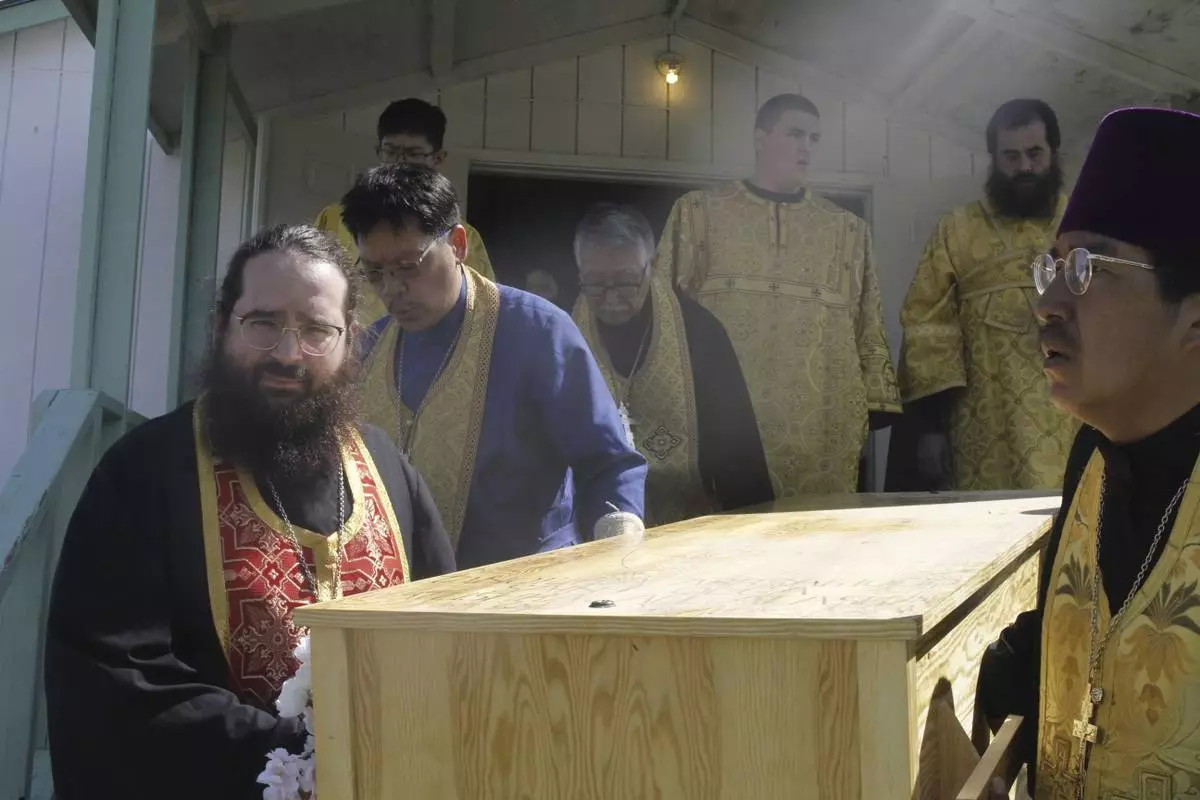
Church officials move the relics, or remains, of Matushka Olga Michael from the church to a nearby graveyard for one last ceremony before her canonization ceremony to become St. Olga, in Kwethluk, Alaska, on June 19, 2025. (AP Photo/Mark Thiessen)
Church officials move the relics, or remains, of Matushka Olga Michael from the church to a nearby graveyard for one last ceremony before her canonization ceremony to become St. Olga, in Kwethluk, Alaska, on June 19, 2025. (AP Photo/Mark Thiessen)

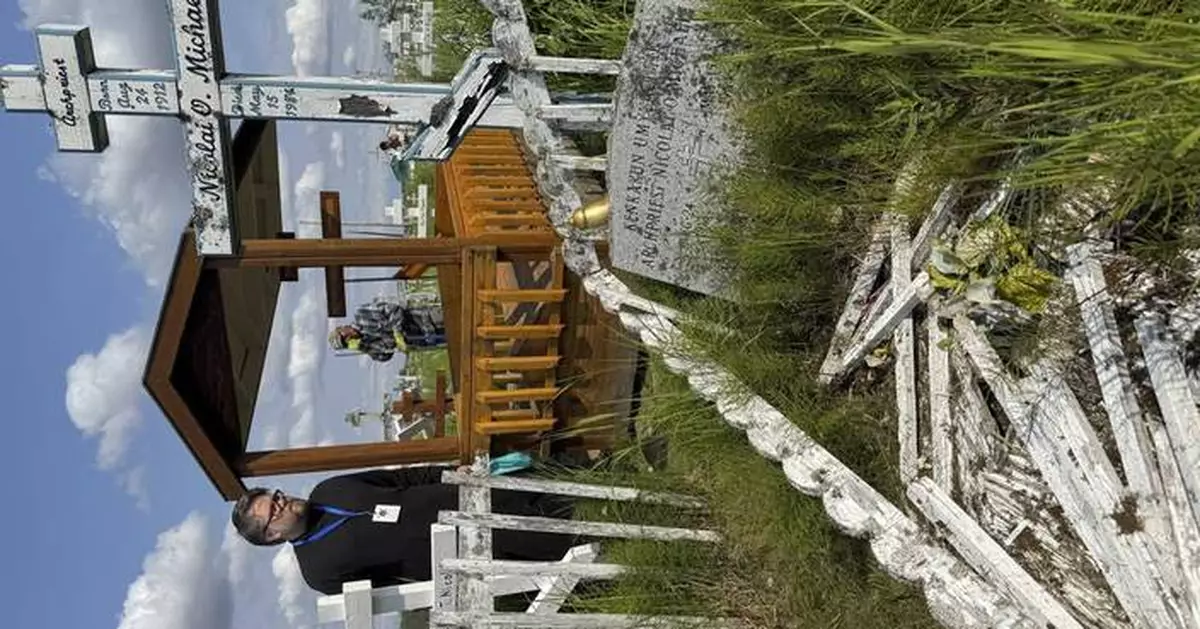
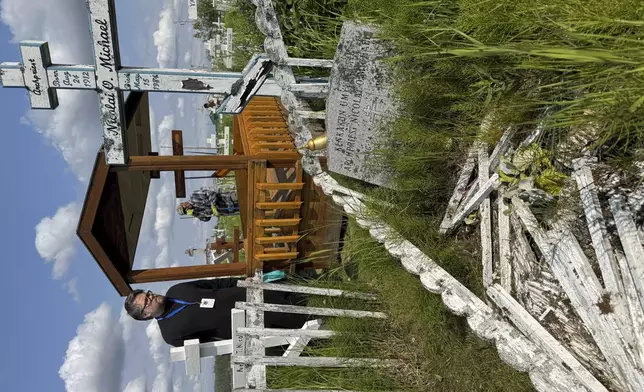
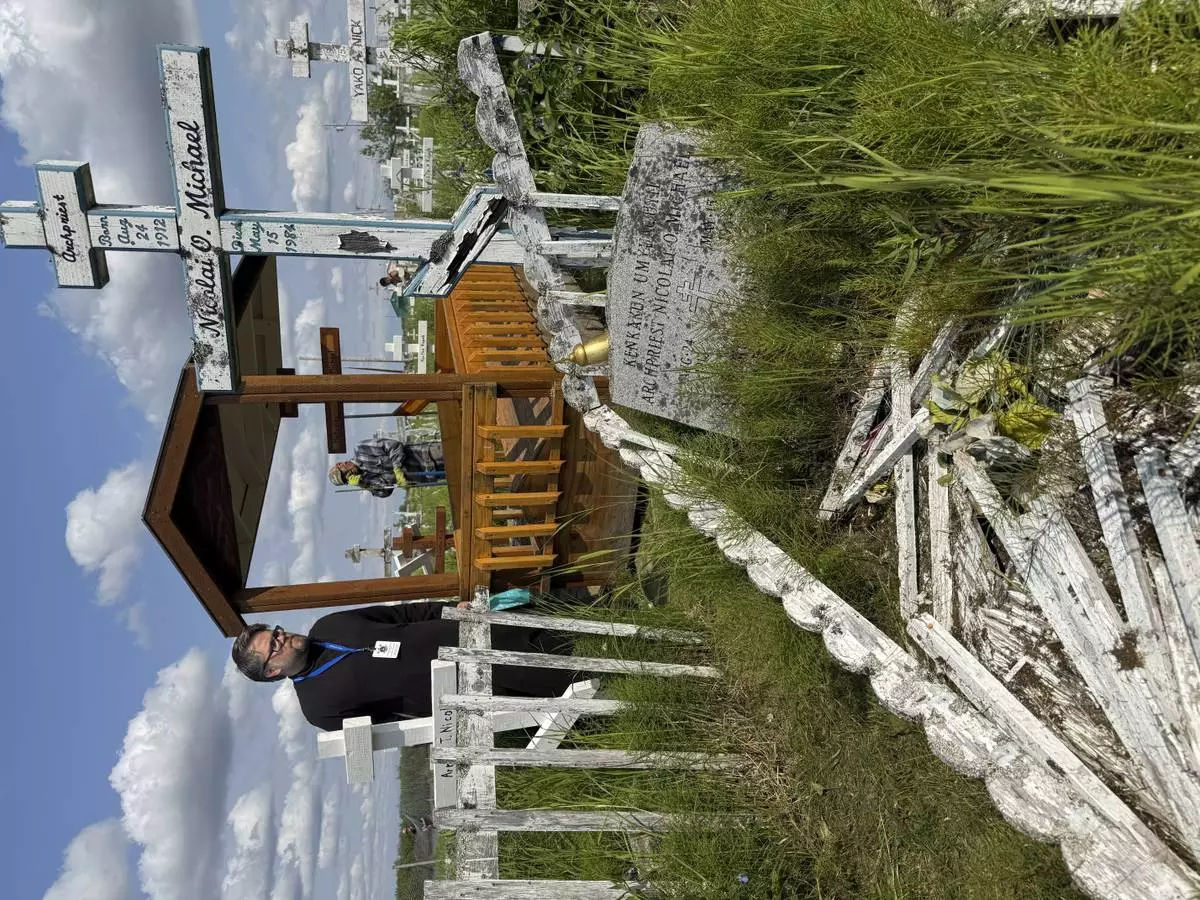
Deacon Michael Lucius of Toronto visits the gravesite of Matushka Olga Michael in Kwethluk, Alaska, on June 18, 2025, a day before she became the first female Orthodox saint in North America. In the foreground is the grave of Olga's husband, Nicolai Michael, who was a priest in Kwethluk. (AP Photo/Mark Thiessen)

Deacon Michael Lucius of Toronto visits the gravesite of Matushka Olga Michael in Kwethluk, Alaska, on June 18, 2025, a day before she became the first female Orthodox saint in North America. In the foreground is the grave of Olga's husband, Nicolai Michael, who was a priest in Kwethluk. (AP Photo/Mark Thiessen)

Her renown spread to a widening circle of devotees after her death from cancer in 1979 at age 63 — through word of mouth and reports of her appearance in sacred dreams and visions, even among people far from Alaska.

Now, after an elaborate ceremony in her village of about 800 people in southwestern Alaska, she is the first female Orthodox saint from North America, officially known as “St. Olga of Kwethluk, Matushka of All Alaska.”

“I only thought of her as my mom,” said her daughter, Helen Larson, who attended the ritual last Thursday along with St. Olga’s other surviving children and many of her grandchildren and great-grandchildren. She is in awe of her mother’s wide impact.

“This is not just my mom anymore,” Larson said. St. Olga is “everybody’s helper.”

For a church led exclusively by male bishops and priests, the glorification of Olga, the first Yup’ik saint, is significant.

“The church is often seen as a hierarchical, patriarchal institution,” said Metropolitan Tikhon, head of the Orthodox Church in America. “Recognizing women like St. Olga is a reminder that the same path of holiness is available to all. Male or female, young or old, rich or poor, everyone is called to follow the same commandments.”

St. Olga’s sainthood is especially meaningful because many women canonized by the church have been ancient martyrs or nuns, said Carrie Frederick Frost, a professor of religion and culture at Western Washington University who studies women and Orthodoxy.

“To come here and be a part of the glorification of a woman who was a lay woman and was a mother and a grandmother and lived a life that many women have lived, it’s just incredibly appealing,” Frost said.

St. Olga’s appeal to those who have suffered abuse or miscarriage is also important, she said: “I think the church has largely failed to minister to those situations, not entirely but largely.”

There are several female Catholic saints from North America. They include St. Kateri Tekakwitha, a 17th century Mohawk-Algonquin woman canonized in 2012.

Hundreds of visitors from near and far converged for her canonization — or “glorification” in Orthodox terminology.

“Thou art the glory of the Yup’ik people … a new North Star in the firmament of Christ’s holy Church,” the choir sang. The ceremonies were replete with ringing bells, robust hymns and processions of black-robed clerics, golden-robed acolytes, women in headscarves and other devotees in a mingling of dust and incense.

Some worshippers arrived for the glorification from nearby Yup’ik villages. Others flew in from faraway states and countries to the regional hub of Bethel, and then rode in a fleet of motorboats some 17 miles up the broad Kuskokwim River — a watershed central to the traditional Yup’ik subsistence lifestyle, marked by yearly rhythms of fishing, hunting and gathering.

Hundreds gathered at a riverbank in Kwethluk to greet Metropolitan Tikhon and other bishops at a specially made dock. Choral chants and incense began rising after they disembarked, and continued for hours in the uncharacteristically hot sun of Alaska’s long solstice eve.

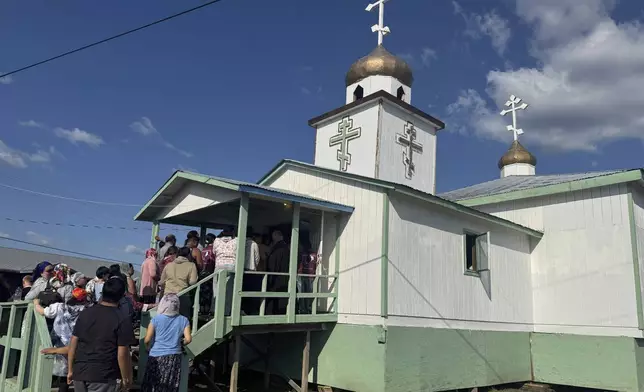
About 150 devotees squeezed into the sanctuary of Saint Nicholas Orthodox Church, whose golden onion domes rise above the village's modest one-story homes. Others listened outside as a choir sang hymns in Yup'ik, many of them composed for the occasion:

“Nanraramteggen elpet, tanqilria atauwaulria cali Aanaput Arrsamquq, cali nanrararput tanqilria yuucin elpet,” said one. (“We magnify thee, O holy and righteous mother Olga, and we honor thy holy memory.”)

Prayers honored St. Olga as “the healer of those who suffered abuse and tragedy, the mother of children separated from their parents, the swift aid of women in hard labor, the comfort of all those wounded in heart and soul.”

Worshippers approached her open casket after the ceremony, crossing themselves and kneeling.

Wiz Ruppert of Cranston, Rhode Island, returned to her native Kwethluk for the ceremony. That the grandmother she lived with for much of her childhood is now a saint seemed strange at first, “but then it was also very fitting, because she was also so kind and generous when she was alive.”

And Larson, one of St. Olga’s daughters, recalled watching women, and some men, seek her mother’s counsel. She didn’t eavesdrop, but “I used to read their faces,” Larson said.

“They’d feel heavy, by their facial expression, their body language,” Larson said. “Then they’d have tea or coffee and talk, and by the time they go out, they’re much lighter and happier.”

St. Olga joins a growing cadre of saints with strong ties to Alaska — widely deemed an Orthodox holy land, even though only a fraction of the state’s population are adherents.

It’s here that Orthodoxy — the world’s second-largest Christian communion — gained a foothold in the present-day United States with the 18th and 19th century arrival of Russian Orthodox missionaries to what was then czarist territory.

Several Orthodox monks and martyrs with ties to Alaska have already been canonized in the Orthodox Church in America, the now-independent offspring of the Russian Orthodox Church.

St. Olga is the third with Alaska Native heritage, emblematic of how the faith has grafted in with some Indigenous cultures. Most of the state’s Orthodox priests, serving about 80 parishes, are Alaska Natives. More than a dozen are from Kwethluk.

In November 2024, priests exhumed Olga’s body. Her remains are currently kept in an open casket in Kwethluk’s church, where pilgrims can venerate her shrouded relics.

When the bishops of the Orthodox Church in America authorized St. Olga’s canonization in 2023, there was talk of moving her body to Anchorage as a more accessible location.

But bishops answered the pleas of village residents, who didn’t want to lose the presence of their spiritual mother.

Now Kwethluk, inaccessible by roads, will become one of the American church's most remote pilgrimage destinations. The diocese is working with the village on plans for a new church, hospitality center and cultural center.

The village provided a taste of such hospitality for the glorification. Pilgrims stayed in a local school or in residents’ homes — amply fed by home-prepared meals of Alaska specialties such as walrus meat and smoked fish.

Nicholai Joekay of nearby Bethel — who is named for St. Olga’s late husband and grew up attending church events with her family — was deeply moved by the glorification.

“In church, up until today, we sang hymns of saints and holy people from foreign lands,” he said in a written reflection shared with The Associated Press. “We have had to learn foreign concepts that are mentioned in the Gospels referencing agricultural terms and concepts from cultures that are difficult for us to understand.

“Today, we sang hymns of a pious Yup’ik woman who lived a life that we can relate to with words that only we can pronounce properly,” he wrote.

“Today,” he added, “God was closer to all of us.”

AP video journalist Mark Thiessen contributed.

Associated Press religion coverage receives support through the AP’s collaboration with The Conversation US, with funding from Lilly Endowment Inc. The AP is solely responsible for this content.
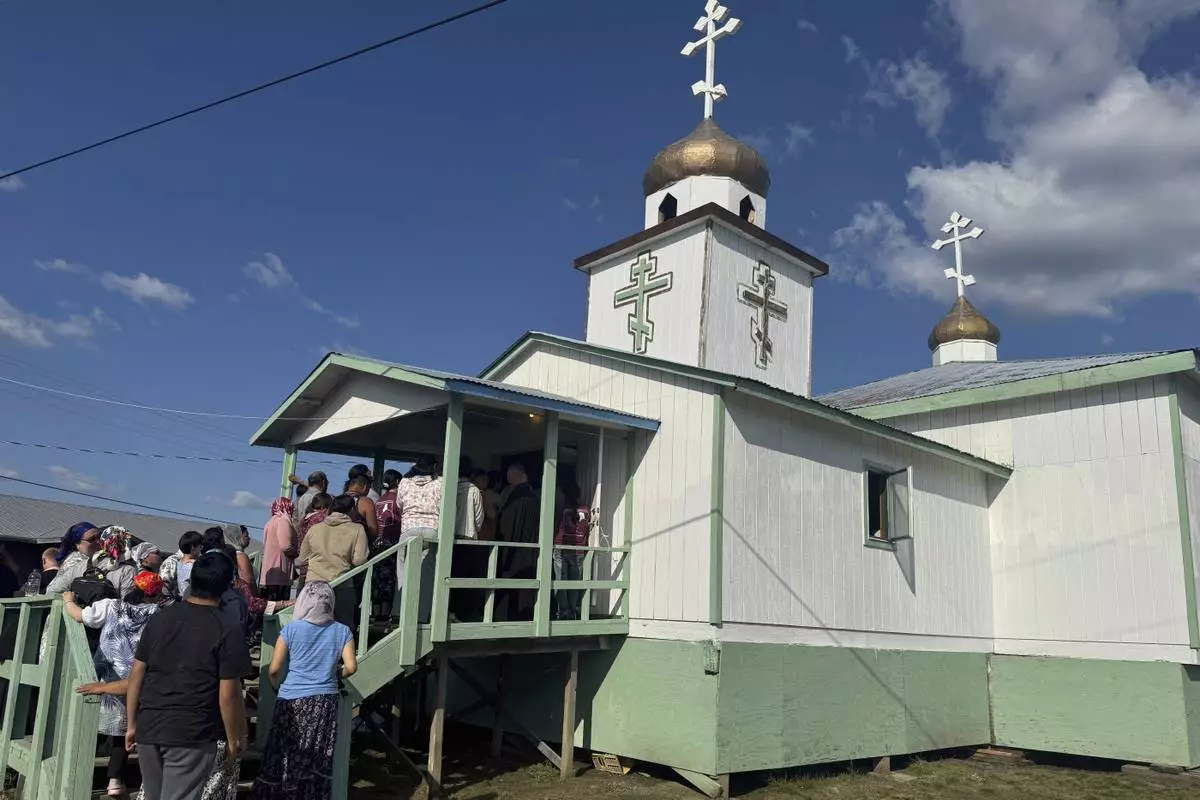
Worshippers wait in long lines to view the remains of St. Olga following her canonization in her hometown of Kwethluk, Alaska, on June 19, 2025. The ceremony drew hundreds of faithful, including from nearby villages and across the world. (AP Photo/Mark Thiessen)
Worshippers wait in long lines to view the remains of St. Olga following her canonization in her hometown of Kwethluk, Alaska, on June 19, 2025. The ceremony drew hundreds of faithful, including from nearby villages and across the world. (AP Photo/Mark Thiessen)

Two women embrace during the canonization ceremony of St. Olga in Kwethluk, Alaska, on June 19, 2025, which made her the first female Orthodox saint in North America. (AP Photo/Mark Thiessen)
Two women embrace during the canonization ceremony of St. Olga in Kwethluk, Alaska, on June 19, 2025, which made her the first female Orthodox saint in North America. (AP Photo/Mark Thiessen)

Worshippers fill St. Nicholas Orthodox Church in Kwethluk, Alaska, on June 19, 2025, for the canonization ceremony of St. Olga, the first female Orthodox saint in North America. (AP Photo/Mark Thiessen)
Worshippers fill St. Nicholas Orthodox Church in Kwethluk, Alaska, on June 19, 2025, for the canonization ceremony of St. Olga, the first female Orthodox saint in North America. (AP Photo/Mark Thiessen)

Worshippers fill St. Nicholas Orthodox Church in Kwethluk, Alaska, on June 19, 2025, for the canonization ceremony of Matushka Olga Michael, who became the first female Orthodox saint in North America. (AP Photo/Mark Thiessen)
Worshippers fill St. Nicholas Orthodox Church in Kwethluk, Alaska, on June 19, 2025, for the canonization ceremony of Matushka Olga Michael, who became the first female Orthodox saint in North America. (AP Photo/Mark Thiessen)

Metropolitan Tikhon, the head of the Orthodox Church in America, swings a censer as he blesses the remains of Matushka Olga Michael before a ceremony that made her the first female Orthodox saint in North America, in Kwethluk, Alaska, on June 19, 2025. (AP Photo/Mark Thiessen)
Metropolitan Tikhon, the head of the Orthodox Church in America, swings a censer as he blesses the remains of Matushka Olga Michael before a ceremony that made her the first female Orthodox saint in North America, in Kwethluk, Alaska, on June 19, 2025. (AP Photo/Mark Thiessen)

Worshippers, including an Orthodox priest wearing a black cassock, walk on the dusty streets of Kwethluk, Alaska, on June 19, 2025, heading to St. Nicholas Orthodox Church for the canonization ceremony of St. Olga, the first female Orthodox saint in North America. (AP Photo/Mark Thiessen)
Worshippers, including an Orthodox priest wearing a black cassock, walk on the dusty streets of Kwethluk, Alaska, on June 19, 2025, heading to St. Nicholas Orthodox Church for the canonization ceremony of St. Olga, the first female Orthodox saint in North America. (AP Photo/Mark Thiessen)

Church officials move the relics, or remains, of Matushka Olga Michael from the church to a nearby graveyard for one last ceremony before her canonization ceremony to become St. Olga, in Kwethluk, Alaska, on June 19, 2025. (AP Photo/Mark Thiessen)
Church officials move the relics, or remains, of Matushka Olga Michael from the church to a nearby graveyard for one last ceremony before her canonization ceremony to become St. Olga, in Kwethluk, Alaska, on June 19, 2025. (AP Photo/Mark Thiessen)

Deacon Michael Lucius of Toronto visits the gravesite of Matushka Olga Michael in Kwethluk, Alaska, on June 18, 2025, a day before she became the first female Orthodox saint in North America. In the foreground is the grave of Olga's husband, Nicolai Michael, who was a priest in Kwethluk. (AP Photo/Mark Thiessen)


Deacon Michael Lucius of Toronto visits the gravesite of Matushka Olga Michael in Kwethluk, Alaska, on June 18, 2025, a day before she became the first female Orthodox saint in North America. In the foreground is the grave of Olga's husband, Nicolai Michael, who was a priest in Kwethluk. (AP Photo/Mark Thiessen)

Scott Adams, whose popular comic strip “Dilbert” captured the frustration of beleaguered, white-collar cubicle workers and satirized the ridiculousness of modern office culture until he was abruptly dropped from syndication in 2023 for racist remarks, has died. He was 68.

His first ex-wife, Shelly Miles, announced the death Tuesday on a livestream posted on Adams’ social media accounts. “He’s not with us right anymore,” she said. Adams revealed in 2025 that he had prostate cancer that had spread to his bones. Miles had said he was in hospice care in his Northern California home on Monday.

“I had an amazing life,” the statement said in part. “I gave it everything I had.”

At its height, “Dilbert,” with its mouthless, bespectacled hero in a white short-sleeved shirt and a perpetually curled red tie, appeared in 2,000 newspapers worldwide in at least 70 countries and 25 languages.

Adams was the 1997 recipient of the National Cartoonist Society’s Reuben Award, considered one of the most prestigious awards for cartoonists. That same year, “Dilbert” became the first fictional character to make Time magazine’s list of the most influential Americans.

“We are rooting for him because he is our mouthpiece for the lessons we have accumulated — but are too afraid to express — in our effort to avoid cubicular homicide,” the magazine said.

“Dilbert” strips were routinely photocopied, pinned up, emailed and posted online, a popularity that would spawn bestselling books, merchandise, commercials for Office Depot and an animated TV series, with Daniel Stern voicing Dilbert.

It all collapsed quickly in 2023 when Adams, who was white, repeatedly referred to Black people as members of a “hate group” and said he would no longer “help Black Americans.” He later said he was being hyperbolic, yet continued to defend his stance.

Almost immediately, newspapers dropped “Dilbert” and his distributor, Andrews McMeel Universal, severed ties with the cartoonist. The Sun Chronicle in Attleboro, Massachusetts, decided to keep the “Dilbert” space blank for a while “as a reminder of the racism that pervades our society.” A planned book was scrapped.

“He’s not being canceled. He’s experiencing the consequences of expressing his views,” Bill Holbrook, the creator of the strip “On the Fastrack,” told The Associated Press at the time. “I am in full support with him saying anything he wants to, but then he has to own the consequences of saying them.”

Adams relaunched the same daily comic strip under the name Dilbert Reborn via the video platform Rumble, popular with conservatives and far-right groups. He also hosted a podcast, “Real Coffee,” where talked about various political and social issues.

After Jimmy Kimmel’s late-night show on ABC was suspended in September in the wake of the host’s comments on the murder of conservative activist Charlie Kirk, Adams stood for free speech.

“Would I like some revenge?” Adams said. “Yes. Yes, I would enjoy that. But that doesn’t mean I get it. That doesn’t mean I should pursue it. Doesn’t mean the world’s a better place if it happens.”

Adams, who earned a bachelor’s degree from Hartwick College and an MBA from the University of California, Berkeley, was working a corporate job at the Pacific Bell telephone company in the 1980s, sharing his cartoons to amuse co-workers. He drew Dilbert as a computer programmer and engineer for a high-tech company and mailed a batch to cartoon syndicators.

“The take on office life was new and on target and insightful,” Sarah Gillespie, who helped discover “Dilbert” in the 1980s at United Media, told The Washington Post. “I looked first for humor and only secondarily for art, which with ‘Dilbert’ was a good thing, as the art is universally acknowledged to be… not great.”

The first “Dilbert” comic strip officially appeared April 16, 1989, long before such workplace comedies as “Office Space” and “The Office.” It portrayed corporate culture as a “Severance”-like, Kafkaesque world of heavy bureaucracy and pointless benchmarks, where employee effort and skill were underappreciated.

The strip would introduce the “Dilbert Principle”: The most ineffective workers will be systematically moved to the place where they can do the least damage — management.

“Throughout history, there have always been times when it’s very clear that the managers have all the power and the workers have none,” Adams told Time. “Through ‘Dilbert,’ I would think the balance of power has slightly changed.”

Other strip characters included Dilbert’s pointy-haired boss; Asok, a young, naive intern; Wally, a middle-aged slacker; and Alice, a worker so frustrated that she was prone to frequent outbursts of rage. Then there was Dilbert’s pet, Dogbert, a megalomaniac.

“There’s a certain amount of anger you need to draw ‘Dilbert’ comics,” Adams told the Contra Costa Times in 2009.

In 1993, Adams became the first syndicated cartoonist to include his email address in his strip. That triggered a dialogue between the artist and his fans, giving Adams a fountain of ideas for the strip.

“Dilbert” was also known for generating aphorisms, like “All rumors are true — especially if your boss denies them” and “OK, let’s get this preliminary pre-meeting going.”

“If you can come to peace with the fact that you’re surrounded by idiots, you’ll realize that resistance is futile, your tension will dissipate, and you can sit back and have a good laugh at the expense of others,” Adams wrote in his 1996 book “The Dilbert Principle.”

In one real-life case, an Iowa worker was fired from the Catfish Bend Casino in 2007 for posting a “Dilbert” comic strip on the office bulletin board. In the strip, Adams wrote: “Why does it seem as if most of the decisions in my workplace are made by drunken lemurs?” A judge later sided with the worker; Adams helped find him a new job.

While Adams’ career fall seemed swift, careful readers of “Dilbert” saw a gradual darkening of the strip’s tone and its creator’s descent into misogyny, anti-immigration and racism.

He attracted attention for controversial comments, including saying in 2011 that women are treated differently by society for the same reason as children and the mentally disabled — “it’s just easier this way for everyone.” In a blog post from 2006, he questioned the death toll of the Holocaust.

In June 2020, Adams tweeted that when the “Dilbert” TV show ended in 2000 after just two seasons, it was “the third job I lost for being white.” But, at the time, he blamed it on lower viewership and time slot changes.

Adams’ beliefs began bleeding into his strips. In one in 2022, a boss says that traditional performance reviews would be replaced by a “wokeness” score. When an employee complains that could be subjective, the boss said, “That’ll cost you two points off your wokeness score, bigot.”

Adams put a brave face on his fall from grace, tweeting in 2023: “Only the dying leftist Fake News industry canceled me (for out-of-context news of course). Social media and banking unaffected. Personal life improved. Never been more popular in my life. Zero pushback in person. Black and White conservatives solidly supporting me.”

On Tuesday, President Donald Trump remembered Adams as a “Great Influencer.”

“He was a fantastic guy, who liked and respected me when it wasn’t fashionable to do so. He bravely fought a long battle against a terrible disease,” the president posted on his social media platform Truth Social.

FLE - Scott Adams, creator of the comic strip Dilbert, poses for a portrait with the Dilbert character in his studio in Dublin, Calif., Oct. 26, 2006. (AP Photo/Marcio Jose Sanchez, File)

FLE - Scott Adams, creator of the comic strip Dilbert, poses for a portrait with the Dilbert character in his studio in Dublin, Calif., Oct. 26, 2006. (AP Photo/Marcio Jose Sanchez, File)

FILE - Scott Adams, creator of the comic strip Dilbert, talks about his work at his studio in Dublin, Calif., on Oct. 26, 2006. (AP Photo/Marcio Jose Sanchez, File)

FILE - Scott Adams, creator of the comic strip Dilbert, talks about his work at his studio in Dublin, Calif., on Oct. 26, 2006. (AP Photo/Marcio Jose Sanchez, File)

Recommended Articles