A new air cargo route was launched on Saturday, linking Kashgar Prefecture in northwest China's Xinjiang Uygur Autonomous Region and Georgia's capital Tbilisi.
The freighter landed in southern Xinjiang's Kashgar Laining International Airport on the day, carrying chilled Norwegian salmon, live French brown crabs and Tajik cherries.
The air cargo charter for the first time opened up a channel for Kashgar to import fresh seafood from Europe.
Aviation cold chain technology was used to ensure that brown crabs and salmon remained fresh. Advanced preservation technology was also used to preserve the cherries' nutrients and taste.
"The import of these goods will greatly enrich the Belt and Road Initiative cooperation and Kashgar's foreign trade. Next, we will add more routes. We plan to open at least four routes within this year," said Zhang Ating, chairman of Kashgar Trade and Logistics Group.

New air cargo route links aviation hub of southern Xinjiang, Georgia
The Saudi-led coalition in Yemen said on Thursday that it had intercepted and destroyed multiple drones launched toward Saudi Arabia.
Coalition spokesman Turki Al-Maliki said on the social media platform X on Thursday afternoon that the forces intercepted and destroyed four drones over Riyadh and Medina and another over Riyadh in separate incidents.
Earlier in the day, the coalition said its forces had destroyed four drones launched toward the Eastern Province.
Meanwhile, Yemen's Houthi group said it had launched four missile and drone attacks against Saudi Arabia over the past 48 hours.
In a televised statement aired by the Houthi-run al-Masirah TV, Houthi military spokesman Yahya Sarea said the attacks targeted the Saudi Defense Ministry in Riyadh, King Fahd International Airport in Dammam, a facility belonging to Saudi oil giant Aramco in Yanbu, and Abha International Airport in the southwestern city of Abha.
All targets were "directly hit," causing air traffic disruption and a fire at the oil facility, Sarea claimed.
In a separate development, the Houthis claimed that Saudi Arabia struck an Indian yacht near Yemen's Zuqar Island in the southern Red Sea, alleging 14 Indian nationals were aboard.
Sarea said Houthi forces were carrying out a rescue operation and would provide further details later.
There was no immediate comment from Saudi Arabia.
Zuqar Island lies north of the strategic Bab al-Mandab Strait, one of the world's key maritime shipping routes.
The developments came amid intensified fighting in Yemen, with the Saudi-backed government forces trying to reverse Houthi territorial gains. The Houthis have also continued missile and drone attacks against Saudi Arabia.
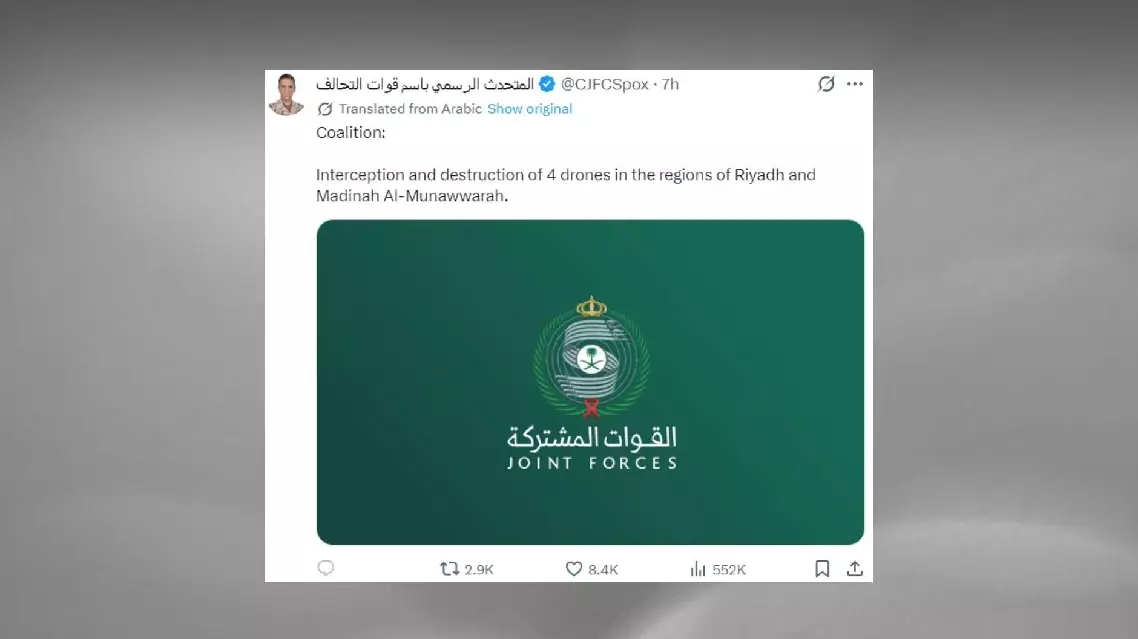
Saudi-led coalition says intercepted drones as Houthis claim new attacks on Saudi Arabia