Skip to Content Facebook Feature Image

Shenzhen-Zhongshan Link handles over 31 million vehicle trips in first year

China

China

China

Shenzhen-Zhongshan Link handles over 31 million vehicle trips in first year

2025-06-30 20:36 Last Updated At:23:27

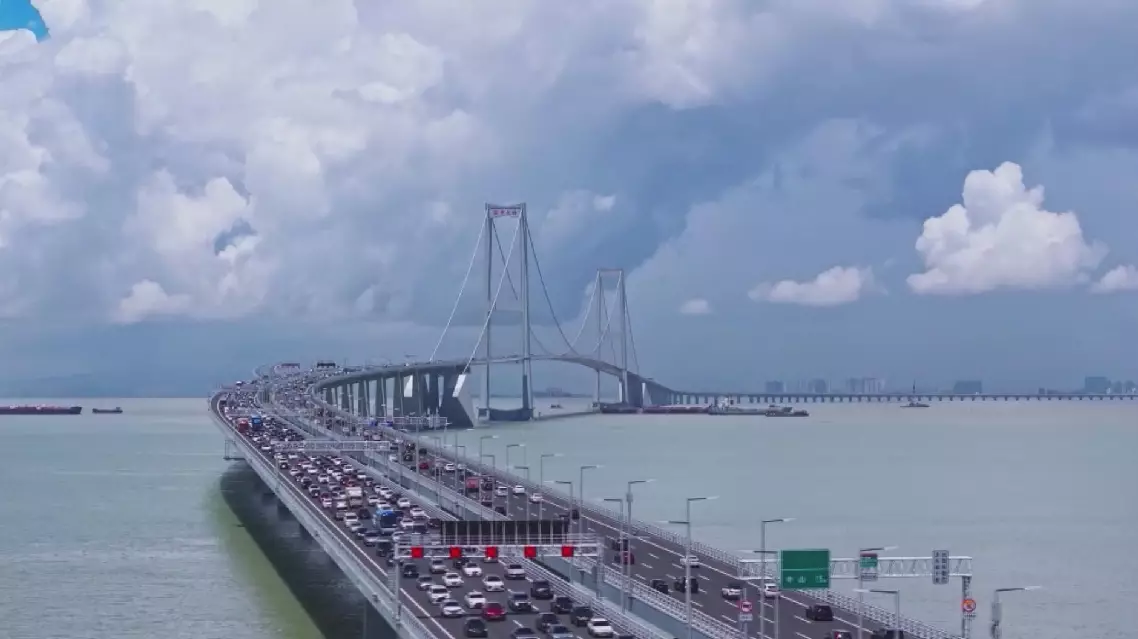
⁠⁠⁠⁠⁠⁠⁠The Shenzhen-Zhongshan Link, a massive cross-sea passage in south China that features two bridges, two artificial islands and an underwater tunnel, has seen a steady surge in vehicle trips since its entry into operation on June 30, 2024, handling more than 31.5 million vehicle crossings in one year.

Of the vehicles crossing the link, those bearing license plates from Hong Kong and Macao totaled 769,700 in number.

Spanning 24 kilometers, the link drastically reduces the time it takes to travel between the city of Zhongshan and the technology hub of Shenzhen -- situated on opposite sides of the Pearl River Estuary in Guangdong Province -- from two hours to approximately 30 minutes.

Data show that during weekdays, the traffic flow on the Shenzhen-Zhongshan Link is stable and orderly, with an average daily traffic volume of 81,500 vehicle trips. 

During holidays, the traffic flow on the Shenzhen-Zhongshan Link constantly remains high. Since its opening, it has broken the daily traffic peak record four times. 

This year, on May 1, it registered a record high of 181,600 vehicle crossings on it after its opening. 

The average daily traffic volume on public holidays is 139,600 vehicle trips, 71.24 percent more than on weekdays. 

In addition, the accumulated traffic volume on the Shenzhen-Zhongshan Link in the first half of this year also increased compared with the second half of last year. The average daily traffic volume in the second half of last year was 82,000 vehicle crossings, while the average daily traffic volume in the first half of this year was 90,900 ones. 

"One year after the opening of the Shenzhen-Zhongshan Link, the overall traffic flow is safe, stable and orderly, and the traffic volume has kept growing. The overall traffic capacity of cross-river channels across the Pearl River Estuary, including the Huangpu Bridge, Nansha Bridge and Humen Bridge, has been enhanced. The traffic environment has been greatly improved, people have shown stronger desire to travel, and there is a marked increase in the overall traffic flow in the cross-river channels across the Pearl River Estuary. The Shenzhen-Zhongshan Link is becoming increasingly prominent as a key transportation hub in the Guangdong-Hong Kong-Macao Greater Bay Area," said Fan Chuanbin, director of the Shenzhen-Zhongshan Link administration center. 
Shenzhen-Zhongshan Link handles over 31 million vehicle trips in first year

Shenzhen-Zhongshan Link handles over 31 million vehicle trips in first year
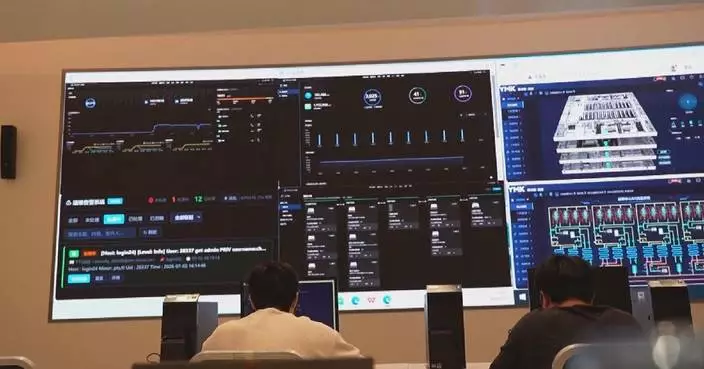
The Beijing Space Computing Innovation Center, unveiled on June 29 in the capital city's satellite town in the northwestern district of Haidian, is expected to gather talent across sectors and drive growth in the space computing industry, according to industry insiders.

Jointly led by the Beijing University of Posts and Telecommunications and leading enterprises in the space computing sector, the center will work on tackling common technological challenges such as large-scale space models, while advancing the construction of public platforms, the formulation of industry standards, and the commercialization of application scenarios.

The Beijing Space Computing Innovation Alliance was also launched at the same time, expected to bring together 108 diverse innovation entities ranging from universities and research institutes to state-owned enterprises and private companies to pool resources and strengthen industry collaboration.

"Space computing power in effect is a field with a very long industrial chain, covering commercial aerospace -- which has developed rapidly in recent years -- as well as chips, artificial intelligence, cloud-related technologies, and specific application scenarios -- integrating all of these together for organized research and development," said Fu Yunhao, CEO of Beijing Tiansuan Xinglian Technology Company.

"As satellite networks become increasingly advanced, they will inevitably host a variety of value-added services and applications. And these value-added services and applications will certainly require computing," said Wang Shangguang, dean of the School of Computer Science at the Beijing University of Posts and Telecommunications.

Space computing power technologies refer to deploying computing facilities within an orbital satellite system so that massive volumes of data can be processed, stored and transmitted in orbit. Compared with traditional space information processing method, where data collected by satellites need to be sent back to the Earth for processing, space computing power technologies can break through latency bottlenecks and be applied to numerous scenarios such as remote sensing and monitoring.

Beijing's new space computing innovation center to attract talent, drive growth: insiders

Beijing's new space computing innovation center to attract talent, drive growth: insiders

Recommended Articles