China's first asteroid sample-return mission, Tianwen-2, launched on May 29 and set to explore two target asteroids, needs to overcome multiple key technological challenges, according to scientists.
The mission aims to achieve multiple goals over a decade-long expedition: collecting samples from near-Earth asteroid 2016HO3 and exploring main-belt comet 311P, which is farther from Earth than Mars.
The entire mission process for Tianwen-2 is complex. After launch, it will journey for about one year to reach its first target, during which it will perform deep-space maneuvers and mid-course corrections until it is about 30,000 km away from 2016HO3.
The probe will gradually approach the target, carrying out close exploration by circling and hovering over the asteroid to determine the sampling area, with a strategy of flying and probing simultaneously.
After completing the sampling, the spacecraft will fly back to the vicinity of Earth. A return capsule will separate from the main probe and is expected to deliver the samples to Earth by the end of 2027.
The main probe will then continue its voyage to rendezvous with the more distant target, the main-belt comet 311P, to carry out subsequent exploration tasks.
Multiple technological challenges are awaiting the exploration, including sampling on a low-gravity celestial surface, high-precision autonomous navigation and control, as well as trajectory design, according to the China National Space Administration (CNSA).
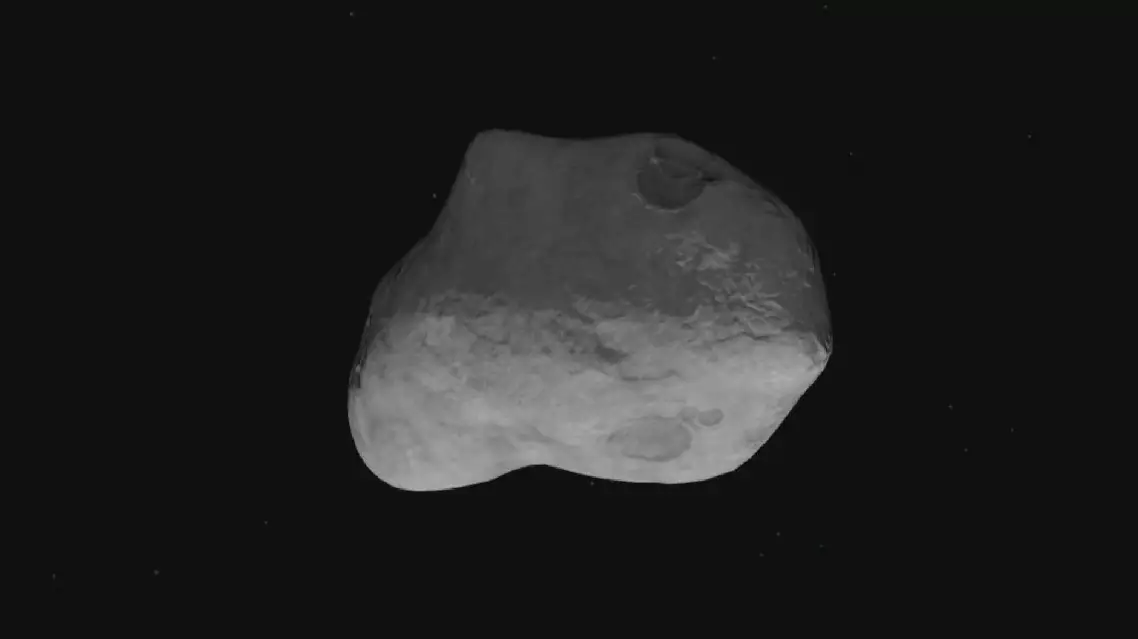
"We need to achieve a stable attachment and sampling of the asteroid in a near-zero gravity environment. The 2016HO3 asteroid has an average diameter of only about 41 meters and is spinning rapidly, which means we need to complete the stable attachment and sampling process within a limited time in a complex environment," said Han Siyuan, deputy director of the CNSA's Lunar Exploration and Space Engineering Center and spokesperson for the Tianwen-2 mission.
Asteroid 2016HO3 is located between 18 million km and 46 million km from Earth, while the main-belt comet 311P lies approximately 150 million km to 500 million km away.
The immense distance from Earth imposes stringent requirements on the probe's communication system, trajectory design, power management, and the capability to maintain highly reliable long-term operational performance, according to Han.
"During the exploration, we face larger issues such as delays in measurement and control signals, which will pose great challenges and raise the requirements to the probe's autonomous control, intelligence level, trajectory design and the durability and reliability of relevant products," said Han.
The mission's name originates from the long poem "Tianwen," meaning "Questions to Heaven," written by Qu Yuan (about 340-278 BC), one of the greatest poets of ancient China. The poem poses philosophical and cosmological queries about heaven, stars, myths, and nature, reflecting a spirit of seeking the truth.
CNSA noted that all of China's interplanetary missions bear the Tianwen series name, symbolizing the nation's enduring pursuit of truth and exploring nature and the universe. China's first Mars exploration mission was named Tianwen-1.
China's Tianwen-2 mission needs to overcome multiple technological challenges: scientists