Ubon Ratchathani province in Thailand has become a landmark for China-Thailand clean energy cooperation, hosting a solar-powered charity school and the world's largest hydro-floating solar project.
These initiatives are transforming local livelihoods and driving a shift in the country's energy structure.
Ubon Ratchathani is nestled in a bend of the Mekong River. With over 2,000 hours of sunshine annually and sunlight intensity reaching as high as 5.2 kilowatt-hours per square meter, which is 27 percent higher than cities such as the capital Bangkok, the region is ideal for solar power generation.
Sisaengtham school, a charity school in Ubon Ratchathani, is powered by solar panels manufactured in China. Phra Panyawachiramoli, the school's founder, stated that before installing the solar panels, the electricity bill amounted to 500 U.S. dollars per month. It has now been massively reduced to just 1.2 U.S. dollars, bringing significant savings to the school.
"China is a leader in solar technology. It has its own domestic products and materials. There's no beating them in quality," Phra Panyawachiramoli said.
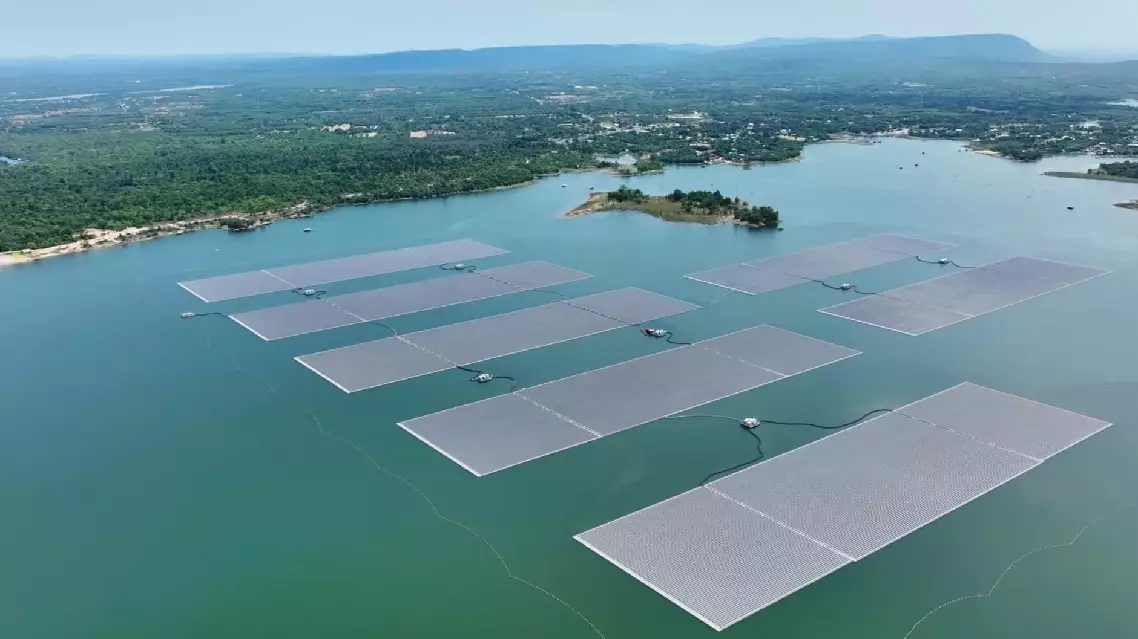
A hydro-floating solar project in the Sirindhorn Dam is the world's largest integrated hydro-floating solar project and one of Ubon Ratchathani's main tourist attractions.
Launched in 2021 and co-developed by China Energy Engineering Group, the project features a massive array of solar panels, totaling 144,000 and covering an area equivalent to 70 football fields, creating a shimmering, sci-fi-like landscape.
"The power plant's been operating for three years. Look at all the rafts, boats and holidaymakers on the lake. So many. It shows how much the power plant is in harmony with the local community. It's helping Thai people to understand clean energy technology and its safe use," said a local official.
"This is Thailand's first hydro-floating solar project. It's also a demonstration project for the whole country," said Zhang Daxue, general manager of the Anhui No.2 Electric Power Construction Co., Ltd. under China Energy Engineering Group.
"Almost a million people have already visited this floating solar power station," said Arthit Phornkuna, director of the Sirindhorn Hydro Power Plant Department.
The Sirindhorn Dam integrated hydro-floating solar project reduces carbon emissions by 47,000 tons annually. With an annual output of 76 million kilowatt-hours, it provides enough energy for 28,300 people for a year.
China-Thailand green cooperation projects boost Thai livelihoods, energy transition
Ghanaian President John Dramani Mahama has underscored the need for the international community to properly recognize the historical injustices committed against Africa and support efforts to advance reparations for Africans and people of African descent.
Mahama made the remarks in an interview with the China Media Group (CMG) which was aired Friday and recorded during the Ghanaian President's trip to Beijing in October.
Earlier this year, Mahama had issued a call for collective action in securing justice for Africans and individuals of African descent through reparations at the 38th Ordinary Session of the African Union.
Located in West Africa along the northern shore of the Gulf of Guinea and bordered by the Atlantic Ocean to the south, Ghana boasts a more than 500-km coastline and abundant agricultural, fishery, forestry and mineral resources. Yet its history, like much of the African continent, has been deeply scarred by centuries of foreign aggression.
From the 15th century onward, Western colonial powers invaded coastal areas of what is now Ghana, plundering resources and conducting the slave trade, casting a long colonial shadow over the African continent which hung for centuries.
In 1955, the successful convening of the Bandung Conference -- which gathered representatives of Asian and African states in Indonesia -- ignited a new wave of national liberation movements these continents, accelerating the collapse of the global colonial system.
Ghana's independence in 1957 lit the first torch of freedom in sub-Saharan Africa and was hailed as the dawn of Africa's awakening.
Africa's first tragedy, the transatlantic slave trade, constituted an extremely grave atrocity, Mahama said.
During that period, an estimated 12 to 15 million Africans were forcibly taken from the continent and sent to the Caribbean, the Americas and Europe. They contributed to the building of modern Western civilization, yet received no compensation for their labor, whether working on sugar plantations or constructing railways, roads and bridges, he noted.
Mahama outlined his wish that the United Nations takes action to recognize the slave trade as "the greatest crime against humanity" and takes steps to ensure reparations are paid back to the descendants of those who suffered.
"We believe that first and foremost, it should be recognized as the greatest crime against humanity. We must condemn the activity of slavery of the people who were shipped to what I call the 'New World', that's the Western world. It's estimated that as many as 2 million did not arrive at the destination because they were either too sick or they died on board, and they were just tossed over into the ocean. That was genocide. And so it's an issue that the first step is for us to accept. And so Ghana wants to move a motion in the UN next year asking the world to recognize the slave trade as the greatest crime against humanity. And so we'll continue to push on the African [Union] Champion on Reparations when I spoke even at the UN, I raised the issue of reparations and so I do think that that is to do with slavery," he said.
Mahama also stressed the impact of colonialism, which further entrenched injustice and led to global inequality as African nations were ruthlessly exploited.
"With regards to colonialism, the Berlin Conference (1884–1885) partitioned Africa and the European nations took colonies in Africa, ran those colonies, exploited their natural resources and transferred those natural resources, oil palm, gold, minerals, cocoa and other products, to develop their countries. And it's only from the late 1950s that countries like Ghana got independent. And so that was an injustice. Colonialism was an injustice against African countries," he said.
Ghanaian president urges reparative justice for Africa, citing slavery, colonial exploitation