The Israel-Iran conflict caused a brief but significant spike in oil prices, demonstrating the market's swift adaptation to geopolitical events while signaling the growing importance of renewable energy for global energy security, said an economist.
Speaking to China Global Television Network (CGTN), Claudio Galimberti, chief economist at Oslo-based research firm Rystad Energy, analyzed the fluctuation in oil prices following Israel's mid-June attacks on Iran.
"What we learn is that the market incorporates the information very efficiently and very quickly. We had a very quick increase in the geopolitical risk premium just after the attack of Israel. It went all the way from one to two U.S. dollars per barrel to 10 U.S. dollars, just in a couple of hours. And then it stayed at the level for two or three days until it became clear that Iran was not going to retaliate significantly after the U.S. attack on the three nuclear sites. So the key takeaway this time around is that the market has really become extremely efficient in incorporating information. And for the most part, the information is readily available for most of the traders around the world," he said.
Galimberti highlighted the risks posed by geopolitical volatility to energy industries while stressing the importance of renewables as a form of energy security.
"So back in the 80s, right? And even more recently, when we had the war in Iraq, the geopolitical risk premium 20 years ago was much higher for much longer. There is need to establish a secure supply chain: oil and gas, and to some extent, renewable. Let's not forget the renewables right now enter the energy security in the sense they have become a source of energy security, especially if you can produce them in a very efficient way like China is doing for instance, right? China has invested a lot in renewable as a form of energy security," he said.

Oil market reacts swiftly to Israel-Iran conflict, signaling renewables' role in energy security: expert

Oil market reacts swiftly to Israel-Iran conflict, signaling renewables' role in energy security: expert
A new round of trade-in subsidy program is energizing China's consumer market these days, with provinces across the country seeing a surge in demand for cars, home appliances and digital devices.
In north China's Shanxi Province, the new trade-in subsidy program, which started on January 9, has further helped boost sales in home appliances and digital devices which are covered by the new round of subsidies.
To enjoy the subsidies, six types of home appliances, including refrigerators and washing machines, must meet national Level 1 energy-efficiency or water-efficiency standards. Digital and smart products include four types, such as mobile phones and tablets, with a sales price cap of 6,000 yuan (about 800 U.S. dollars) per item.
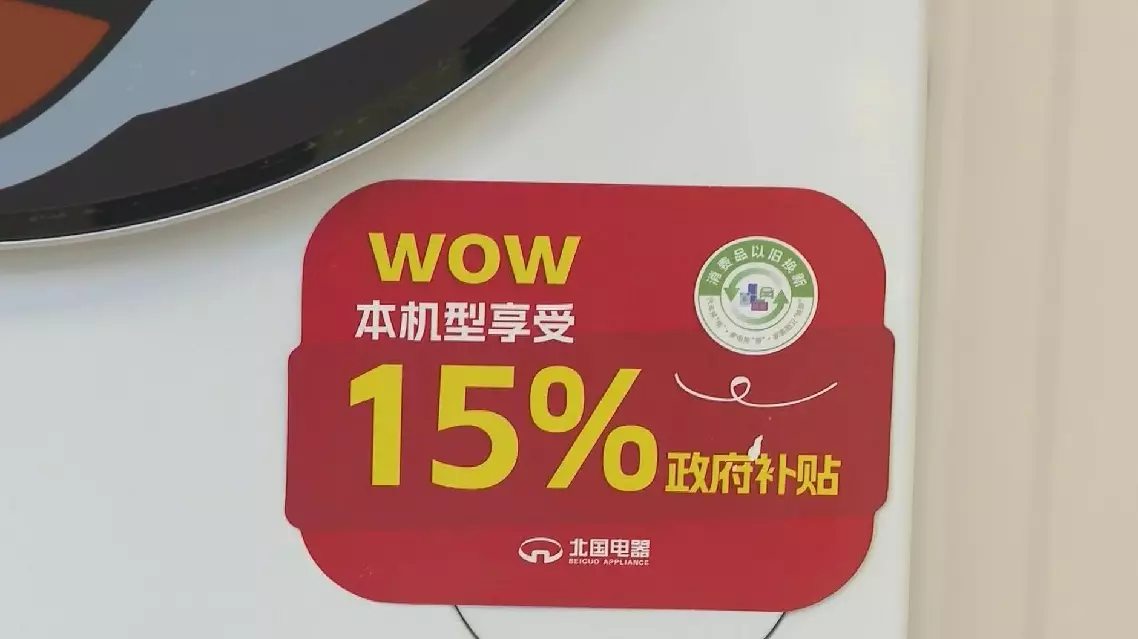
In both categories, subsidies are set at 15 percent of the final transaction price. For home appliances, the maximum subsidy is 1,500 yuan per item. For digital products, the cap is 500 yuan per item. Each consumer can receive a subsidy for one unit in each category.
Neighboring Shanxi, Hebei Province kicked off the year of 2026 with the new round of trade-in subsidy program starting on January 1.
The subsidies cover automobiles, home appliances, and digital products. Individual consumers who purchase designated Level 1 energy-efficiency appliances or eligible digital products priced at no more than 6,000 yuan can receive subsidies equal to 15 percent of the transaction price. The maximum subsidy is 1,500 yuan per appliance and 500 yuan per digital or smart device, with each person limited to one subsidized item in each category.
Data showed that from Jan 1 to 9, Hebei's home appliance trade-in program alone disbursed more than 130 million yuan in subsidies, driving sales of over 920 million yuan.
In east China's Jiangsu Province, the new trade-in subsidy program, taking effect for two weeks, has brought the province a boom in trade-in.
At a local 4S store in Jiangsu's Suqian City, showroom traffic has spiked as salespeople walked customers through the new benefits from the trade-in subsidy program.
"Under the scrappage-and-replacement scheme, customers who buy a new energy vehicle (NEV) can receive a subsidy worth 12 percent of the vehicle price, capped at 20,000 yuan (about 2,860 U.S. dollars). For combustion-engine cars, the subsidy is 10 percent, with an upper limit of 15,000 yuan. For trade-ins, NEVs are able to receive a subsidy worth 8 percent of the vehicle price, up to 15,000 yuan, while combustion-engine cars will receive a 6-percent subsidy, with a cap of 13,000 yuan," said Sun Yue, a saleswoman at the store.
In the home appliance sector, Jiangsu's policy this year stipulates that only products that meet China's Level 1 energy-efficiency standard are eligible for subsidies. The scheme covers six major categories, including refrigerators and washing machines.
Consumers who purchase qualifying appliances can receive a subsidy equal to 15 percent of the final retail price, up to a maximum of 1,500 yuan per item. Each person is limited to one subsidized unit per product category.
Four types of digital and smart products, such as mobile phones and tablets, are eligible for a 15-percent subsidy capped at 500 yuan per unit, with a retail price no more than 6,000 yuan.
"With the national subsidy policy back in place this year, I went to the store to check what discounts I could get. It knocked 500 yuan off the price. [The discounted price is] very reasonable," said Wang Kang, a resident of Jiangsu's Xuzhou Province.
To enhance the shopping experience for consumers, many retailers are pairing subsidies with "one-stop" services that combine the delivery of new products with on-site collection of old ones.
"After consumers place an order for new home appliances, our staff will schedule a time to pick up the old units. Recycling the old appliance can also further offset the purchase price of the new one," said Yang Jie, a sales supervisor at a major home appliance company.
China's new trade-in program sparks consumption boom