A Hong Kong-born fashion designer has made a career transition in the Guangdong-Hong Kong-Macao Greater Bay Area (Greater Bay Area) to become a kindergarten teacher, finding self-worth there, a vibrant city cluster in south China.
Kole Hung from Hong Kong is now a fashion designer-turned-director of an international kindergarten. Today her life is an embodiment of the saying "Caring for your own children and those of others."
Her decade-long educational journey in the Greater Bay Area has granted her profound insights into multicultural education. Simultaneously, the Greater Bay Area has offered her and her family a comfortable and carefree living environment.
"I'm Kole Hung. I'm actually from Hong Kong. I've been working in an international school for 10 years already. My major was arts and design, and when I graduated, I worked as a fashion designer for years. When I had my own children, then I decided to see if maybe I can try to get into education because I was trying to educate my own child," she said.
In 2017, Kole Hung obtained a degree in education from the University of South Wales and officially became a teacher.
"To be a kindergarten teacher, you don't have to be expert for everything, but you do have to know things, a little bit about everything. So you need to know some PE. You gotta be physical. You gotta be able to be funny. You have to be also know human business, and knowing how they feel. And you also have to be artsy as well, because as a kindergarten teacher, so you do have to come up with a lot of art ideas," she said.
She noted that there will be some children who are more active, while others may be quieter, each exhibiting their own unique personalities.
"As a teacher, we have to remember that we are not trying to change a kid. We have to respect if they have their own personality. That's okay. But we are also here to guide them, and help them to enhance some skills and give them some advice," she said.
In 2024, Kole Hung moved from Guangzhou to the new campus in Foshan and became the kindergarten coordinator.
She recalled that when she came to the mainland, her eyes opened again in the field of education.
"For education, I think we also have a lot to learn here in the mainland. Being an international school, we always talk about being diverse," she continued.
"We respect the local culture as well, and we respect the local parents, the language, the food and everything. That's one of the main reasons we also have a regular Mandarin lesson, the Chinese teacher. We have to teach the Chinese culture, of course the writing, the reading, the pinyin," she said.
She thinks being balanced and also respecting the culture is very important.
"I gotta be more responsible. I gotta be more accountable. I gotta be more consistent or I gotta be more patient or I gotta be more caring. So that's what the meaning is," she said.
Kole and her family have been living in Guangdong for six years. The Greater Bay Area has brought her new career opportunities, and it has become their home, a place where they always feel welcome.
"I think I had a good time and Guangzhou had a lot of stuff going on. But Foshan is great for me too. The air quality is better, like a lot of trees. It's just not as busy as Guangzhou," she said.
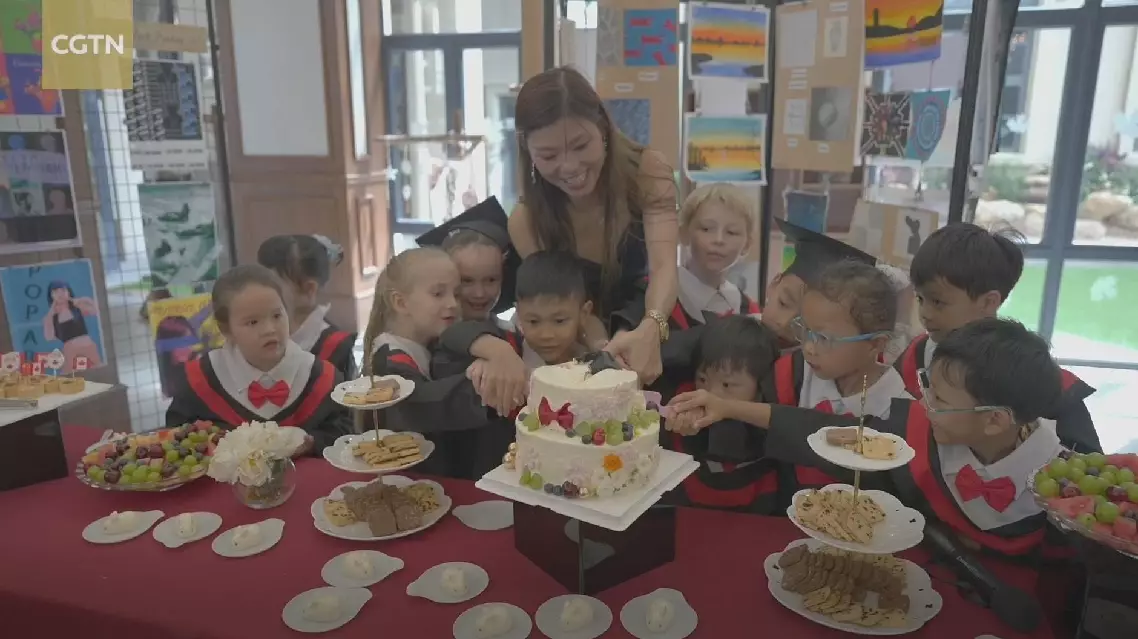
HK-born fashion designer makes career transition, finding self-worth in Greater Bay Area