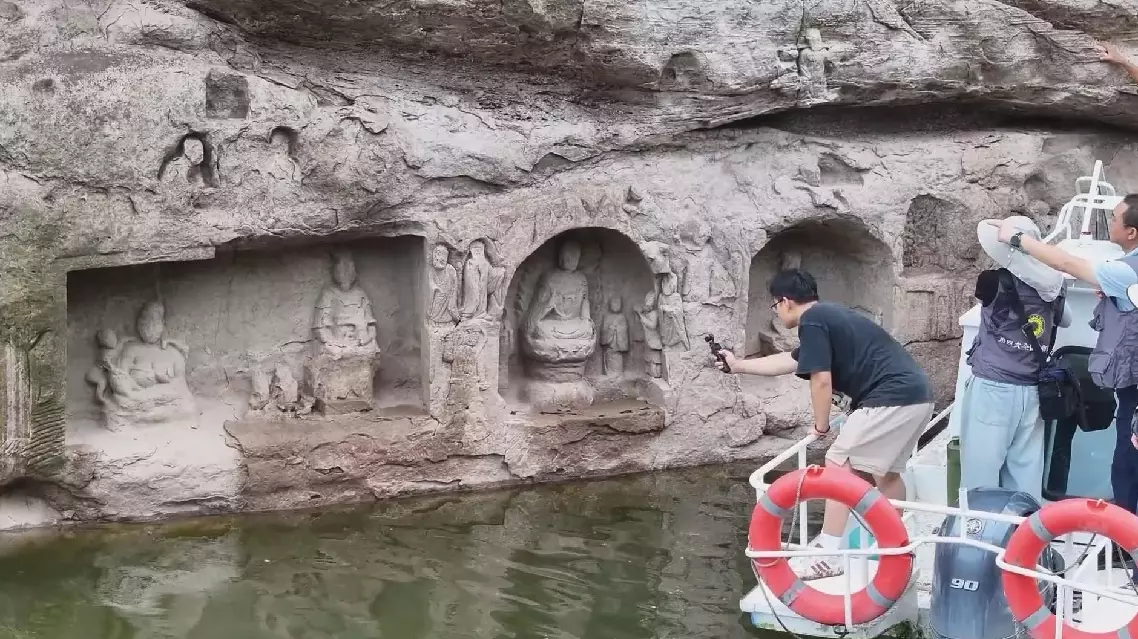
A recent drop in water levels at Yutan Reservoir in Dazu District of Chongqing Municipality, southwest China, has revealed a newly discovered set of Song Dynasty (960-1279) cliffside carvings, offering fresh insight into ancient Chinese religious art.
The carvings were found on a rock face measuring approximately three meters high and six meters wide, with six individual niches from left to right, containing a total of 27 statues. Experts noted that the second through fourth niches are especially significant due to their size and exceptional state of preservation.
"Since early this spring, rainfall in Dazu District has been lower than usual. Water levels in the Yutan Reservoir have continued to fall, revealing these long-submerged carvings," said Deng Qibing, a researcher at the Dazu Rock Carvings Research Institute.
According to researchers, the newly revealed carvings include religious and folk themes such as Water-Moon Avalokitesvara (shuiyue guanyin) and the Shakyamuni preaching scene, all regarded as typical of Song Dynasty Buddhist rock art.
The sculptures also demonstrate meticulous craftsmanship and incorporate secular imagery, such as kneeling pilgrims, standing figures, and characters carrying shoulder poles, reflecting the vivid blend of folk life and Buddhist belief during the Song Dynasty.
"These themes were very prevalent in Song Dynasty Buddhist art in Dazu. This discovery not only enriches the types of subjects found in Dazu stone carvings but also holds important value in studying the evolution of Water-Moon Avalokitesvara and Hariti figures in the Bashu region (encompassing Sichuan Province and Chongqing Municipality)," said Deng.
Local cultural heritage authorities have already completed preliminary mapping and digital imaging of the site. Further efforts will focus on preservation and academic research to ensure the protection and understanding of these underwater treasures freshly brought to light.
Ancient cliff carvings surface in Chongqing

South China's Guangdong is seeing a surge in winter tourism, as visitors from around the world flock to the province, drawn by its mild climate, supportive travel policies, and increasingly diverse tourism experiences.
One of Guangdong's most popular winter attractions is its hot springs. Just an hour's drive from Guangzhou city proper, Conghua District is home to what are known as the "rare hot springs", naturally rich in radon, which is believed to offer health benefits. For many visitors, these natural, mineral-rich waters provide a welcome escape from colder temperatures.
Guangdong is home to many hot spring resorts. And the business model is clearly evolving. They are not just selling the views, they are selling the whole experience.
Dusit Devarana Hot Springs and Spa is China's first hot spring joint venture, backed by state-owned investors and run by a premium resort group from Thailand.
"It's peaceful, the air is clear, the water is nice — it feels like Southeast Asia," said Mrs. Ye, a tourist in the resort.
That Southeast Asian influence is evident in both the service and the Northern Thai-style architecture, with custom-made decorations imported straight from the Land of Smiles.
For travel agencies, a warm winter is reshaping demand — with families and group travel leading the way.
Tourists now prefer hotels with shared spaces for gatherings, said Che Qianhui, marketing director of local travel agency Day Day Holiday. Government consumption vouchers are also driving demand, Che said. The top voucher offers 300 yuan off a 1,500-yuan purchase, including some hotels — and they're usually snapped up within five minutes, she added.
The resort is expected to receive large crowds during the upcoming Spring Festival, which falls on February 17, 2026.
"During the Spring Festival, we expect occupancy between 90 and 100 percent. Over the New Year holiday, our rooms were fully booked, with more than 700 visitors to the hot springs every day. We've added family activities and cultural experience offerings, moving beyond a simple health retreat. About 70 percent of new revenue now comes from regions north of the Yangtze River in China, and there are also international visitors from Europe, the Middle East, and Africa," said Shao Yingda, general manager of Dusit Devarana Hot Springs and Spa in Conghua.
To attract more tourists, Guangdong has issued 20 million yuan (2.9 million U.S. dollars) in vouchers. The wider ripple effect could generate around 200 million yuan in total economic activity.
However, vouchers and promotions can only go so far. Across China — and around the world — traditional tourism destinations face the same challenge: how to stay fresh, stand out from similar offerings, and remain competitive over time. That puts the focus on policy design, sustainability, and how to attract international visitors.
"Globally, when per capita GDP surpasses 10,000 U.S. dollars, it enters a leisure stage. Yet many tourism products still focus on traditional sightseeing. International tourists cannot simply be seen as an extension of domestic travelers. Domestic and international travelers have different needs, and destinations must offer customized, in-depth experiences to compete globally," said Li Yaoqi, professor and director of the Cultural and Tourism Consumption Research Center of Sun Yat-sen University.
With growing policy support for both domestic and international travel, this winter is shaping up to be more than just a seasonal getaway. It's also a test of how tourism adapts to changing demand.
Mild climate, policy support, new experiences attract more tourists worldwide to Guangdong