A special exhibition commemorating the 620th anniversary of Chinese navigator Zheng He's voyages was opened on Friday in Jakarta, capital city of Indonesia.
The voyages, led by Zheng, also an ambassador in China's Ming Dynasty (1368-1644 AD), brought silk, porcelain and tea to Indonesia, sowing seeds of friendship and trust between the two countries.
The exhibition, held at the Museum of Fine Arts and Ceramics in Jakarta, features ancient books, shipbuilding tools, navigation charts, archival footage, and rare footage about the voyages, systematically presenting the grand scenes of Zheng He's maritime expeditions, the prosperity of the ancient Maritime Silk Road, the cultural exchanges and mutual learning between China and Indonesia, and the new chapter of jointly building the 21st Century Maritime Silk Road.
This year also marks the 75th anniversary of diplomatic relations between China and Indonesia, and the 70th anniversary of the Bandung Conference.
Held at this historic moment, the exhibition not only pays tribute to the long-standing exchanges between the two nations but also preserves and disseminates the concept of peaceful development, said Zhou Kan, an envoy of the Chinese Embassy in Indonesia, during the opening ceremony, adding that it reflects the shared aspiration of China and Indonesia to advance mutual learning between civilizations and deepen people-to-people exchanges in the new era.
Co-organized by the Chinese Association for International Understanding, the Chinese embassy in Indonesia, and the China Zheng He Research Association, the one-month exhibition is jointly hosted by the Shanghai Art Collection Museum, the China Maritime Museum and Jakarta's Museum of Fine Arts and Ceramics.
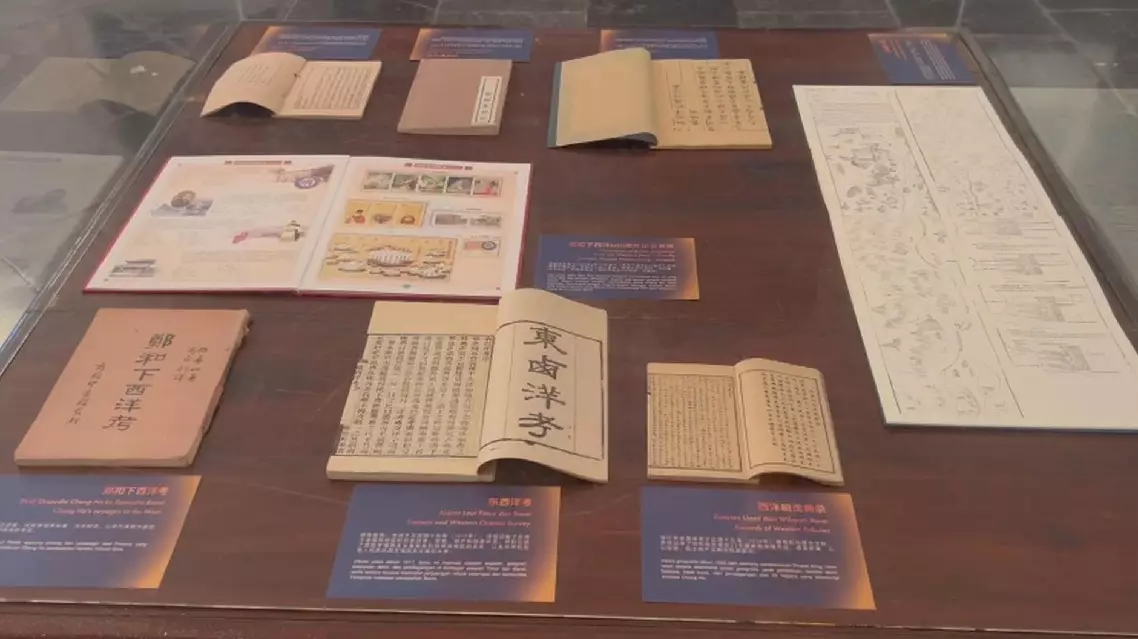
Exhibition held in Indonesia to commemorate Chinese explorer Zheng He's epic voyages
A French expert on international affairs urged Japan to squarely face up to and thoroughly reflect upon its invasion history as the world marks the 80th anniversary of the Tokyo Trial this year.
In an interview with the China Media Group (CMG) on Saturday, Sebastien Perimony from the International Schiller Institute said that Japan is pushing to revive militarism, which once again puts the world in danger.
"This year, we commemorate the 80th anniversary of the Tokyo Trial, which adjudicated the crimes committed by Japan during World War II. At the same time, we see Japan reviving militarist policies, which again place the world in danger," said Perimony.
"The world stands at a crossroads today. On one side are those who seek war and mutual destruction, choosing conflict over cooperation. On the other side, as President Xi Jinping has said, are the efforts to build a community with a shared future for mankind. I believe the 80th anniversary of the Tokyo Trial can serve as an opportunity for Japan to acknowledge the crimes it committed during World War II," Perimony said.
The French expert also criticized the repeated visits by Japanese right-wing politicians to the notorious Yasukuni Shrine, where convicted Class-A war criminals are enshrined, saying such behaviors constitute an insult and a provocation, and are very dangerous and worrying.
"We've seen that some members of Japan's ruling party and lawmakers have visited the Yasukuni Shrine, which has long been controversial because it honors World War II war criminals. I think such actions are shocking and provocative, amounting to a glorification of those who massacred the Chinese people. It is an insult and a provocation, and the repeated provocations are extremely dangerous and worrying," said Perimony.
From 1946 to 1948, the International Military Tribunal for the Far East, historically referred to as the Tokyo Trial, tried Japan's principal Class-A war criminals.
Nevertheless, Japan has failed to bring all Japanese war criminals to justice.

French expert urges Japan to thoroughly reflect on historical crimes