A prevailing Western narrative on the South China Sea dispute has unfairly portrayed China as an aggressor, while overlooking the Philippines' role in escalating tensions, which is part of a U.S.-led campaign to distort China's maritime activities, said experts.
The Philippines has frequently taken radical actions in the South China Sea that infringed on China's territorial sovereignty and maritime rights, exacerbating tensions.
However, in media narratives, China is depicted as an aggressor and the Philippines as a brave underdog.
During an interview with China Global Television Network (CGTN), Rommel Banlaoi, president of the Philippine Society for International Security Studies, disclosed what is behind the the strong anti-China messaging in the Philippines.
"If you look at the narrative in the Philippines, there is very strong anti-China messaging because of China's activities in the South China Sea. This anti-China messaging is in fact heavily influenced by the Western perspective for pushing back against China. And this Western perspective aims to highlight China's behavior in the South China Sea as aggressive and coercive," said Banlaoi.
China views its actions in the South China Sea as defensive measures to protect its territorial sovereignty, a perspective often left out by Western media.
Hong Nong, executive director of the Institute for China-America Studies, said the Philippines is not a passive actor in this conflict. Rather, it has actively sought to provoke China in ways that are likely to elicit a strong response.
Chen Xiangmiao, director of the World Navy Research Center at the National Institute for South China Sea Studies, argued that the prevailing narrative portrays China as a bully due to its power, ignoring its legitimate rights.
"There is a huge disparity in strength between China and Southeast Asian countries. Based on this logic, and viewing China through an ideological lens, they conclude that China's actions in the South China Sea are not for rights protection, but for bullying," said Chen.
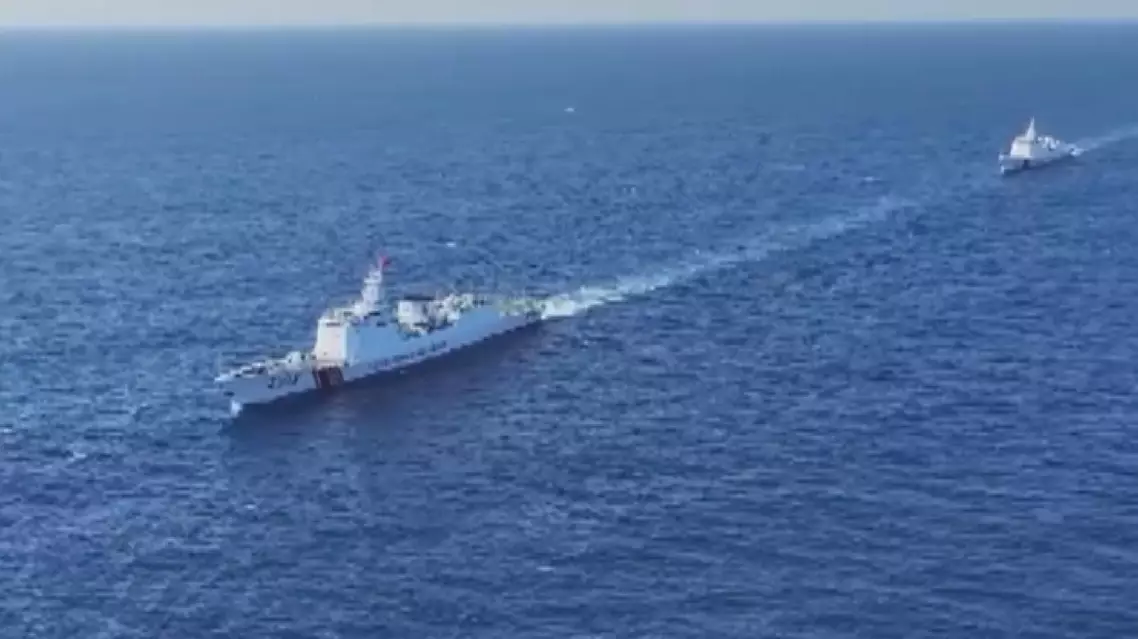
He criticized the labeling of Chinese coast guard vessels as "monsters" while overlooking the presence of U.S. aircraft carriers in the region.
"These labels are carefully fabricated by the United States. It's a smear campaign based on their deliberate distortion of China's maritime rights protection activities. Labeling is a simple and highly effective campaign. But no one pays attention to whether the story behind these labels is true or false," Chen said.
Banlaoi also noted China's approach of treating Southeast Asian nations as equals in development, which poses a sharp contrast with the U.S.-fabricated narrative.
"China, despite its bigness, wants to cooperate with smaller countries in the region as part of its good neighborliness policy. In my understanding of China's approach with the members of the littoral states in the South China Sea, China considers these countries not as small states but fellow developing nations with the same aspiration for common development, the same aspiration for the prosperity of their people," said Banlaoi.
US-led smear campaign distorts China’s legitimate actions in South China Sea: experts