Skip to Content Facebook Feature Image

Death of Australia's 'Outback Killer' leaves whereabouts of British backpacker's body unknown

News

Death of Australia's 'Outback Killer' leaves whereabouts of British backpacker's body unknown
News

News

Death of Australia's 'Outback Killer' leaves whereabouts of British backpacker's body unknown

2025-07-16 23:52 Last Updated At:07-17 00:01

MELBOURNE, Australia (AP) — Police fear Bradley John Murdoch, known as the “Outback Killer,” has taken to his grave the secret of how he disposed of the body of British backpacker Peter Falconio who was murdered in arid central Australia 24 years ago.

Murdoch died Tuesday night, aged 67, in the palliative care unit of the Alice Springs Hospital, officials said Wednesday. He was diagnosed with terminal throat cancer in 2019 and was recently transferred to the hospital from the Alice Springs prison.

His death leaves the mystery of the whereabouts of Falconio’s body unsolved.

The Northern Territory Police Force said investigators remain "committed to resolving this final piece of the investigation.”

“It is deeply regrettable that Murdoch has died without, as far as we are aware, ever disclosing the location of Peter Falconio’s remains," a police statement said. “His silence has denied the Falconio family the closure they have so long deserved."

The victim's 83-year-old father, Luciano Falconio, was visibly shocked and lost for words after learning of Murdoch's death a day after the anniversary of his son's disappearance, News Corp Australia reported.

“I tell you what I think, I wish he (Murdoch) left something for me to find him,” the father told the news company from his home in the U.K.

In 2005, Murdoch was convicted of the 2001 murder of 28-year-old Falconio, from Huddersfield in England’s Yorkshire region, and the attempted kidnapping of Falconio’s girlfriend Joanne Lees.

The crime captured global attention and was one of the inspirations for the 2005 Australian horror movie “Wolf Creek,” about a serial killer who preyed on backpackers and left a single witness who became a suspect.

Lees, who wrote about her ordeal in her 2006 memoir “No Turning Back,” complained that police treated her as a suspect in the years before Murdoch was charged.

A court order prevented the movie’s release in the Northern Territory during Murdoch’s trial, fearing it could influence jurors. Murdoch was not accused of any other killings.

Murdoch consistently maintained his innocence and did not help authorities search for Falconio’s remains.

At the time of the killing, Murdoch was an interstate drug runner, using amphetamines to stay awake for dayslong drives and cannabis to sleep.

On the night of July 14, 2001, he tricked Falconio and Lees into stopping their campervan on a dark and remote highway north of Alice Springs.

Lees watched her boyfriend leave the van to inspect a supposedly sparking exhaust pipe. She testified that she heard a gunshot and never saw her boyfriend again.

Murdoch, an imposing 193 centimeters (6 foot, 4 inches) in height, bound her wrists with cable ties before she managed to escape and hid in the desert scrub for hours. She testified she watched Murdoch searching for her with a flashlight and his dog.

Lees later waved down a truck and raised the alarm.

Last month, police doubled the reward for information leading to the location of Falconio’s remains to 500,000 Australian dollars ($330,000), following news that Murdoch was in palliative care.

“Police still hold out hope that someone may be able to provide some vital information to assist in this search,” Police Commander Mark Grieve said.

Colleen Gwynne, a former police officer who led the investigation at the time of Falconio's disappearance, said Murdoch might have panicked after Lees escaped and in his confusion forgot what he did with the body.

“Once that panic set in … he may have disposed of a body somewhere he’s not entirely certain where that is,” Gwynne said earlier this month.

Murdoch was sentenced to life in prison for Falconio’s murder and was ordered to serve at least 28 years before he could be considered for parole. He was also sentenced to six years for assaulting Lees.

The earliest he could have applied for parole would have been 2032, but without providing information as to what he had done with Falconio’s body, Murdoch was not likely to have been released. The territory passed laws in 2016 preventing prisoners convicted of murder from qualifying for parole unless they provide police with the location of their victims’ bodies.

Murdoch was born in the west coast town of Geraldton, the third child of an automobile mechanic and his wife, a hairdresser.

As a teen, he became involved in biker gang crime and was first sentenced to prison in 1995 for shooting at a group of Indigenous people at Fitzroy Crossing in Western Australia. He served 15 months of a 21-month sentence.

In sentencing Murdoch for Falconio’s killing, Chief Justice Brian Martin said he doubted any words could express the trauma and terror Lees had suffered.

“It must have been close to the worst nightmare imaginable,” the judge said.

FILE - Joanne Lees, former girlfriend of missing British backpacker Peter Falconio, arrives at Darwin Supreme Court, Oct. 17, 2005, ahead of the murder trial over his disappearance. (AP Photo/Rob Griffith, File)
FILE - Joanne Lees, former girlfriend of missing British backpacker Peter Falconio, arrives at Darwin Supreme Court, Oct. 17, 2005, ahead of the murder trial over his disappearance. (AP Photo/Rob Griffith, File)

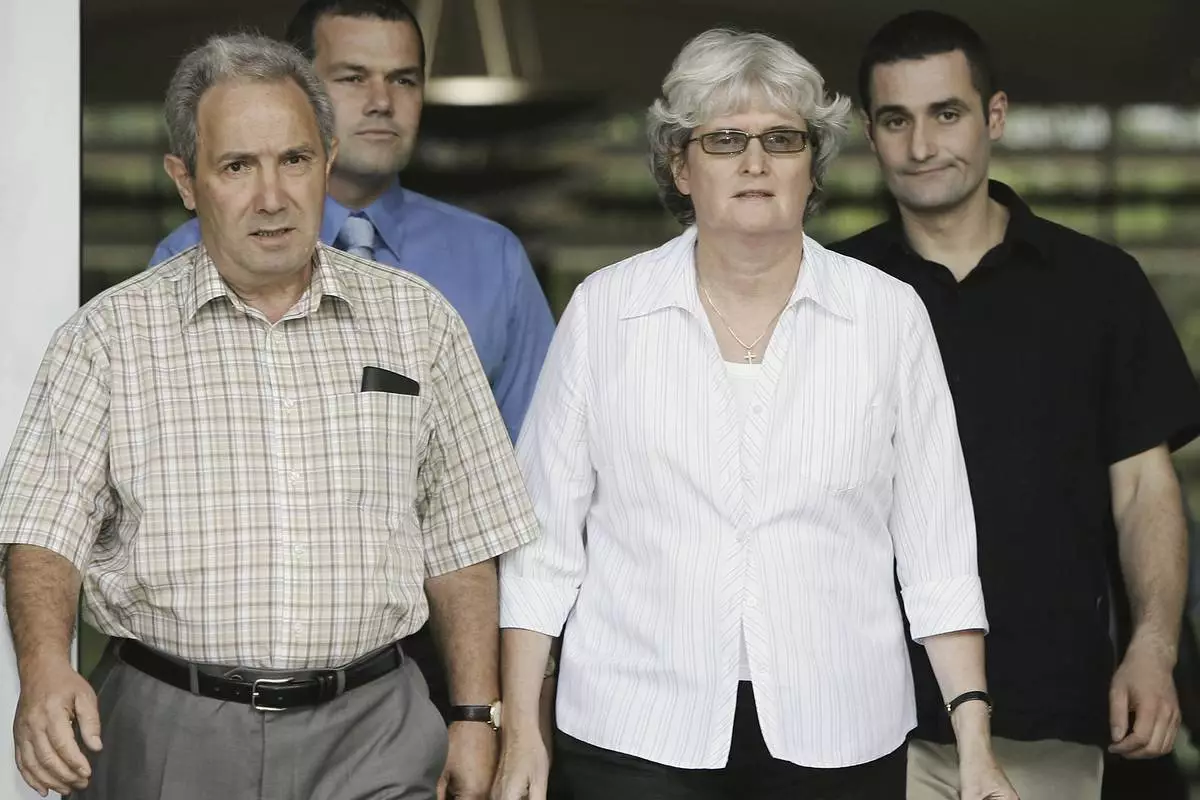
FILE - Falconio family, from left, Luciano, Nick, Joan and Paul Falconio, leave the Northern Territory Supreme Court in Darwin, Australia, Oct. 18, 2005. (AP Photo/Rob Griffith, File)

FILE - Falconio family, from left, Luciano, Nick, Joan and Paul Falconio, leave the Northern Territory Supreme Court in Darwin, Australia, Oct. 18, 2005. (AP Photo/Rob Griffith, File)

FILE - Bradley John Murdoch is led through the compound at the Adelaide Magistrates court, Adelaide, Australia, Nov. 13, 2003. (AP Photo/David Mariuz, File)


FILE - Bradley John Murdoch is led through the compound at the Adelaide Magistrates court, Adelaide, Australia, Nov. 13, 2003. (AP Photo/David Mariuz, File)

ALEPPO, Syria (AP) — First responders on Sunday entered a contested neighborhood in Syria’ s northern city of Aleppo after days of deadly clashes between government forces and Kurdish-led forces. Syrian state media said the military was deployed in large numbers.

The clashes broke out Tuesday in the predominantly Kurdish neighborhoods of Sheikh Maqsoud, Achrafieh and Bani Zaid after the government and the Syrian Democratic Forces, the main Kurdish-led force in the country, failed to make progress on how to merge the SDF into the national army. Security forces captured Achrafieh and Bani Zaid.

The fighting between the two sides was the most intense since the fall of then-President Bashar Assad to insurgents in December 2024. At least 23 people were killed in five days of clashes and more than 140,000 were displaced amid shelling and drone strikes.

The U.S.-backed SDF, which have played a key role in combating the Islamic State group in large swaths of eastern Syria, are the largest force yet to be absorbed into Syria's national army. Some of the factions that make up the army, however, were previously Turkish-backed insurgent groups that have a long history of clashing with Kurdish forces.

The Kurdish fighters have now evacuated from the Sheikh Maqsoud neighborhood to northeastern Syria, which is under the control of the SDF. However, they said in a statement they will continue to fight now that the wounded and civilians have been evacuated, in what they called a “partial ceasefire.”

The neighborhood appeared calm Sunday. The United Nations said it was trying to dispatch more convoys to the neighborhoods with food, fuel, blankets and other urgent supplies.

Government security forces brought journalists to tour the devastated area, showing them the damaged Khalid al-Fajer Hospital and a military position belonging to the SDF’s security forces that government forces had targeted.

The SDF statement accused the government of targeting the hospital “dozens of times” before patients were evacuated. Damascus accused the Kurdish-led group of using the hospital and other civilian facilities as military positions.

On one street, Syrian Red Crescent first responders spoke to a resident surrounded by charred cars and badly damaged residential buildings.

Some residents told The Associated Press that SDF forces did not allow their cars through checkpoints to leave.

“We lived a night of horror. I still cannot believe that I am right here standing on my own two feet,” said Ahmad Shaikho. “So far the situation has been calm. There hasn’t been any gunfire.”

Syrian Civil Defense first responders have been disarming improvised mines that they say were left by the Kurdish forces as booby traps.

Residents who fled are not being allowed back into the neighborhood until all the mines are cleared. Some were reminded of the displacement during Syria’s long civil war.

“I want to go back to my home, I beg you,” said Hoda Alnasiri.

Associated Press journalist Kareem Chehayeb in Beirut contributed to this report.

Sandbag barriers used as fighting positions by Kurdish fighters, left inside a destroyed mosque in the Sheikh Maqsoud neighborhood, where clashes between government forces and Kurdish fighters have been taking place in the northern city of Aleppo, Syria, Sunday, Jan. 11, 2026. (AP Photo/Ghaith Alsayed)

Sandbag barriers used as fighting positions by Kurdish fighters, left inside a destroyed mosque in the Sheikh Maqsoud neighborhood, where clashes between government forces and Kurdish fighters have been taking place in the northern city of Aleppo, Syria, Sunday, Jan. 11, 2026. (AP Photo/Ghaith Alsayed)

Burned vehicles at one of the Kurdish fighters positions at the Sheikh Maqsoud neighborhood, where clashes between government forces and Kurdish fighters have been taking place in the northern city of Aleppo, Syria, Sunday, Jan. 11, 2026. (AP Photo/Ghaith Alsayed)

Burned vehicles at one of the Kurdish fighters positions at the Sheikh Maqsoud neighborhood, where clashes between government forces and Kurdish fighters have been taking place in the northern city of Aleppo, Syria, Sunday, Jan. 11, 2026. (AP Photo/Ghaith Alsayed)

People flee the Sheikh Maqsoud neighborhood, where clashes between government forces and Kurdish fighters have been taking place in the northern city of Aleppo, Syria, Sunday, Jan. 11, 2026. (AP Photo/Ghaith Alsayed)

People flee the Sheikh Maqsoud neighborhood, where clashes between government forces and Kurdish fighters have been taking place in the northern city of Aleppo, Syria, Sunday, Jan. 11, 2026. (AP Photo/Ghaith Alsayed)

A Syrian military police convoy enters the Sheikh Maqsoud neighborhood, where clashes between government forces and Kurdish fighters have been taking place in the northern city of Aleppo, Syria, Sunday, Jan. 11, 2026. (AP Photo/Ghaith Alsayed)

A Syrian military police convoy enters the Sheikh Maqsoud neighborhood, where clashes between government forces and Kurdish fighters have been taking place in the northern city of Aleppo, Syria, Sunday, Jan. 11, 2026. (AP Photo/Ghaith Alsayed)

Burned vehicles and ammunitions left at one of the Kurdish fighters positions at the Sheikh Maqsoud neighborhood, where clashes between government forces and Kurdish fighters have been taking place in the northern city of Aleppo, Syria, Sunday, Jan. 11, 2026. (AP Photo/Ghaith Alsayed)

Burned vehicles and ammunitions left at one of the Kurdish fighters positions at the Sheikh Maqsoud neighborhood, where clashes between government forces and Kurdish fighters have been taking place in the northern city of Aleppo, Syria, Sunday, Jan. 11, 2026. (AP Photo/Ghaith Alsayed)

Recommended Articles