The GenAI Week Silicon Valley 2025 in California showcased groundbreaking Generative AI-powered products such as autonomous security robots and transformable smart homes, demonstrating how this cutting-edge technology is reshaping human life in unprecedented ways.
The event, spanning from Sunday to Thursday at the Santa Clare Convention Center, brought together the world's leading entrepreneurial teams, corporate decision-makers, and investment institutions to explore the future of AI jointly.
"I think the trend that we're seeing is that the cost and the accessibility of intelligence will be driven towards zero, and that any knowledge we want to know from the public internet will become instantly available," said Jason Wei, a researcher at the U.S. AI research organization OpenAI.
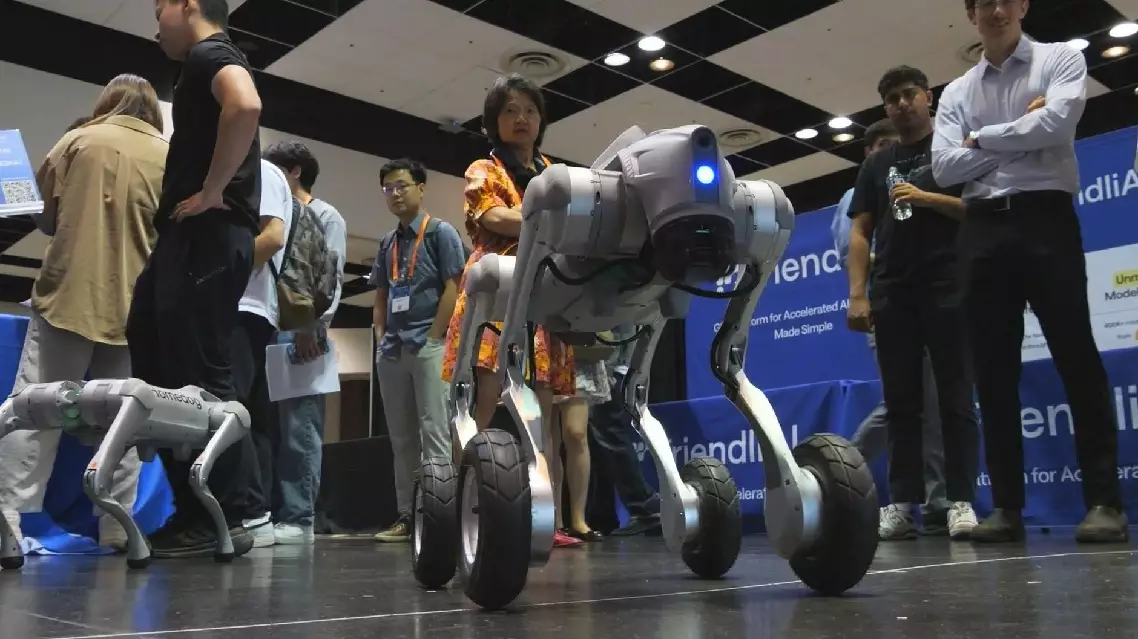
Toborlife AI, a U.S. company specializing in robot autonomous control systems, demonstrated how its robot dog -- co-produced with Chinese company Unitree Robotics -- can quickly climb stairs and spin without slipping.
Company representatives at the event stated that their AI technology, currently in development, could further enhance the security levels of daily life through the utilization of the robots.
"(We're) using AI to give these robots the power to do the jobs on their own, no humans involved. So, things like a security dog that automatically wakes up at night, a security dog that has object recognition, facial recognition. It connects to the internet, and it can control your whole building, and it can tell you if there's anything wrong, like if there are people or a broken window or anything like that," said Corey Du Val, product specialist at Toborlife AI.
The event also showed how AI is influencing the automotive industry with a glimpse of Alef Aeronautics' flying car, set to enter production by early 2026.
Next to the flying car sat a much larger vehicle -- an AI transformable home developed by AC Future, a leading company in AI-powered sustainable living solutions. This vehicle does not require a traditional driving cabin; instead, it creates a more spacious interior environment that doubles in size when fully expanded, redefining the concept of smart mobile living.
Eleanor Qin, AC Future's board member, explained that this transformable home can not only be driven around on wheels but can also expand and contract on three sides.
"Even if you are living in a house that's an ADU [accessory dwelling unit] or even if it's just like 400 square feet, you cannot move it. Because when you're on the road, you have to be narrow. But with this technology, we're able to contract them so they fit in what can goes on the road. That's how we are going to disrupt, not just the RV, but mostly the housing industry in general," she said.
According to Qin, the transformable home utilizes AI for climate control, including the capability to generate electricity from solar panels and produce water.
GenAI event in California showcases AI innovations to reshape human life