Thousands of tourists are flocking to Turpan in northwest China's Xinjiang Uygur Autonomous Region, a city known as "the land of fire," despite scorching temperatures.
Turpan, one of the driest and hottest places in China, has seen consecutive days of temperatures exceeding 40 degree Celsius, with surface temperatures reaching a peak of 63 degree Celsius.
However, the scorching heat failed to deter curious tourists from visiting the iconic Flaming Mountains in Turpan.
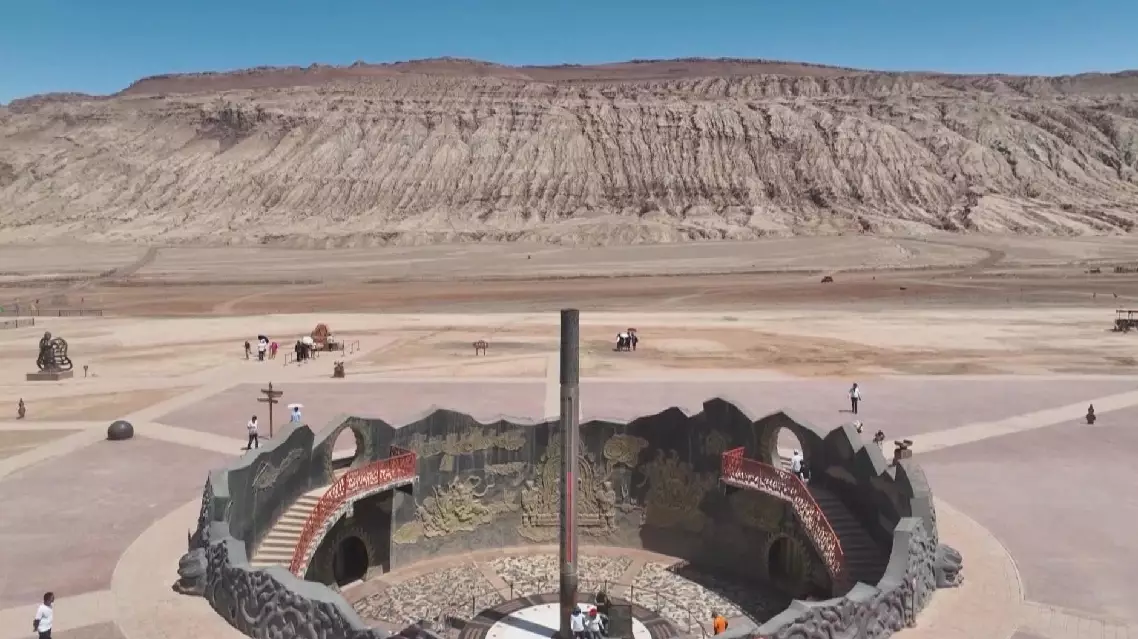
Visitors flocked to take photos with the Flaming Mountain scenic area's landmark "Jin Gu Bang" (Golden Cutgel" or "Monkey King Bar") -- the world's largest thermometer -- which displays real-time surface temperatures reaching over 60 degree Celsius during day time.
At the scenic area, visitors can enjoy a variety of unique activities, including camel riding, exploring underground palace exhibition halls to feel the Flaming Mountains' geological history from hundreds of millions of years ago, and tasting the distinctive sand-baked eggs with their charred, earthy aroma.
"I think this is truly amazing -- the ground temperature can actually get this high! The eggs baked in the sand here with scorching sunlight aren't dry or hard to eat. They're quite tender, and with the seasoning, it's just like eating barbecue," said Zhang Xianxi, a tourist from southwest China's Sichuan Province.
Due to extremely high average surface temperatures, multiple heatstroke prevention measures have recently been taken in the scenic area, including distributing cooling supplies, installing outdoor air coolers, and setting up shaded rest areas for visitors.
The Flaming Mountains are barren, eroded, red sandstone hills in the Tianshan Mountains of Xinjiang. They lie near the northern rim of the Taklamakan Desert and east of the city of Turpan.
To tourists, the Flaming Mountains are perhaps best known for their depiction in the Chinese classical novel Journey to the West. According to the novel, the mountains blaze with flames, keeping the region scorching hot year-round, and not a single blade of grass can grow anywhere nearby.
Thrill-seekers flock to Xinjiang's scorching fire land