China’s Macao welcomed a record 39.41 million tourist arrivals in 2025, according to data released on Saturday by the Macao Special Administrative Region (SAR) government’s Public Security Police Force.
Visitors from the Chinese mainland accounted for 72.4 percent of total arrivals.
Industry experts attributed the surge in visitor numbers to the continued expansion of mainland cities eligible for the Individual Visit Scheme to Hong Kong and Macao, as well as favorable policies, such as the “multiple-entry” and “one-trip-per-week” permits for travel to Macao.
Easier cross-border travel has further driven an increase in mainland tourists visiting the city.
The Macao SAR government has continued to integrate tourism with sports, culinary experiences, and exhibitions and conventions to attract more visitors.
Major events, such as the 15th National Games, jointly hosted by Guangdong Province, Hong Kong, and Macao in November, and the 72nd Macao Grand Prix, an annual international motorsport competition, have been key drivers for tourism growth. These events have enabled tourism stakeholders to diversify their offerings and provide richer, more varied experiences for travelers.

Macao welcomes record 39.41 million tourist arrivals in 2025: official data
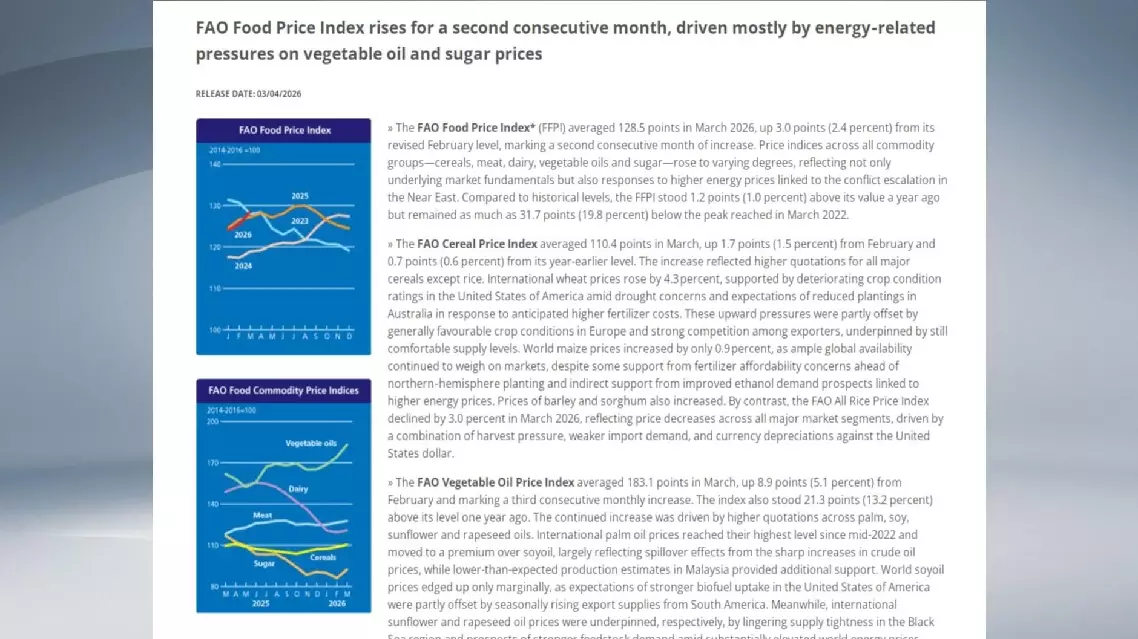
Global food commodity prices climbed for a second consecutive month in March, driven mainly by higher energy costs linked to escalating conflict in the Middle East, the Food and Agriculture Organization of the United Nations (FAO) said in report released on Friday.
The FAO Food Price Index, which tracks monthly changes in the international prices of a basket of globally traded food commodities, averaged 128.5 points in March, up 2.4 percent from February and 1.0 percent above its level a year ago.
According to the report, the FAO Vegetable Oil Index and Sugar Price Index showed the largest increases, up 5.1 percent and 7.2 percent, respectively.
The FAO Cereal Price Index increased by 1.5 percent from the previous month, driven primarily by higher world wheat prices, which rose 4.3 percent.
The FAO Meat Price Index rose by 1.0 percent from the previous month, and the FAO All-Rice Price Index declined by 3.0 percent in March, according to the report.
FAO stated that rising energy and fertilizer prices have been driving up agricultural input costs.
If the conflict stretches beyond 40 days, farmers will have to choose to farm the same with fewer inputs, plant less, or switch to less intensive fertilizer crops, according to FAO Chief Economist Maximo Torero.
These choices will hit future yields and shape food supply and commodity prices for the rest of this year and beyond, Torero said.
Global food prices rise for 2nd consecutive month in March amid Middle East conflict: FAO