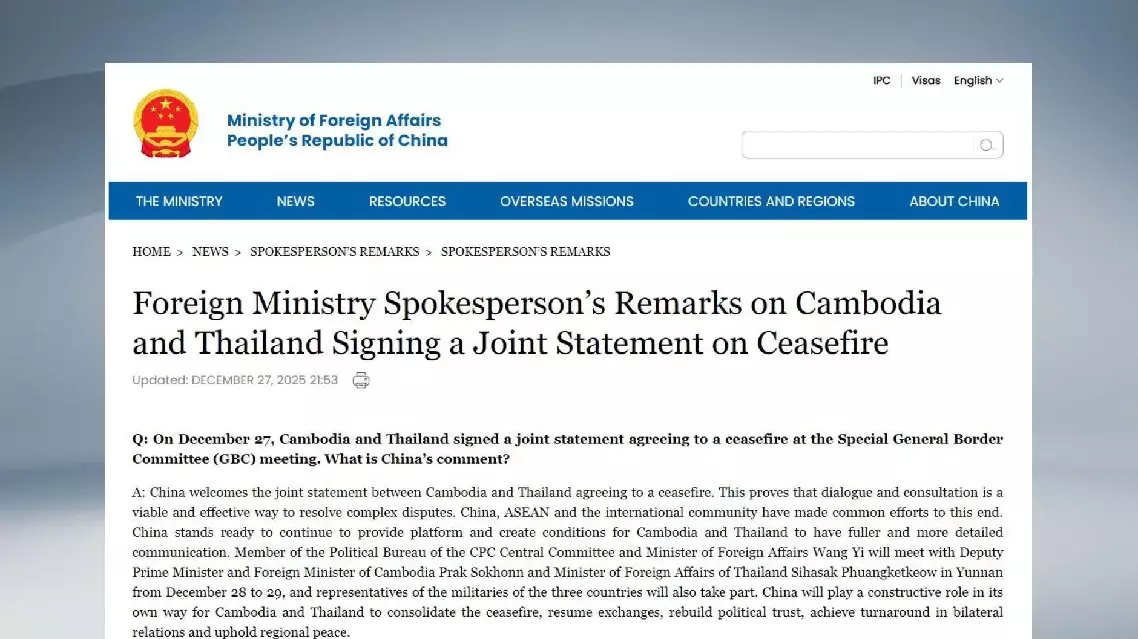
China welcomes a joint ceasefire statement signed by Cambodia and Thailand, a Chinese Foreign Ministry spokesperson said on Saturday in response to reporters’ questions.
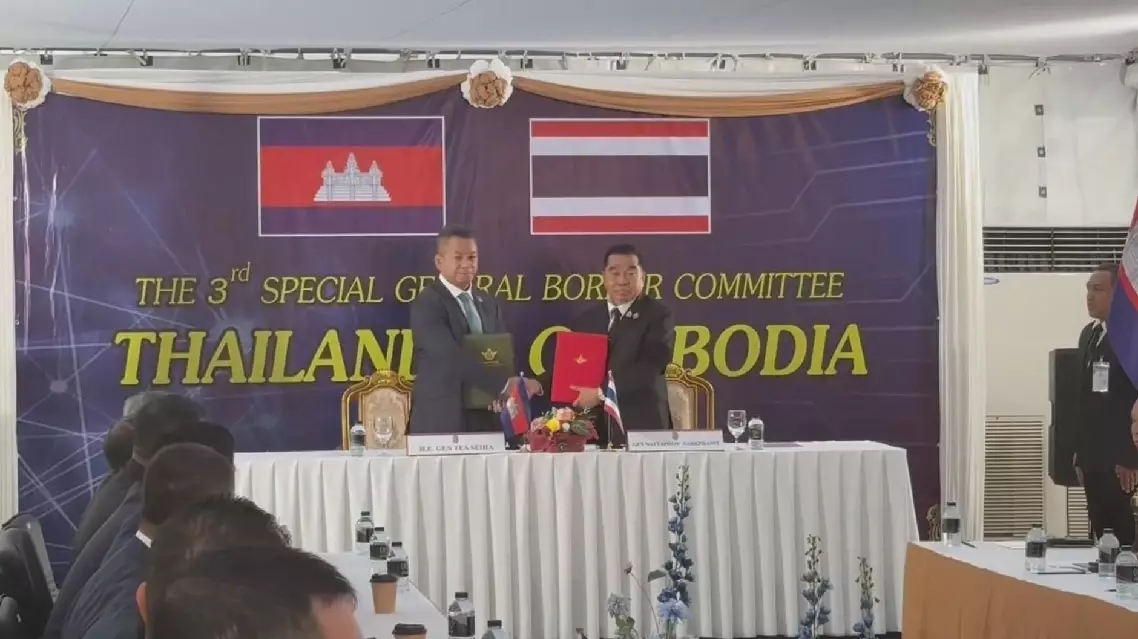
On Dec. 27, Cambodia and Thailand signed a joint statement agreeing to a ceasefire at a special meeting of the General Border Committee.
The move proves that dialogue and consultation are viable and effective ways of resolving complex disputes, the spokesperson noted.
The spokesperson added that China, ASEAN, and the international community have made joint efforts toward this outcome, and said China stands ready to continue providing platforms and creating conditions for Cambodia and Thailand to engage in more comprehensive and substantive communication.
Chinese Foreign Minister Wang Yi will meet with his Cambodian and Thai counterparts in Yunnan from Dec. 28 to 29, the spokesperson said.
At the invitation of Wang, who is also a member of the Political Bureau of the Communist Party of China Central Committee, Cambodian Deputy Prime Minister and Minister of Foreign Affairs and International Cooperation Prak Sokhonn and Thai Foreign Minister Sihasak Phuangketkeow will lead their respective delegations to the meeting. Representatives from the armed forces of the three countries will also attend.
The spokesperson stressed that China will continue to play a constructive role, in its own way, in helping Cambodia and Thailand consolidate the ceasefire, resume exchanges, rebuild political trust, improve bilateral relations, and safeguard regional peace.
China welcomes Cambodia–Thailand ceasefire; Wang Yi to meet Cambodian, Thai counterparts
Thailand will release detained Cambodian soldiers once peace is restored, a Thai official said on Saturday, after the two countries agreed to a ceasefire following days of heavy clashes.
The ceasefire was agreed following intense discussions at General Border Committee (GBC) meetings between Cambodia and Thailand in Thailand’s Chanthaburi province.
Under the agreement, the truce took effect at noon local time and will be monitored by both sides for 72 hours. The Thai government said it reached the agreement after considering the impact of the crisis on the country's economy and international standing.
"Once peace has been restored, civilians can return to their homes safely. Thailand will then release 18 detained Cambodian soldiers," said Thai Defense Minister Gen. Nattaphon Narkphanit at a press conference after the meeting.
Thailand, in turn, expressed hope that Cambodian authorities will allow Thai citizens remaining in Cambodia to return safely.
The coming hours will be a key test of mutual trust. The two countries have agreed to keep communication channels open and work together to combat disinformation, which has complicated negotiations. Thailand also expects Cambodia to assist in clearing landmines in disputed areas.
Thailand said it is watching closely to see whether the ceasefire will be fully implemented, while remaining prepared to defend itself if hostilities resume.
"The ceasefire must be sincerely conducted and maintained. We are going to wait. That is why we have the 72-hour monitoring period in place. If things are not settled within the 72 hours, we will fall back to our protocol of using our right to defend our country," said Thai Air Chief Marshal Prapas Sonjaidee.
Prior to the ceasefire, the situation along the border was tense. During the General Border Committee talks, airstrikes and clashes occurred almost daily, with frontline control shifting frequently, taking a heavy toll on civilians.
Thailand to release detained Cambodian soldiers once peace is restored: official