PARIS (AP) — Interpol said Tuesday it was removing a most-wanted designation for anti-whaling campaigner Paul Watson, who is sought by Japan over an encounter with a whaling ship and who was jailed for several months last year in Greenland.
Watson, 74, is a former head of the Sea Shepherd Conservation Society, whose high seas confrontations with whaling vessels have drawn support from celebrities and featured in the reality television series “Whale Wars.”
Japan wants his extradition over an encounter with a Japanese whaling research ship in 2010, when he was accused of obstructing the crew’s official duties by ordering the captain of his ship to throw explosives at the whaling ship. He and his team deny those allegations.
Starting in 2012, Watson had been subject to a “red notice” of Interpol, the Lyon, France-based international police body. A red notice is a request to law enforcement worldwide to locate and provisionally arrest a person pending legal action, based on a warrant from the judicial authorities in the requesting country, in this case Japan.
The Canadian-American activist — whose recent long white hair and beard give him a Santa Claus look — has long criss-crossed the world's oceans in an almost singular focus on defending whales, feeding his popularity among environmentalists, animal-rights activists and others. Critics have questioned his often-combative methods.
Watson was arrested and jailed on the Japanese warrant last year in Greenland, a semi-autonomous territory of Denmark, but released after five months.
“My first reaction is that the decision ends 14 years of politically motivated persecution and underscores the blatant illegality of Japanese whaling operations in the Southern Ocean Whale Sanctuary,” Watson said in a brief statement provided by Sea Shepherd France.
“A small justice victory for me, a major justice victory for the whale,” he added.
Denmark does not have an extradition treaty with Japan, where Watson's foundation said he could have faced a maximum sentence of 15 years in prison, and the Danish government declined to extradite him to Japan.
At the time of his release, the Danish Justice Ministry said it had not received adequate guarantees from Japanese authorities that the time Watson had already served in custody would be counted against any sentence he would receive in Japan.
In a statement, Interpol said the decision to remove Watson from the “red notice” list did not reflect any judgment on the merits of the case in Japan, but that it did take into account Denmark's refusal to extradite him.
“This is not a judgement on the merits of the case, or the events that occurred in 2010,” the Interpol statement said.
The police agency said the decision was made by an independent body, the Commission for the Control of Interpol's File, which is tasked to ensure that the police body's processing of personal data adheres to its internal rules.
The decision said Japan had “vigorously engaged” with the commission during the review, which "may be demonstrative of the existence of political elements around the case.” The decision noted that other countries, aside from Denmark, had refused to extradite Watson.
Watson, after his release in December, told the AP that he was planning to travel to Interpol to make his case in person.
The move means that data about Watson held by Interpol will be deleted from its extensive databases, which track some of the world's most-wanted criminals and violent extremists.
Willam Julie, a Paris-based lawyer for Watson, said the commission recognized the “disproportionate nature of the charges” and “the considerable passage of time” since the incident with the whaling research ship.
In a phone interview, Julie said he had informed Watson about the decision, and his response was: “He's relieved ... He had to be resilient like he always is. He's happy we won.”
Lamya Essemlali, president of Sea Shepherd France, hailed the “good news that this notice was finally cancelled," but she noted that Watson still could be arrested and sent to Japan for prosecution.
“It does not give Paul Watson his freedom of movements because the Japanese arrest warrant is sufficient for a country to order his arrest,″ she said.
Keaten reported from Geneva.

FILE - Environmental activist Paul Watson smiles as he arrives at Charles de Gaulle's airport in Roissy, north of Paris, Dec. 20, 2025 after being released from prison few days ago. (AP Photo/Thibault Camus, file)
DUBAI, United Arab Emirates (AP) — Saudi Arabia bombed Yemen's port city of Mukalla on Tuesday after a weapons shipment from the United Arab Emirates arrived for separatist forces in the war-torn country, and warned that it viewed Emirati actions as “extremely dangerous.”
The bombing followed tensions over the advance of Emirates-backed separatist forces known as the Southern Transitional Council. The council and its allies issued a statement supporting the UAE's presence, even as others allied with Saudi Arabia demanded that Emirati forces withdraw from Yemen in 24 hours' time.
The UAE called for “restraint and wisdom” and disputed Riyadh’s allegations. But shortly after that, it said it would withdraw its remaining troops in Yemen. It remained unclear whether the separatists it backs will give up the territory they recently took.
The confrontation threatened to open a new front in Yemen's decade-long war, with forces allied against the Iranian-backed Houthi rebels possibly turning their sights on each other in the Arab world's poorest nation.
It also further strained ties between Saudi Arabia and the UAE, neighbors on the Arabian Peninsula that increasingly have competed over economic issues and regional politics, particularly in the Red Sea area. Tuesday’s airstrikes and ultimatum appeared to be their most serious confrontation in decades.
“I expect a calibrated escalation from both sides. The UAE-backed Southern Transitional Council is likely to respond by consolidating control,” said Mohammed al-Basha, a Yemen expert and founder of the Basha Report, a risk advisory firm.
“At the same time, the flow of weapons from the UAE to the STC is set to be curtailed following the port attack, particularly as Saudi Arabia controls the airspace.”
A military statement carried by the state-run Saudi Press Agency announced the strikes on Mukalla, which it said came after ships arrived there from Fujairah in the UAE.
“The ships’ crew had disabled tracking devices aboard the vessels, and unloaded a large amount of weapons and combat vehicles in support of the Southern Transitional Council’s forces,” the statement said.
“Considering that the aforementioned weapons constitute an imminent threat, and an escalation that threatens peace and stability, the Coalition Air Force has conducted this morning a limited airstrike that targeted weapons and military vehicles offloaded from the two vessels in Mukalla,” it added.
It wasn't clear if there were any casualties.
The Emirati Foreign Ministry hours later denied it shipped weapons but acknowledged it sent the vehicles “for use by the UAE forces operating in Yemen.” It also claimed Saudi Arabia knew about the shipment ahead of time.
The ministry called for “the highest levels of coordination, restraint and wisdom, taking into account the existing security challenges and threats.”
The Emirati Defense Ministry later said it would withdraw its remaining troops from Yemen over “recent developments and their potential repercussions on the safety and effectiveness of counter-terrorism operations.” It gave no timeline for the withdrawal. The UAE broadly withdrew its forces from Yemen years earlier.
Yemen’s anti-Houthi forces not aligned with the separatists declared a state of emergency Tuesday and ended their cooperation with the UAE. They issued a 72-hour ban on border crossings in territory they hold, as well as entries to airports and seaports, except those allowed by Saudi Arabia. It remained unclear whether that coalition, governed under the umbrella of Yemen's Presidential Leadership Council, would remain intact.
The Southern Transitional Council’s AIC satellite news channel aired footage of the strike's aftermath but avoided showing damage to the armored vehicles.
“This unjustified escalation against ports and civilian infrastructure will only strengthen popular demands for decisive action and the declaration of a South Arabian state,” the channel said.
The attack likely targeted a ship identified as the Greenland, a vessel flagged out of St. Kitts. Tracking data analyzed by the AP showed the vessel had been in Fujairah on Dec. 22 and arrived in Mukalla on Sunday. The second vessel could not be immediately identified.
Jens Laerke, a spokesperson for the U.N. humanitarian office, urged combatants to protect civilians and civilian infrastructure, like the port, saying any disruption to its operations “risks affecting the already dire humanitarian situation and humanitarian supply chains.”
Mukalla is in Yemen's Hadramout governorate, which the council seized in recent days. The port city is some 480 kilometers (300 miles) northeast of Aden, which has been the seat of power for anti-Houthi forces after the rebels seized the capital, Sanaa, in 2014.
Yemen, on the southern edge of the Arabian Peninsula off East Africa, borders the Red Sea and the Gulf of Aden. The war there has killed more than 150,000 people, including fighters and civilians, and created one of the world's worst humanitarian disasters.
The Houthis, meanwhile, have launched attacks on hundreds of ships in the Red Sea corridor over the Israel-Hamas war in the Gaza Strip, disrupting regional shipping. The U.S., which earlier praised Saudi-Emirati efforts to end the crisis over the separatists, has launched airstrikes against the rebels under both Presidents Joe Biden and Donald Trump.
Tuesday's strike in Mukalla comes after Saudi Arabia targeted the council in airstrikes Friday that analysts described as a warning for the separatists to halt their advance and leave the governorates of Hadramout and Mahra.
The council had pushed out forces there affiliated with the Saudi-backed National Shield Forces, another group in the anti-Houthi coalition.
Those aligned with the council have increasingly flown the flag of South Yemen, which was a separate country from 1967-1990. Demonstrators have been rallying to support political forces calling for South Yemen to secede again.
A statement Tuesday from Saudi Arabia's Foreign Ministry directly linked the council's advance to the Emiratis for the first time.
“The kingdom notes that the steps taken by the sisterly United Arab Emirates are extremely dangerous,” it said.
Allies of the council later issued a statement in which they showed no sign of backing down.
Associated Press writer Jamey Keaten in Geneva contributed to this report.
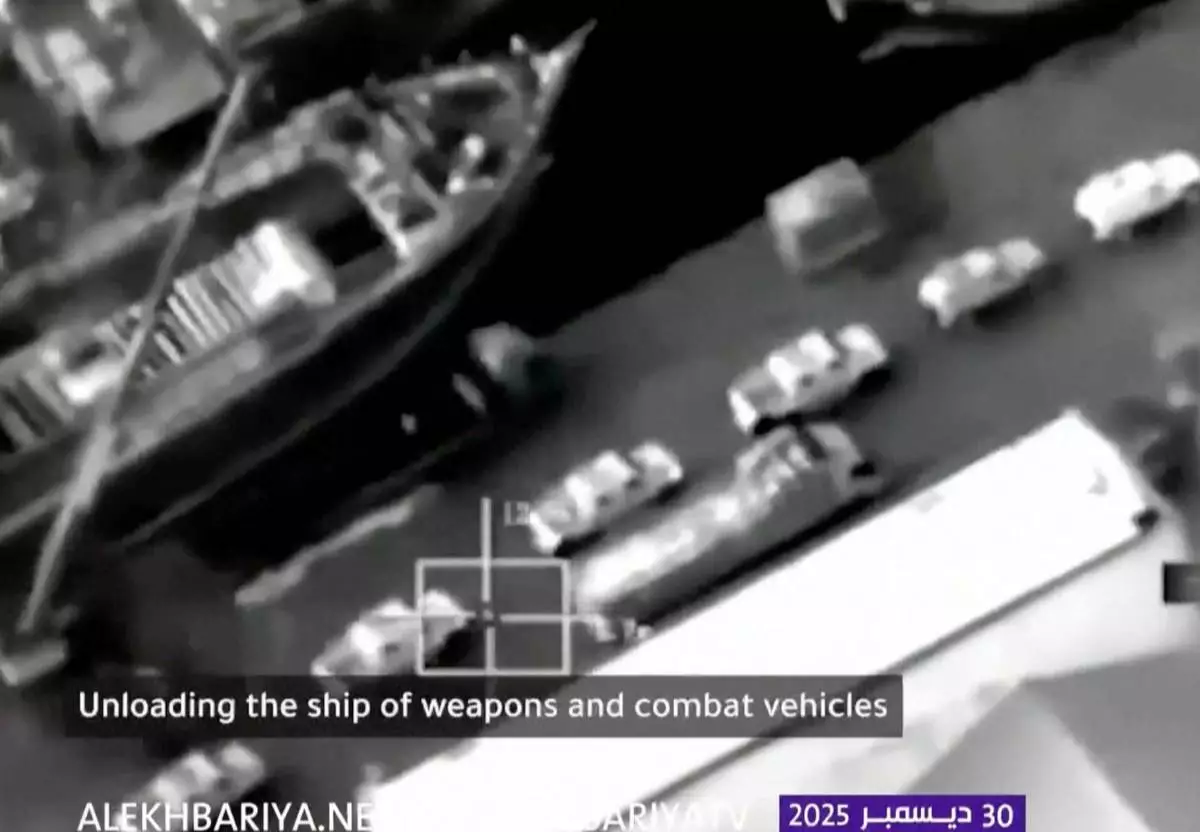
This frame grab from video broadcast by Saudi state television on Tuesday, Dec. 30, 2025, shows what the kingdom describes as a shipment of weapons and armored vehicles coming from the United Arab Emirates, at Mukalla, Yemen. (Saudi state television via AP)