Devastated by World War II bombings, the French city of Caen in Normandy preserves its turbulent history through museums and D-Day sites, with survivors recounting stories of destruction and liberation.
Once occupied by German forces and heavily bombed by Allied troops, the city’s path to freedom came at a profound cost, leaving behind painful memories of war. Today, Caen stands as a beacon of remembrance, housing Normandy's largest war museum, the Mémorial de Caen, and serving as a gateway for visitors exploring the iconic D-Day landing sites.
"The world is changing very fast and I think we don't realize enough what freedom means and what others have done for us to have actually freedom," said Martella Blaak, a Dutch tourist.
"It's very sad actually, I felt quite tearful this morning actually when we went into one of the cemeteries and saw the graves of all the really young soldiers," said Katrina Hoare, a British tourist.
But for the French, there are mixed emotions over the price civilians paid following the D-Day landings.
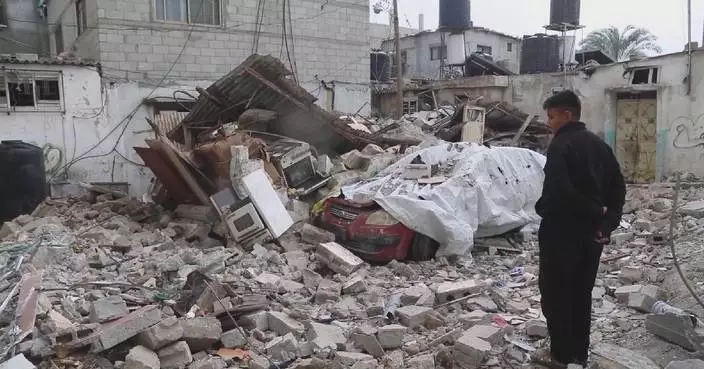
Caen had to be completely rebuilt after the war. Three quarters of the city was destroyed following weeks of Allied bombing raids, aimed at the German occupying forces.
Marie Nicole Deschamps was nine years old at the time and lost several relatives in the bombing raids on the city. She spent more than a month sheltering in caves beneath nearby limestone quarries.
"We saw that Caen was burning, we could see the fires because of the bombing. And that's why we went to the quarries. We slept on the straw, we had no water, so we drank the water that fell from the roof. We had no toys, we had nothing. We left home like that. I lived with my clothes on for a month without [ever changing]," she said.
At dawn on June 6, 1944, around 150,000 American, British and Canadian troops stormed the beaches of Normandy. One of the key objectives for the military command following the D-Day landings was to capture German occupied Caen.
"The city of Caen was a strategic city for the Allies because of its position. Once it was taken, the Allied and British troops would be able to spread southwards. It was the gateway to the liberation of French territory and then Germany," said Christophe Prime, a historian at Memorial de Caen Museum.
Sword beach was one of the British landing sites back in 1944, today it's a regular stopping off point on D-day tours. The original orders were for the British and Canadian troops to push on and take Caen the same day. But it didn't go to plan.
What followed was weeks of intense fighting against stiff German resistance. But the Allies had air superiority, carpet bombing Caen and the surrounding towns and villages, at times hitting civilians and their own troops as well as the German positions.
By the time the Allied troops entered Caen, the city was reduced to rubble. More than 2,000 residents had been killed in allied efforts to liberate them, with thousands more left destitute.
Historian Emmanuel Thiebot is founder of a museum in nearby Falaise, dedicated to the civilian casualties of war.
"When the fighters arrived, there was obviously some bitterness," Thiebot said, adding that despite everything, they were the ones who set us free.
For Marie Nicole Descamps, there were also some happier memories.
"They waved at us and would throw us chocolates and cigarettes. They were nice. They were happy," she said.
The row upon row of immaculately maintained graves at the Saint Manvieu War Graves cemetery near Caen are a stark reminder of the human cost of war.
"Indeed, we are here on the remains of the bodies that have been found. Even today we realize that unfortunately, as in the past, the civilian populations are increasingly put at the forefront of all these battles," said Thiebot.
It took almost 20 years to rebuild the city after the war. Today the bustling city of Caen is designated a UNESCO creative city.
A statue of a Phoenix in the city, the bird which rose from the ashes, has become a symbol of the city's renewal.

French city of Caen's struggle, rise from WWII devastation show resilience