The Polish capital Warsaw, a city once left scarred by the horrors of the Second World War, has undergone a resurgence in the eight decades since, carrying forward the memory of the brave resistance which stood up in those troubling times while rebuilding for a brighter future.
Before the onset of WWII, Warsaw was one of Europe's most dynamic cities, home to over a million people and a cultural crossroads with thriving Jewish and Polish communities.
However, the devastation brought by the war meant that some 85 percent of Warsaw was left destroyed by the time the conflict finally ended in 1945.
Historian Krzysztof Mordynski reflected on the damaging toll this took, but said that there was a resilience among residents who were determined to restore their city to its former glory.
"Warsaw was like a pile of ruins. Nearly nothing [was left] here. But people returned to the city. People returned themselves, nobody told them to. They wanted to keep their identity, the tradition of Warsaw. So, for the people, for the pre-war inhabitants, [it was important] to feel still like they were living in their Warsaw," he said.
Amid their campaign of hate, the Nazis established the Warsaw Ghetto in 1940. At its peak, 460,000 Jews were confined within the 3.4-square-kilometer ghetto which was surrounded by three-meter high walls crowned with barbed wire. The Nazis' calculated plan to annihilate Jewish history altered the look of the area forever.
"Everything we see here is completely new. Nothing survived where we are, nothing has survived from the pre-war Jewish Warsaw. Everything was destroyed, there wasn't even a sea of ruins. It was more a sea of rubble," said Patrycja Jastrzebska, an art historian.
But amid this war-time despair came a story of great bravery and defiance. Across modern Warsaw, monuments mark the 1943 Ghetto Uprising, commemorating those who gave their lives resisting Nazi terror. Just over a year later, Warsaw rose up again, and this time across the whole city.
While many structures were consigned to rubble, a former bank building which was caught in the crossfire of the ferocious frontline clashes between Polish resistance fighters and the advancing German forces remarkably still stands today.
It is emblazoned with the distinctive emblem of the kotwica, a combination of the letters P and W, which together form an anchor shape and represents the resistance of the Polish Underground State during WWII.
The letters are a short form of the Polish phrase 'Pomscimy Wawer,' which means 'We'll avenge the Wawer massacre', an atrocity which saw over 100 Poles being brutally executed by the Nazis in the Wawer neighborhood in 1939.
"Everyone who lived in Warsaw lost somebody during the war, and especially during the Warsaw uprising, because 200,000 people died," said Mordynski.
The painful memories still linger vividly in the mind of war veteran Janusz Maksymowicz, who was just a teenager when he volunteered to fight.
"If a German was walking towards you on the sidewalk, a Pole had to step off into the street so that the so-called 'master of the world' could walk freely," he recalled.
After a brave 63-day fight, the uprising was crushed in October 1944, and Warsaw's destruction was ordered by the vengeful Nazis who sought to raze the city to the ground.
Following the end of the war, the rebuilding of Warsaw became a passion project of renowned Polish architect Jan Zachwatowicz (1900-1983). He and his team used classic paintings on which they based the mammoth reconstruction task.
Amid this huge work, Zachwatiwicz also incorporated several new touches of his own, and gave poignant nods to the people of Warsaw who had suffered so much, including one pigeon-themed stone sculpture which was perched atop a traditional archway. "This is a certain creation of the old town. Here we have pigeons. Where did they come from? Right after the war, a woman was living in the ruins here. There was nothing, no buildings at all. She came every day to feed the birds with pieces of bread. And Zachwatowicz decided to commemorate her in such a beautiful way by dedicating this archway to her," said Jastrzebska.
Warsaw was rebuilt for its people and by its people and out of the embers rose again to take its place as Poland's capital, retaining its storied history while evolving over time.
"From this spot we see what Warsaw is, a patchwork of different times. We have pre-war Warsaw, post-war Warsaw and a modern city -- a city that is still being built, that is constantly changing," said Jastrzebska.
The devastating impact of the war on Warsaw cannot be overstated, but for those like Maksymowicz who boldly stood up to defend their city at its darkest moment, the uprising was a necessary move.
"I'm often asked, was it worth it? Absolutely, yes. Why? Because there was no political or moral force that would stop the youth so that we would not take up arms and try to take revenge on the occupiers," he said.
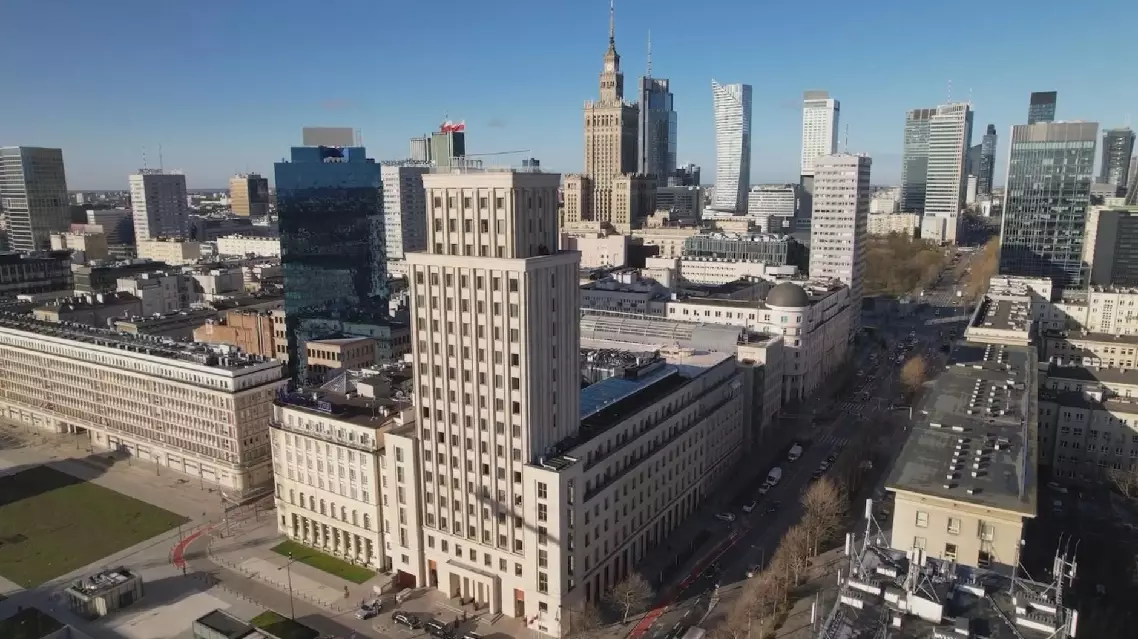
Warsaw rises from WWII destruction while retaining memory of brave resistance