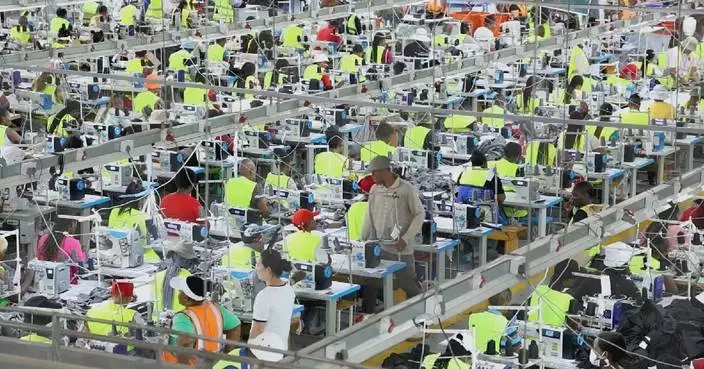
China-EU trade and industrial chain integration surged forward in early 2025, achieving 1.3 trillion yuan in quarterly trade while fostering deeper cooperation amid global trade frictions and groundbreaking investments in technology and manufacturing.
In the first quarter of 2025, China-EU trade reached 1.3 trillion yuan (about 180.5 billion U.S. dollars), up 1.4 percent year on year, equivalent to over 10,000,000 yuan in trade per minute, according to China's General Administration of Customs.
Against the backdrop of intensified China-U.S. and EU-U.S. trade frictions, the industrial chains of China and Europe are accelerating their integration.
Chinese battery giant CATL invested 7.6 billion U.S. dollars to build a battery plant in Hungary. The plant produces battery cells and modules for European car makers including Mercedes-Benz, BMW, Stellantis, and Volkswagen.
In addition, CATL also transports power lithium-ion batteries through the China-Europe Railway Express, which cuts the delivery time to around 20 days. The transported batteries are assembled in Europe.
What CATL has done is not only minimize logistics costs, but also form a stable supply chain of Chinese technology plus European manufacturing.
European companies investments in China are also driving the development of China's industrial chain. Data from China's Ministry of Commerce shows that by the end of 2024, EU companies had invested more than 150 billion U.S. dollars in China.
Established in 2008, the Airbus A320 Family Final Assembly Line Asia in China's Tianjin was the company's first production facility outside Europe. At least one third of Airbus A320 aircraft in China are delivered from Tianjin.
Data from the World Smart Industry Expo shows that the leading Airbus project has driven rapid development in the aviation industry of Tianjin. It has successively introduced over 50 aviation manufacturing and maintenance projects, as well as over 50 aviation logistics projects, among which there are more than 20 well-known leading enterprises.
An initial agglomeration effect of the aviation industry has been formed.
A report jointly released by the China Chamber of Commerce to the EU and global management consulting firm Ronan Berger shows that more than half of the surveyed enterprises believe China-EU cooperation will help the EU accelerate its digital transformation, explore cutting edge applications, such as artificial intelligence and form a closer complementary relationship in the industrial chain.
China-EU industrial chain cooperation holds an important position in the global economy, demonstrating strong complementarity and further promoting the continuous deepening of bilateral cooperation.
China-EU trade hits 1.3 trillion yuan in Q1, driving industrial chain integration amid global frictions