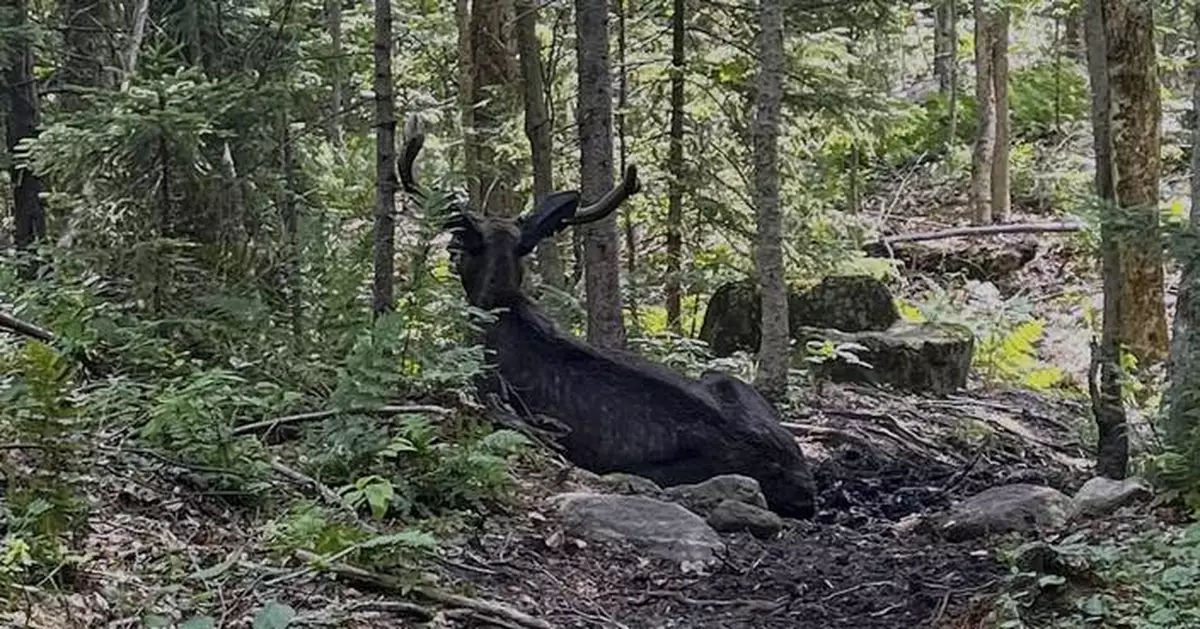
A big bull moose has spent the summer lingering around a popular Adirondack mountain hiking trail, prompting New York state wildlife officials to close the path as they monitor the potentially ailing animal.
The Goodman Mountain trail in the Horseshoe Lake Wild Forest has been temporarily closed since June 6 due to the oddly behaving animal. The moose is staying on or around the trail near the summit, sometimes sitting and sometimes foraging in a small area, according to the Department of Environmental Conservation.
Attempts to coax the moose from the trial have failed.
“This is very unusual behavior,” agency research scientist Dave Kramer said Thursday. “Typically at this time of year, moose will have moved down into the lower elevations where they’re primarily browsing on aquatic vegetation.”
Kramer estimates the moose stands about 6 feet (1.8 meters) tall at the shoulder and weighs 900 pounds (408 kilograms) or more. The spread of its antlers indicate it might be around four years old.
And it's a mystery why the moose won't move on.
The agency has said an “underlying illness influencing behavior" was suspected. Moose are susceptible to a couple of different parasites that can lead to their deaths.
Wildlife staffers were recently able to get close enough to observe the moose's behavior but did not find obvious signs of disease.
“Although the moose does appear a little thinner than we would expect this time of year,” Kramer said, adding that it is difficult to make conclusive diagnoses of animals in the wild.
The moose has not shown signs of aggression. But the trail in the town of Tupper Lake remains closed in part over concerns that the large animal could pose a danger to people if approached too closely.
The state is keeping tabs on the moose with three trail cameras, and wildlife staffers make regular treks up the mountain.
“His body condition hasn’t deteriorated to a point where we're concerned that he’s struggling," Kramer said. "So right now we’re just kind of monitoring periodically and assessing each time.”
New York state is on the southern edge of moose range. The state’s population was wiped out in the 1800s but has gradually grown from animals that wandered in from other northern states and Canada starting around 1980. There might be roughly 700 moose in the Adirondack region.
Conservation officers in January saved a bull moose that fell through the ice of Lake Abanakee elsewhere in the Adirondacks.
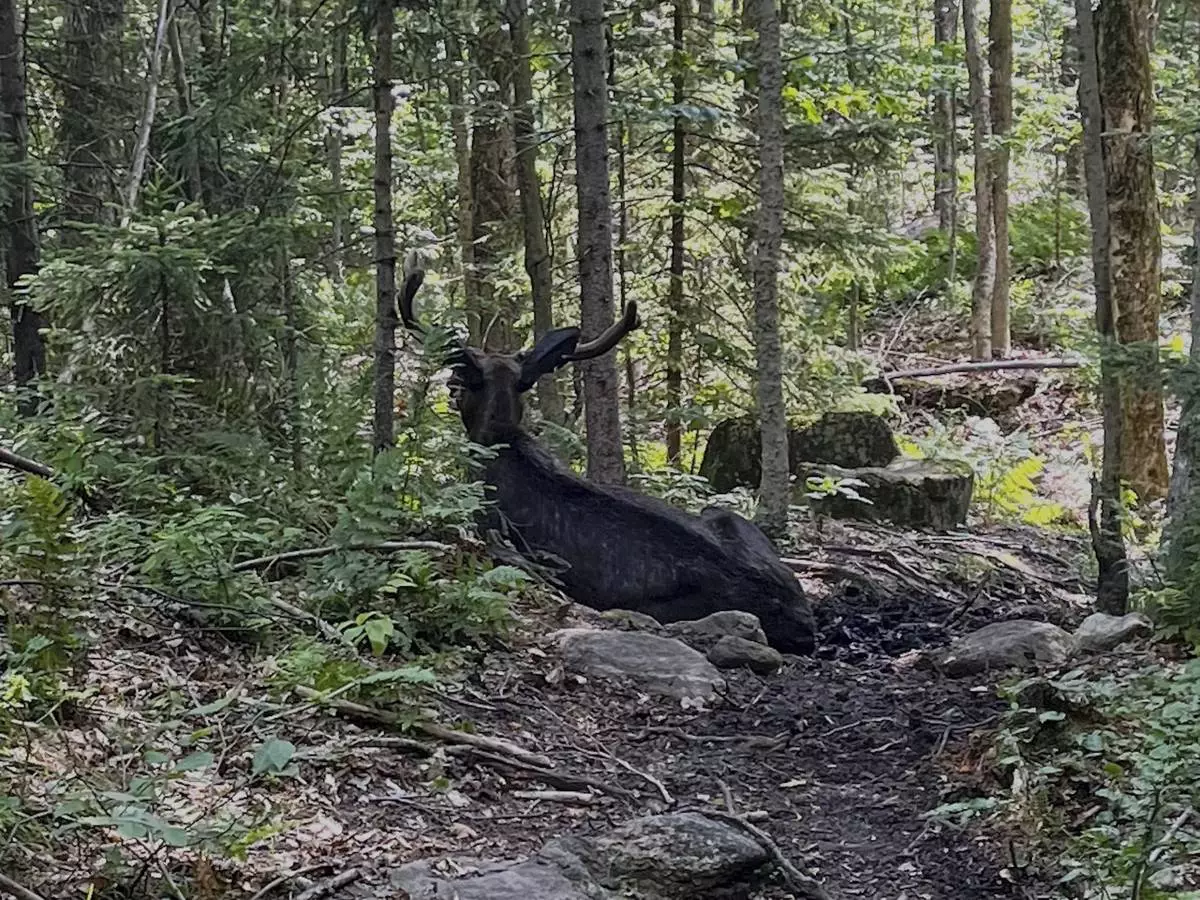
This undated image, provided by the New York State Department of Environmental Conservation, shows a bull moose, near Tupper Lake, NY, that has been lingering around an Adirondack mountain trail, through this summer, forcing New York wildlife officials to keep hikers away as they keep watch and wonder why the majestic animal is not moving on. (New York State Department of Environmental Conservation via AP)
WASHINGTON (AP) — U.S. forces in the Caribbean Sea have seized another sanctioned oil tanker that the Trump administration says has ties to Venezuela, part of a broader U.S. effort to take control of the South American country’s oil.
Homeland Security Secretary Kristi Noem wrote on social media that the U.S. Coast Guard had boarded the Motor Tanker Veronica early Thursday. She said the ship had previously passed through Venezuelan waters and was operating in defiance of President Donald Trump’s "established quarantine of sanctioned vessels in the Caribbean.”
U.S. Southern Command said Marines and sailors launched from the aircraft carrier USS Gerald R. Ford to take part in the operation alongside a Coast Guard tactical team, which Noem said conducted the boarding as in previous raids. The military said the ship was seized “without incident.”
Noem posted a brief video that appeared to show part of the ship’s capture. The black-and-white footage showed helicopters hovering over the deck of a merchant vessel while armed troops dropped down on the deck by rope.
The Veronica is the sixth sanctioned tanker seized by U.S. forces as part of the effort by Trump’s administration to control the production, refining and global distribution of Venezuela’s oil products and the fourth since the U.S. ouster of Venezuela President Nicolás Maduro in a surprise nighttime raid almost two weeks ago.
The Veronica last transmitted its location on Jan. 3 as being at anchor off the coast of Aruba, just north of Venezuela’s main oil terminal. According to the data it transmitted at the time, it was partially filled with crude.
Days later, the Veronica became one of at least 16 tankers that left the Venezuelan coast in contravention of the quarantine U.S. forces have set up to block sanctioned ships from conducting trade, according to Samir Madani, the co-founder of TankerTrackers.com.
Madani said his organization used satellite imagery and surface-level photos to document the ship movements.
The ship is currently listed as flying the flag of Guyana and is considered part of the shadow fleet that moves cargoes of oil in violation of U.S. sanctions.
According to its registration data, the ship also has been known as the Gallileo, owned and managed by a company in Russia. In addition, a tanker with the same registration number previously sailed under the name Pegas and was sanctioned by the U.S. Treasury Department for being associated with a Russian company moving cargoes of illicit oil.
As with prior posts about such raids, Noem and the military framed the seizure as part of an effort to enforce the law. Noem argued that the multiple captures show that “there is no outrunning or escaping American justice.”
However, other officials in Trump's Republican administration have made clear that they see the actions as a way to generate cash as they seek to rebuild Venezuela’s battered oil industry and restore its economy.
Trump met with executives from oil companies last week to discuss his goal of investing $100 billion in Venezuela to repair and upgrade its oil production and distribution. His administration has said it expects to sell at least 30 million to 50 million barrels of sanctioned Venezuelan oil.
This story has been corrected to show the Veronica is the fourth, not the third, tanker seized by U.S. forces since Maduro's capture and the ship also has been known as the Gallileo, not the Galileo.

Homeland Security Secretary Kristi Noem speaks with reporters at the White House, Thursday, Jan. 15, 2026, in Washington. (AP Photo/Alex Brandon)

Homeland Security Secretary Kristi Noem speaks with reporters at the White House, Thursday, Jan. 15, 2026, in Washington. (AP Photo/Evan Vucci)

Homeland Security Secretary Kristi Noem speaks with reporters at the White House, Thursday, Jan. 15, 2026, in Washington. (AP Photo/Evan Vucci)

Homeland Security Secretary Kristi Noem speaks with reporters at the White House, Thursday, Jan. 15, 2026, in Washington. (AP Photo/Evan Vucci)

Homeland Security Secretary Kristi Noem speaks with reporters at the White House, Thursday, Jan. 15, 2026, in Washington. (AP Photo/Evan Vucci)

U.S. Homeland Security Secretary Kristi Noem speaks during a press conference, Thursday, Jan. 8, 2026, in New York. (AP Photo/Yuki Iwamura)

U.S. Homeland Security Secretary Kristi Noem speaks at a news conference at Harry Reid International Airport, Nov. 22, 2025, in Las Vegas. (AP Photo/Ronda Churchill, File)