Skip to Content Facebook Feature Image

Tale of 3 A's cities: Oakland left behind, Sacramento a temporary stop, Las Vegas awaits

News

Tale of 3 A's cities: Oakland left behind, Sacramento a temporary stop, Las Vegas awaits
News

News

Tale of 3 A's cities: Oakland left behind, Sacramento a temporary stop, Las Vegas awaits

2025-07-28 18:00 Last Updated At:18:20

WEST SACRAMENTO, Calif. (AP) — Those chants of “sell the team” that rang from every corner of the Coliseum during the Athletics' final seasons in Oakland are noticeably less obvious these days as the club plays the first of three scheduled years at a Triple-A ballpark in California's capital region.

Not that all the negative feelings have been cast aside. There is still plenty of ill will toward the team that moved some 90 miles north.

More Images
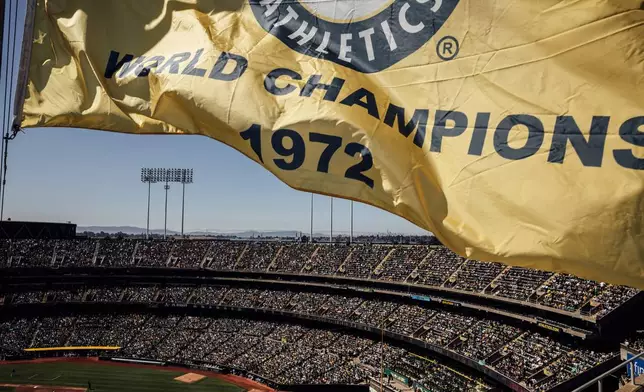
FILE - A 1972 world champions banner flies over the Oakland Coliseum during the Oakland Athletics' last home baseball game at the ballpark against the Texas Rangers in Oakland, Calif., Thursday, Sept. 26, 2024. (Stephen Lam/San Francisco Chronicle via AP, File)
FILE - A 1972 world champions banner flies over the Oakland Coliseum during the Oakland Athletics' last home baseball game at the ballpark against the Texas Rangers in Oakland, Calif., Thursday, Sept. 26, 2024. (Stephen Lam/San Francisco Chronicle via AP, File)

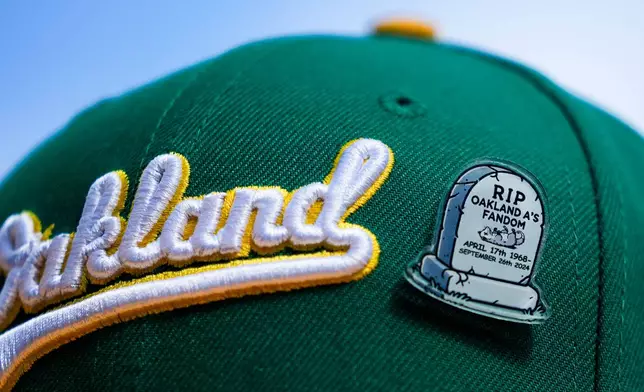
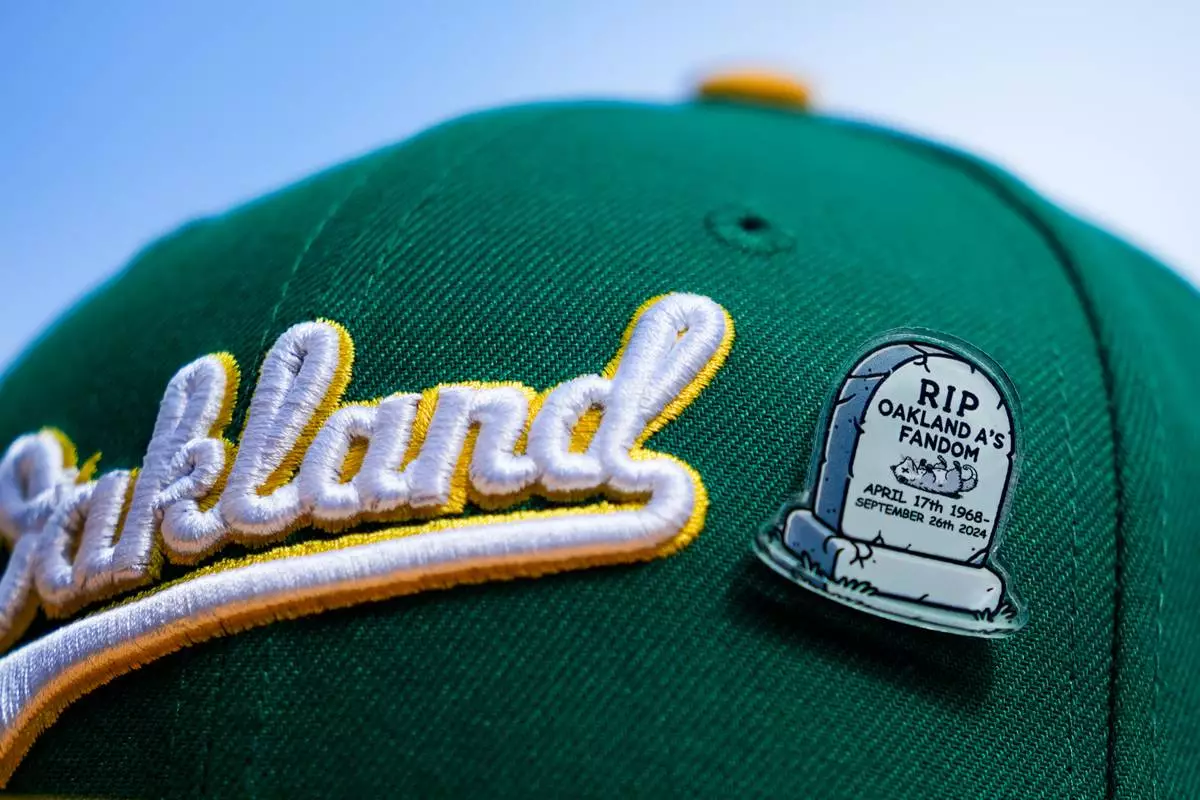
FILE - A fan wears an Oakland Athletics hat with a pin referencing the end of the team's time in Oakland before a baseball game against the Seattle Mariners, Sunday, Sept. 29, 2024, in Seattle. (AP Photo/Lindsey Wasson, File)
FILE - A fan wears an Oakland Athletics hat with a pin referencing the end of the team's time in Oakland before a baseball game against the Seattle Mariners, Sunday, Sept. 29, 2024, in Seattle. (AP Photo/Lindsey Wasson, File)

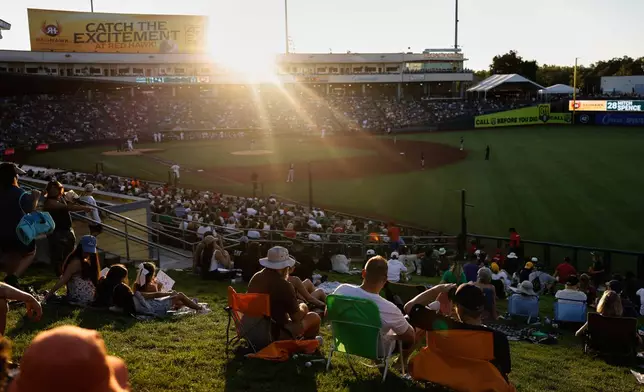
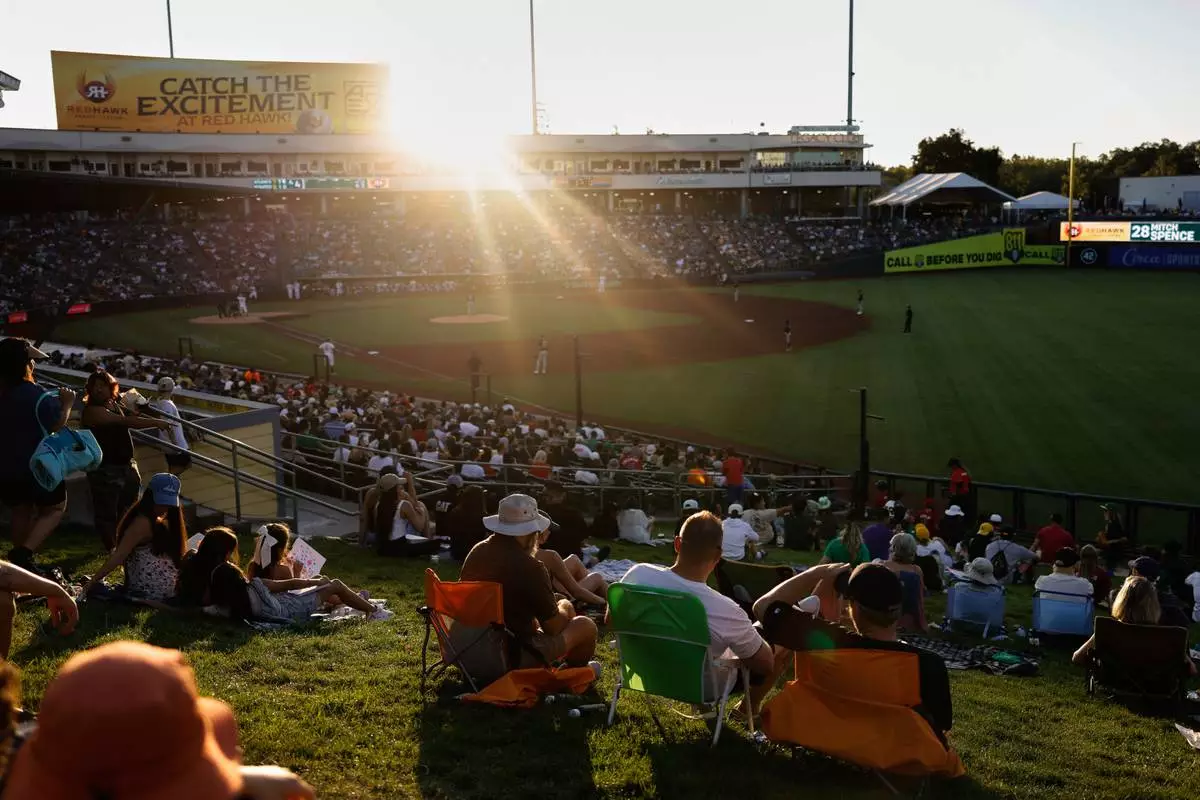
FILE - Fans watch from the outfield seats during the fourth inning of a baseball game between the Atlanta Braves and the Athletics Wednesday, July 9, 2025, in West Sacramento, Calif. (AP Photo/Sergio Estrada, File)
FILE - Fans watch from the outfield seats during the fourth inning of a baseball game between the Atlanta Braves and the Athletics Wednesday, July 9, 2025, in West Sacramento, Calif. (AP Photo/Sergio Estrada, File)

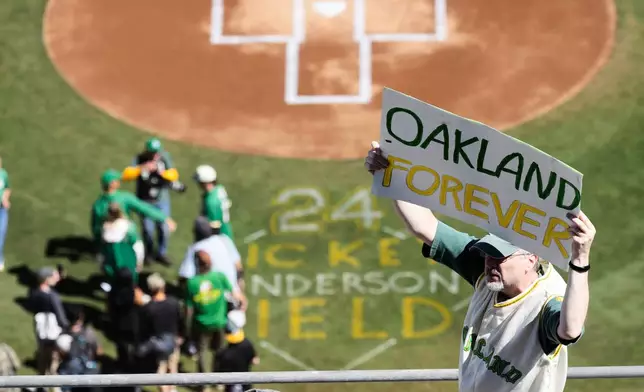
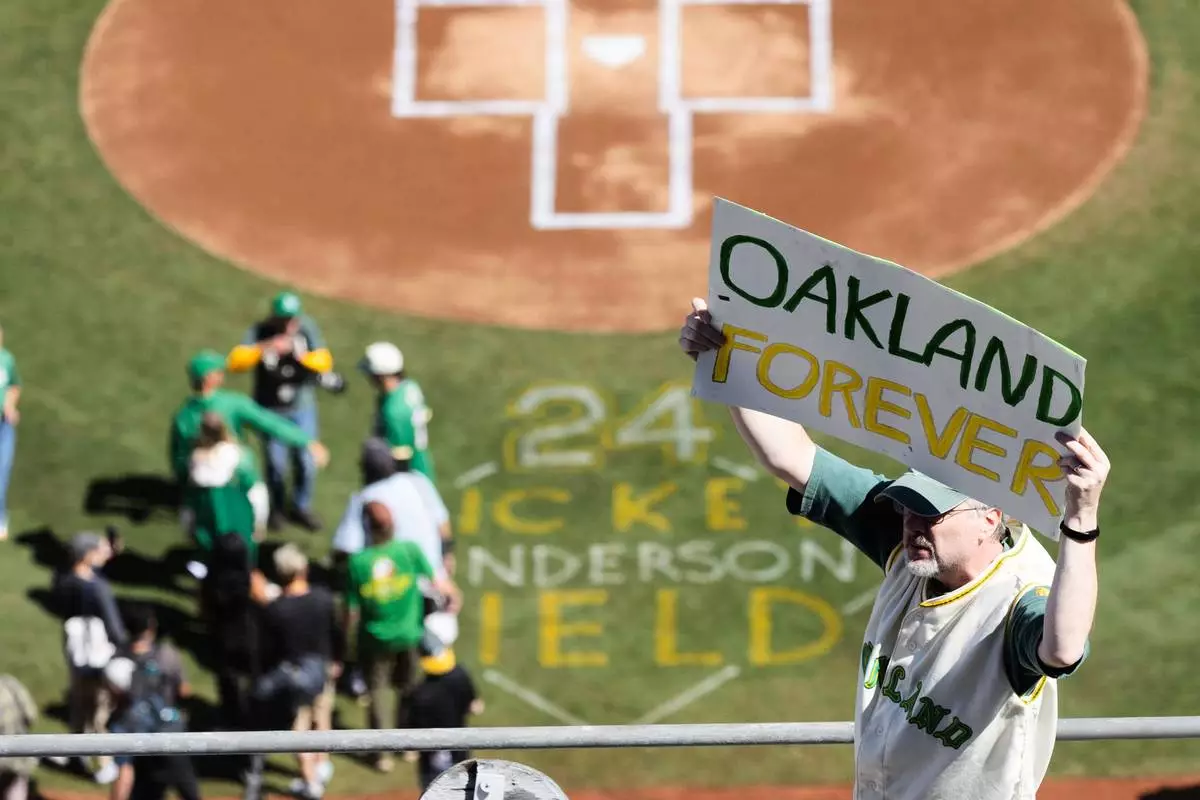
FILE - A fan holds up an "Oakland Forever" sign during the A's last home baseball game at the Oakland Coliseum against the Texas Rangers, Thursday, Sept. 26, 2024, in Oakland, Calif. (AP Photo/Benjamin Fanjoy, File)
FILE - A fan holds up an "Oakland Forever" sign during the A's last home baseball game at the Oakland Coliseum against the Texas Rangers, Thursday, Sept. 26, 2024, in Oakland, Calif. (AP Photo/Benjamin Fanjoy, File)

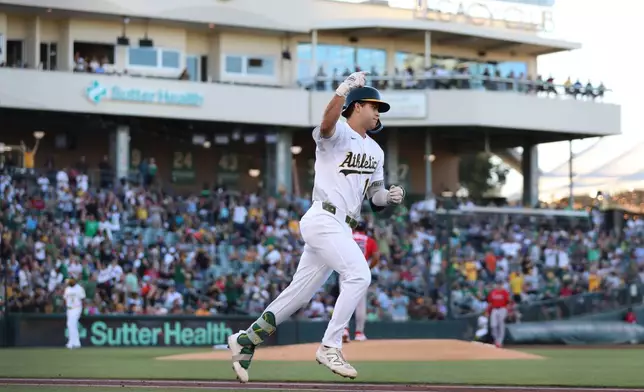
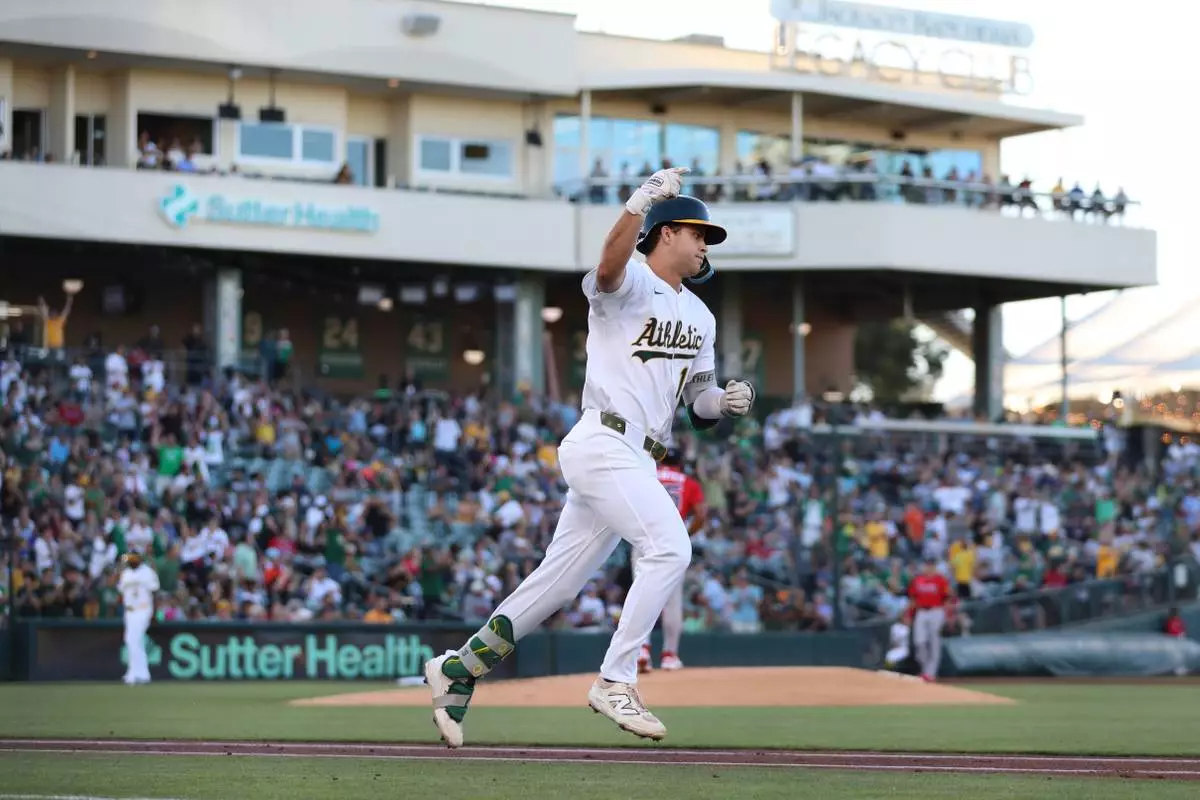
FILE - Athletics' Max Muncy celebrates a two-run home run during the first inning of a baseball game against the Atlanta Braves, Tuesday, July 8, 2025, in West Sacramento, Calif. (AP Photo/Scott Marshall, File)

FILE - Athletics' Max Muncy celebrates a two-run home run during the first inning of a baseball game against the Atlanta Braves, Tuesday, July 8, 2025, in West Sacramento, Calif. (AP Photo/Scott Marshall, File)

During a recent Braves-A's series, two supporters showed up in “Forever Oakland” T-shirts, while another fan from Fresno arrived at Sutter Health Park wearing a “Rooted in Oakland" shirt.

It's a drastically different scene from the A's old Oakland home.

Fans staged “reverse boycott” protests where they packed the Coliseum, brought homemade signs begging the team to stay and loudly called for owner John Fisher to “SELL!” In Sacramento, there's a pervading sense the A's are a rental, not a long-term investment. As soon as 2028, they plan to move into a what has been valued as a $1.75 billion ballpark on the Las Vegas Strip. Construction began last month.

While many A's fans moved on and want nothing to do with the team, some still drive long distances to games in Sacramento and try to make the best of the situation — a big league team in a small-time stadium.

“It's a big difference walking (through the ballpark) in about five minutes instead of walking the Coliseum in like 20, 30 minutes,” said Francisco Almazan from Modesto.

It's not a wholly comfortable setup for players and coaches. The A's built a two-story clubhouse beyond left field that on the top floor includes a lounge, kitchen and offices for manager Mark Kotsay and his coaches. The players' lockers are on the first level.

“Everybody is trying to make the best of it," outfielder Lawrence Butler said. "I'm just thankful for them trying to make it up to big-league standard.”

Major League Baseball Commissioner Rob Manfred acknowledged while speaking at the All-Star Game that playing in a 10,000-seat ballpark isn't perfect. He said the circumstances would be different if the A's moved directly into a 33,000-capacity facility like the one underway in Las Vegas.

Union chief Tony Clark was less diplomatic, insisting players prefer to work in an actual big league ballpark.

“There’s still a little bit of hope that something may come to fruition before 2028 and what’s being described as the time where the new ballpark will be in place,” Clark said. "But we’ll have to see.”

A's players know the situation: The plan is to play in America's party capital less than three years from now, but that seemingly far-off timeline doesn't consume their day-to-day baseball lives.

“I think this group is focused on what they need to be focused on,” Kotsay said. “They come to prepare every day. You walk through our locker room, there's a consistent routine and consistent work ethic that goes on prior to them playing the game.”

Still, as much as they try to stay in the moment, the A’s are very much tied to their past, present and future with three far different cities.

Some baseball fans in the A's old market have shifted their interest to the Oakland Ballers. The “B's” have been a huge hit at intimate Raimondi Park — capacity around 4,000 — complete with mascot Scrappy the Rally Possum and nostalgic nods to Oakland at every turn.

The B's have provided a big lift for a city that watched the NBA’s Golden State Warriors move to San Francisco in 2019 and the NFL’s Raiders leave for Las Vegas the next year.

Last month, the Ballers unveiled a mural honoring late Hall of Famer Rickey Henderson, who died in December at age 65.

The Oakland Roots soccer team now plays its home games at the Coliseum, where cricket has also become a popular choice given the dual-sport facility's size.

Some longtime employees now work Roots games but many moved on or retired, unwilling to make the trek to Sacramento — though most weren't invited.

A formal groundbreaking on the new ballpark occurred June 23, with Fisher, Manfred and Nevada Gov. Joe Lombardo among those speaking at the festivities. There is a tight window for the venue to be ready by opening day in 2028.

The A’s hope to complete the project in 2027. They launched a construction cam so fans can track the progress, and without a doubt, the team will be under a microscope trying to meet its ambitious deadline.

Then the question becomes: Will Las Vegas embrace the A’s?

Las Vegas’ strong support for its first major professional team, the NHL’s Golden Knights, helped pave the way for what has become an explosion of sports in a city once shunned because of legalized sports betting. The Raiders draw large crowds, but many game days feel like neutral sites with opposing fans showing up by the thousands. The Aces became the first WNBA team to sell out an entire season — and did so twice.

Longtime A's radio play-by-play man Ken Korach has a unique perspective on it. In his 30th season calling A's games, Korach moved to the Henderson, Nevada, suburb in 1992 and has stayed put. He figured MLB might explore the market, either through relocation or expansion.

“There are a lot of conflicting emotions there," Korach said. "I’ve always felt the Bay Area is a two-team market, and I’ve always felt that Vegas could support a major-league team.”

Rookie infielder Max Muncy, too, can already weigh in on the A's current home and their future one. He has played 81 games in Las Vegas over the past two seasons, but began this season in Sacramento and returned to the big club before going on the 10-day injured list Tuesday after taking a pitch to his right hand.

“I had a great time in Las Vegas,” Muncy said. “Those fans are great. The atmosphere is great. It's a great city. I enjoyed living there. I think it's going to be a special place to play, as it is here. I really enjoyed my time there, and I think a lot of guys that played there will say the same thing.”

Being on the Strip would allow the A's to attract tourists given the ballpark is walking distance for many visitors. That could be especially important for non-marquee, weeknight matchups in contrast to in-demand weekend series against big-market teams like the Yankees or Dodgers.

The club has begun trying to establish a foothold in the community. The A's said they have contributed $1.5 million since 2023, including more than $400,000 this year, to nonprofits and other similar organizations that include every youth baseball and softball team. They have been involved in more than 30 events this year from youth sports to festivals to public watch parties with more planned through the end of 2025.

Robert Greenberg, an A's fan who lives in Fresno, isn't sure he will keep rooting for the green and gold if and when they move for good even if it's an easier drive to Sacramento than to Oakland. He believes Fisher cut payroll and undermined the team to suppress attendance and facilitate its move.

“I guess he got what he wanted,” Greenberg said.

Ayad Bunni of San Mateo said he was a fan before hosting the “Locked on A’s” podcast. He considered not following the A's and understands why many others no longer cheer them on, but said he didn't fault the club for taking these steps.

“As an A's fan and being from here, would I love for them to be in Oakland?" he said. "Absolutely, 100%."

The A's average 9,782 fans, and they and Tampa Bay — also playing in a Triple-A ballpark this season after Tropicana Field was damaged by a hurricane — are the only teams were fewer than 10,000 per game. The Athletics averaged 11,386 fans last season in the Coliseum, lowest in MLB.

Meanwhile, the players play on, and whether the process turns out to be one big sinking ship remains to be seen. It also could become a move that puts the organization on the trajectory to future success in the box office and on the field.

But the here and now gives the A's plenty to think about, and All-Star designated hitter Brent Rooker acknowledged he and his teammates have faced adversity most other clubs haven't encountered.

“Every challenge you face in this game or outside this game is going to mold you and build you into the person you're going to ultimately become," Rooker said. “So anything you can use to your advantage, whether it's adversity, a challenge, a success, a failure, all those things can be made into positives.”

AP Baseball Writer Janie McCauley in Oakland contributed to this report.

AP MLB: https://apnews.com/hub/MLB
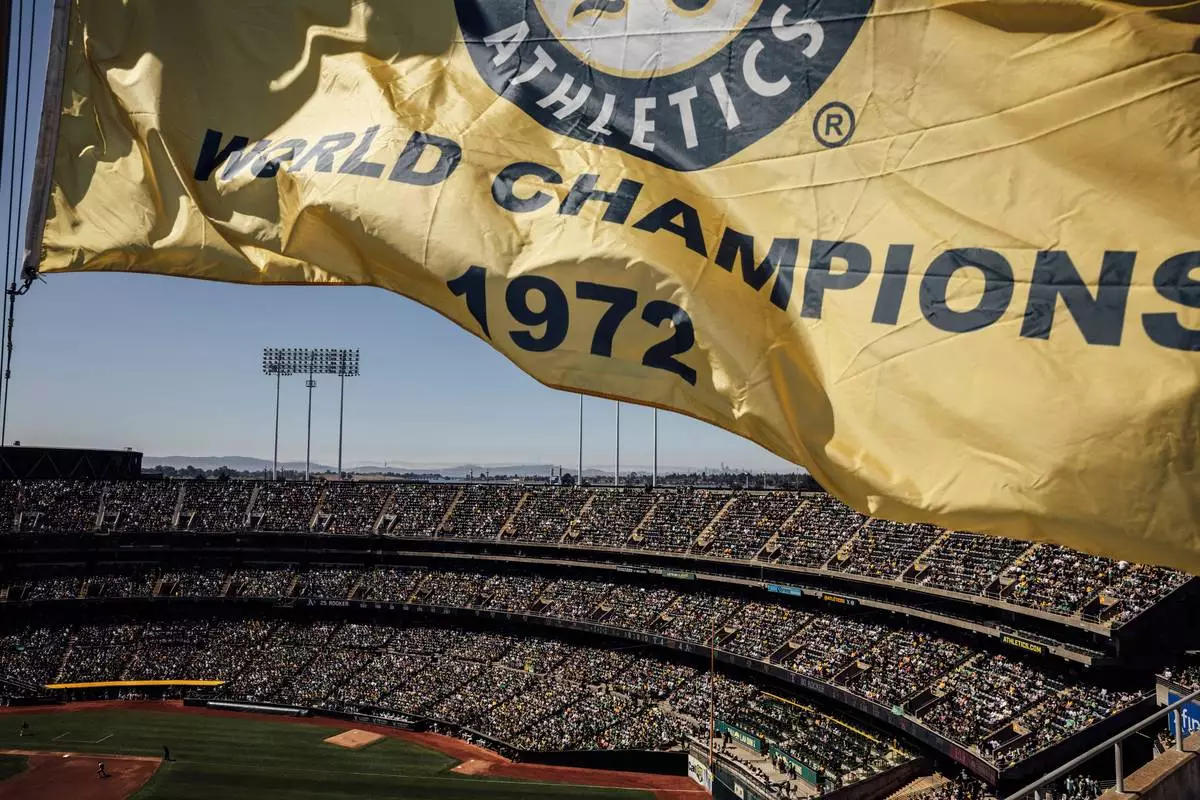
FILE - A 1972 world champions banner flies over the Oakland Coliseum during the Oakland Athletics' last home baseball game at the ballpark against the Texas Rangers in Oakland, Calif., Thursday, Sept. 26, 2024. (Stephen Lam/San Francisco Chronicle via AP, File)
FILE - A 1972 world champions banner flies over the Oakland Coliseum during the Oakland Athletics' last home baseball game at the ballpark against the Texas Rangers in Oakland, Calif., Thursday, Sept. 26, 2024. (Stephen Lam/San Francisco Chronicle via AP, File)

FILE - A fan wears an Oakland Athletics hat with a pin referencing the end of the team's time in Oakland before a baseball game against the Seattle Mariners, Sunday, Sept. 29, 2024, in Seattle. (AP Photo/Lindsey Wasson, File)
FILE - A fan wears an Oakland Athletics hat with a pin referencing the end of the team's time in Oakland before a baseball game against the Seattle Mariners, Sunday, Sept. 29, 2024, in Seattle. (AP Photo/Lindsey Wasson, File)

FILE - Fans watch from the outfield seats during the fourth inning of a baseball game between the Atlanta Braves and the Athletics Wednesday, July 9, 2025, in West Sacramento, Calif. (AP Photo/Sergio Estrada, File)
FILE - Fans watch from the outfield seats during the fourth inning of a baseball game between the Atlanta Braves and the Athletics Wednesday, July 9, 2025, in West Sacramento, Calif. (AP Photo/Sergio Estrada, File)

FILE - A fan holds up an "Oakland Forever" sign during the A's last home baseball game at the Oakland Coliseum against the Texas Rangers, Thursday, Sept. 26, 2024, in Oakland, Calif. (AP Photo/Benjamin Fanjoy, File)
FILE - A fan holds up an "Oakland Forever" sign during the A's last home baseball game at the Oakland Coliseum against the Texas Rangers, Thursday, Sept. 26, 2024, in Oakland, Calif. (AP Photo/Benjamin Fanjoy, File)

FILE - Athletics' Max Muncy celebrates a two-run home run during the first inning of a baseball game against the Atlanta Braves, Tuesday, July 8, 2025, in West Sacramento, Calif. (AP Photo/Scott Marshall, File)
FILE - Athletics' Max Muncy celebrates a two-run home run during the first inning of a baseball game against the Atlanta Braves, Tuesday, July 8, 2025, in West Sacramento, Calif. (AP Photo/Scott Marshall, File)
Federal immigration agents deployed to Minneapolis have used aggressive crowd-control tactics that have become a dominant concern in the aftermath of the deadly shooting of a woman in her car last week.

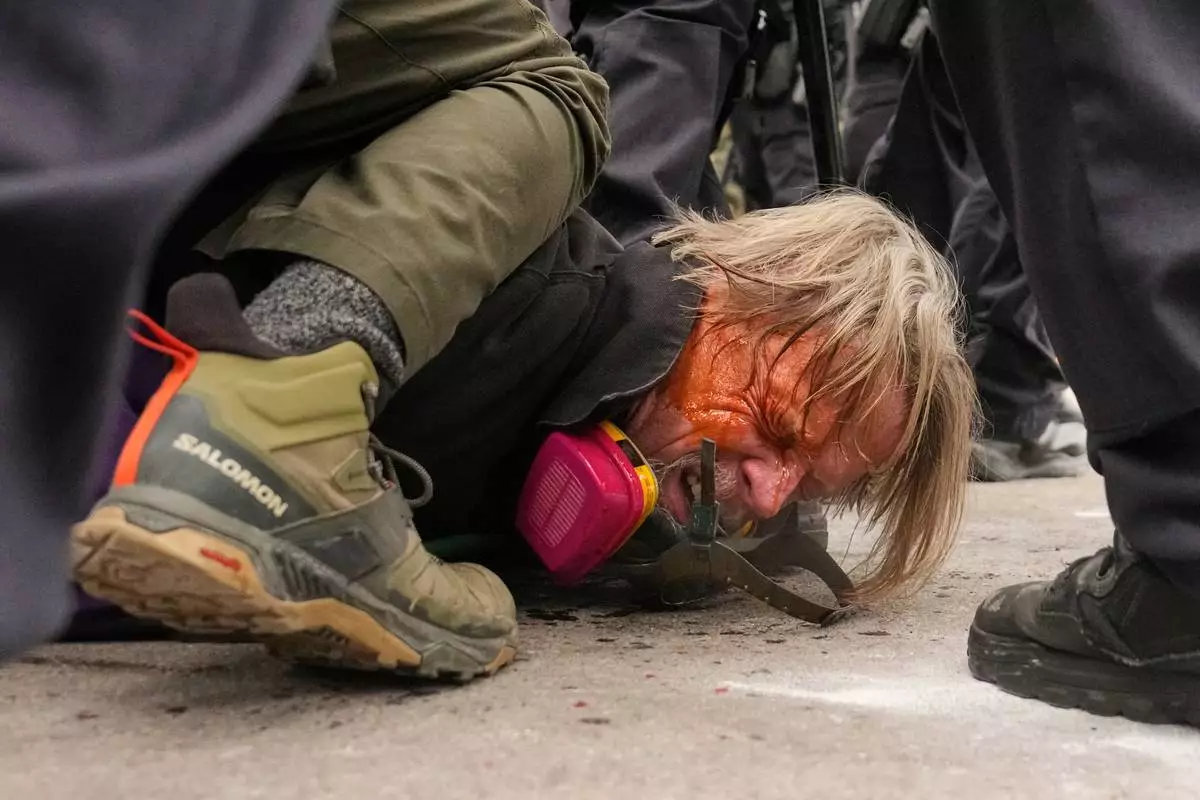
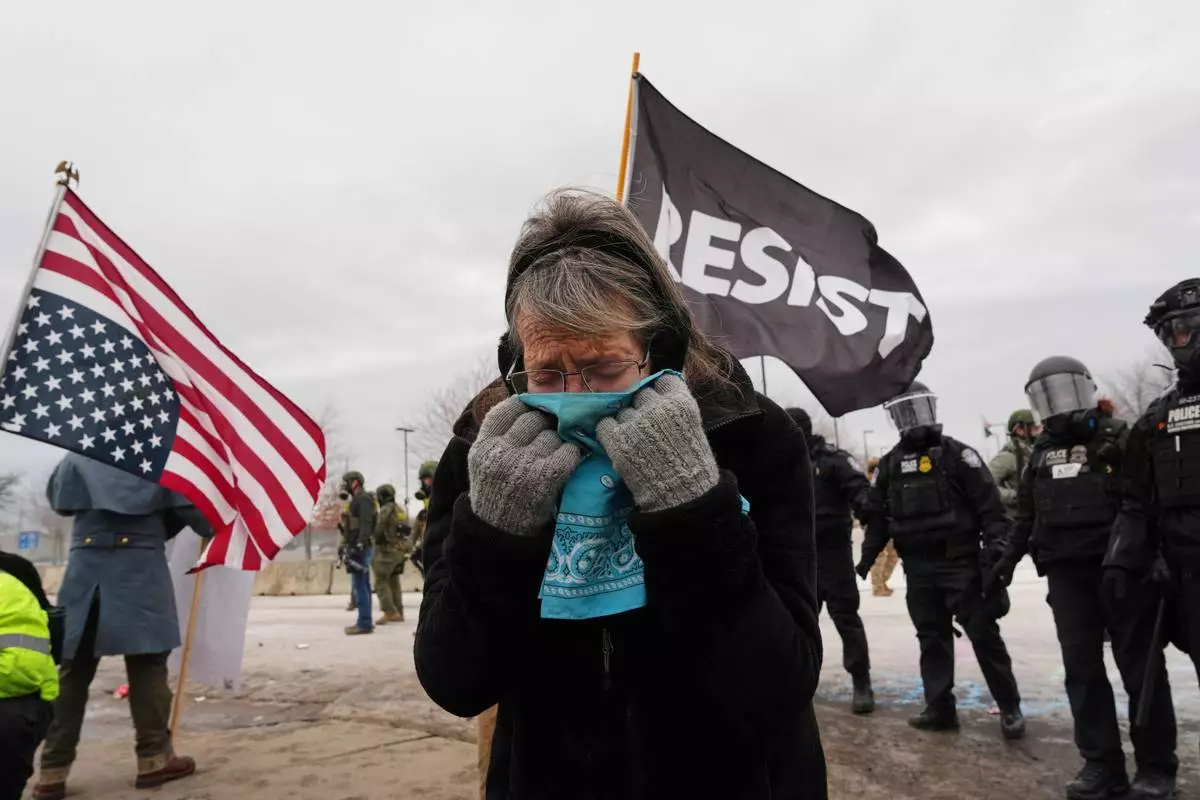
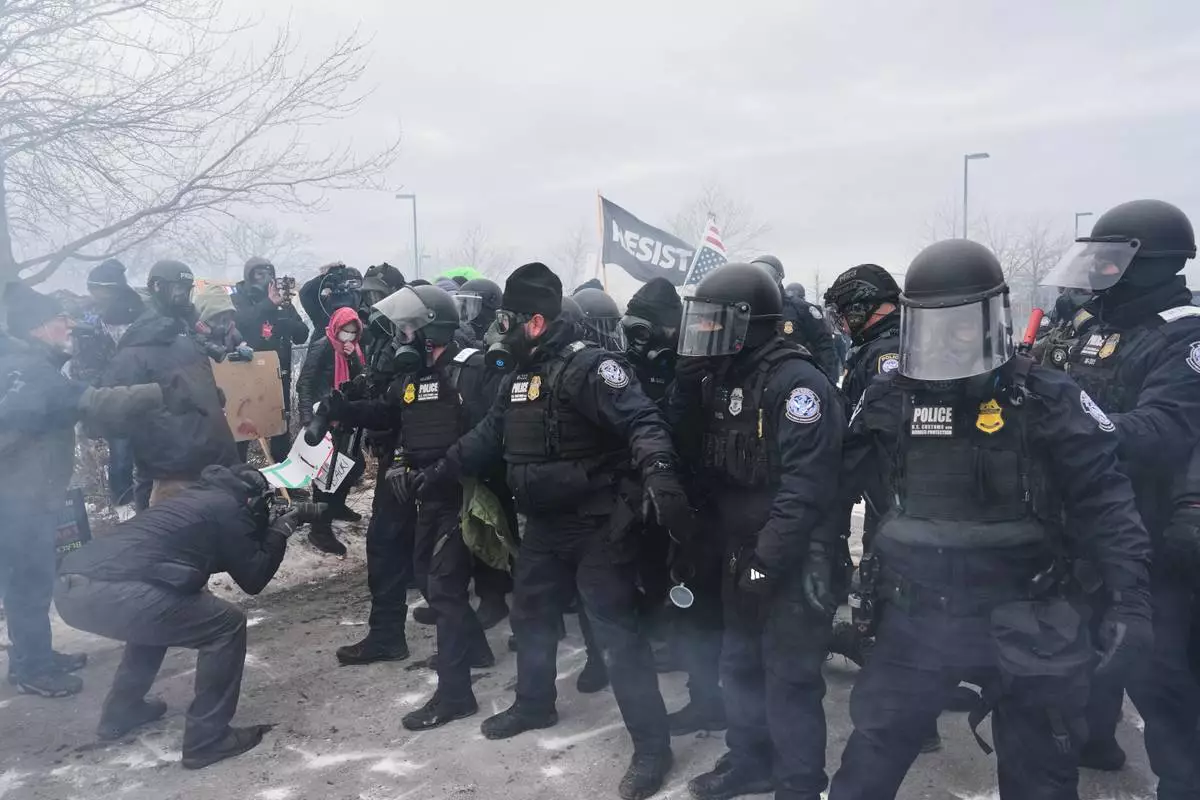
They have pointed rifles at demonstrators and deployed chemical irritants early in confrontations. They have broken vehicle windows and pulled occupants from cars. They have scuffled with protesters and shoved them to the ground.

The government says the actions are necessary to protect officers from violent attacks. The encounters in turn have riled up protesters even more, especially as videos of the incidents are shared widely on social media.

What is unfolding in Minneapolis reflects a broader shift in how the federal government is asserting its authority during protests, relying on immigration agents and investigators to perform crowd-management roles traditionally handled by local police who often have more training in public order tactics and de-escalating large crowds.

Experts warn the approach runs counter to de-escalation standards and risks turning volatile demonstrations into deadly encounters.

The confrontations come amid a major immigration enforcement surge ordered by the Trump administration in early December, which sent more than 2,000 officers from across the Department of Homeland Security into the Minneapolis-St. Paul area. Many of the officers involved are typically tasked with arrests, deportations and criminal investigations, not managing volatile public demonstrations.

Tensions escalated after the fatal shooting of Renee Good, a 37-year-old woman killed by an immigration agent last week, an incident federal officials have defended as self-defense after they say Good weaponized her vehicle.

The killing has intensified protests and scrutiny of the federal response.

On Monday, the American Civil Liberties Union of Minnesota asked a federal judge to intervene, filing a lawsuit on behalf of six residents seeking an emergency injunction to limit how federal agents operate during protests, including restrictions on the use of chemical agents, the pointing of firearms at non-threatening individuals and interference with lawful video recording.

“There’s so much about what’s happening now that is not a traditional approach to immigration apprehensions,” said former Immigration and Customs Enforcement Director Sarah Saldaña.

Saldaña, who left the post at the beginning of 2017 as President Donald Trump's first term began, said she can't speak to how the agency currently trains its officers. When she was director, she said officers received training on how to interact with people who might be observing an apprehension or filming officers, but agents rarely had to deal with crowds or protests.

“This is different. You would hope that the agency would be responsive given the evolution of what’s happening — brought on, mind you, by the aggressive approach that has been taken coming from the top,” she said.

Ian Adams, an assistant professor of criminal justice at the University of South Carolina, said the majority of crowd-management or protest training in policing happens at the local level — usually at larger police departments that have public order units.

“It’s highly unlikely that your typical ICE agent has a great deal of experience with public order tactics or control,” Adams said.

DHS Secretary Tricia McLaughlin said in a written statement that ICE officer candidates receive extensive training over eight weeks in courses that include conflict management and de-escalation. She said many of the candidates are military veterans and about 85% have previous law enforcement experience.

“All ICE candidates are subject to months of rigorous training and selection at the Federal Law Enforcement Training Center, where they are trained in everything from de-escalation tactics to firearms to driving training. Homeland Security Investigations candidates receive more than 100 days of specialized training," she said.

Ed Maguire, a criminology professor at Arizona State University, has written extensively about crowd-management and protest- related law enforcement training. He said while he hasn't seen the current training curriculum for ICE officers, he has reviewed recent training materials for federal officers and called it “horrifying.”

Maguire said what he's seeing in Minneapolis feels like a perfect storm for bad consequences.

“You can't even say this doesn't meet best practices. That's too high a bar. These don't seem to meet generally accepted practices,” he said.

“We’re seeing routinely substandard law enforcement practices that would just never be accepted at the local level,” he added. “Then there seems to be just an absence of standard accountability practices.”

Adams noted that police department practices have "evolved to understand that the sort of 1950s and 1960s instinct to meet every protest with force, has blowback effects that actually make the disorder worse.”

He said police departments now try to open communication with organizers, set boundaries and sometimes even show deference within reason. There's an understanding that inside of a crowd, using unnecessary force can have a domino effect that might cause escalation from protesters and from officers.

Despite training for officers responding to civil unrest dramatically shifting over the last four decades, there is no nationwide standard of best practices. For example, some departments bar officers from spraying pepper spray directly into the face of people exercising Constitutional speech. Others bar the use of tear gas or other chemical agents in residential neighborhoods.

Regardless of the specifics, experts recommend that departments have written policies they review regularly.

“Organizations and agencies aren’t always familiar with what their own policies are,” said Humberto Cardounel, senior director of training and technical assistance at the National Policing Institute.

“They go through it once in basic training then expect (officers) to know how to comport themselves two years later, five years later," he said. "We encourage them to understand and know their training, but also to simulate their training.”

Adams said part of the reason local officers are the best option for performing public order tasks is they have a compact with the community.

“I think at the heart of this is the challenge of calling what ICE is doing even policing,” he said.

"Police agencies have a relationship with their community that extends before and after any incidents. Officers know we will be here no matter what happens, and the community knows regardless of what happens today, these officers will be here tomorrow.”

Saldaña noted that both sides have increased their aggression.

“You cannot put yourself in front of an armed officer, you cannot put your hands on them certainly. That is impeding law enforcement actions,” she said.

“At this point, I’m getting concerned on both sides — the aggression from law enforcement and the increasingly aggressive behavior from protesters.”

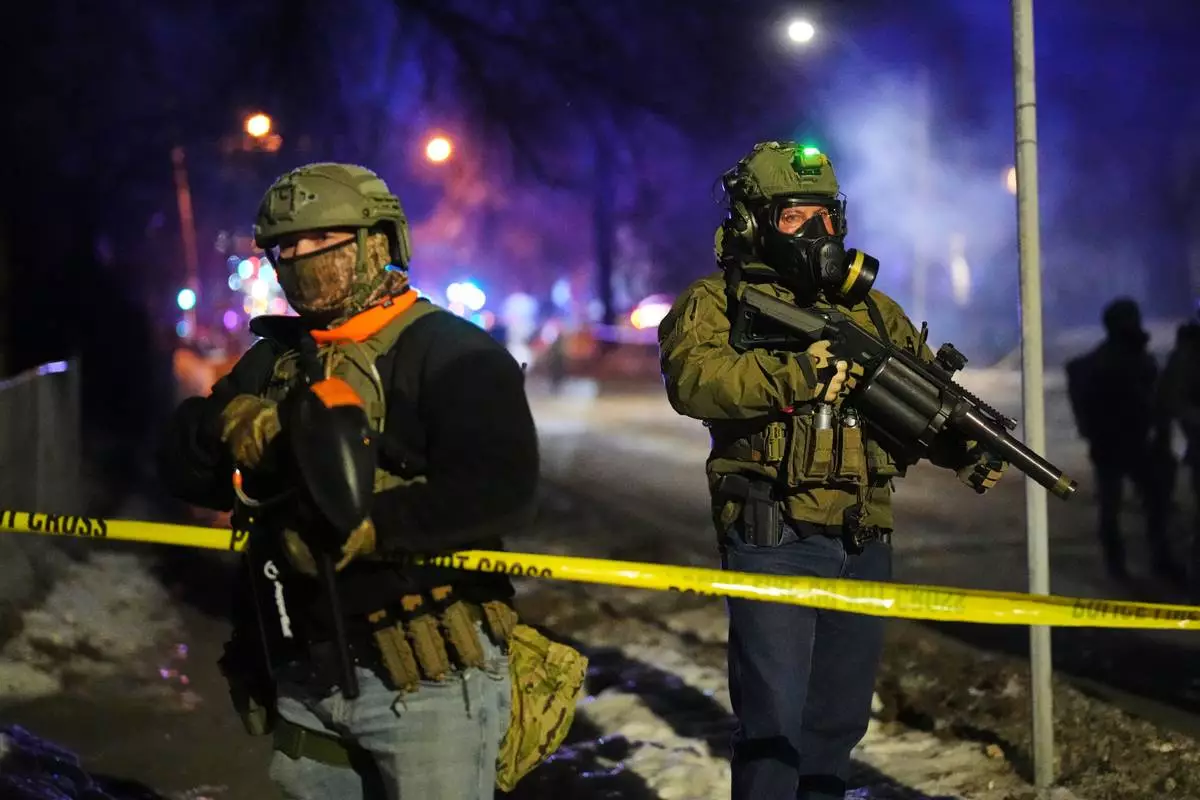
Law enforcement officers at the scene of a reported shooting Wednesday, Jan. 14, 2026, in Minneapolis. (AP Photo/Adam Gray)

Law enforcement officers at the scene of a reported shooting Wednesday, Jan. 14, 2026, in Minneapolis. (AP Photo/Adam Gray)

Federal immigration officers confront protesters outside Bishop Henry Whipple Federal Building, Thursday, Jan. 15, 2026, in Minneapolis. (AP Photo/Adam Gray)

Federal immigration officers confront protesters outside Bishop Henry Whipple Federal Building, Thursday, Jan. 15, 2026, in Minneapolis. (AP Photo/Adam Gray)

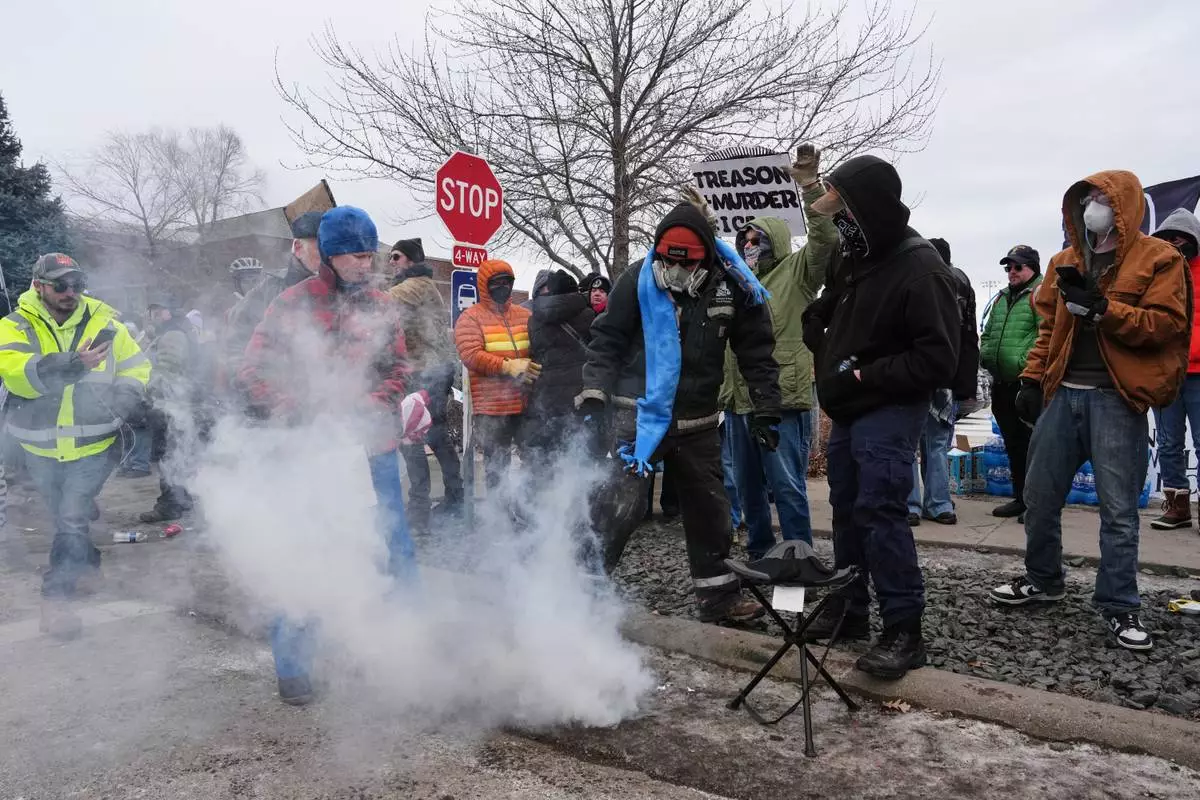
People cover tear gas deployed by federal immigration officers outside Bishop Henry Whipple Federal Building, Thursday, Jan. 15, 2026, in Minneapolis. (AP Photo/Adam Gray)

People cover tear gas deployed by federal immigration officers outside Bishop Henry Whipple Federal Building, Thursday, Jan. 15, 2026, in Minneapolis. (AP Photo/Adam Gray)

A man is pushed to the ground as federal immigration officers confront protesters outside Bishop Henry Whipple Federal Building, Thursday, Jan. 15, 2026, in Minneapolis. (AP Photo/John Locher)

A man is pushed to the ground as federal immigration officers confront protesters outside Bishop Henry Whipple Federal Building, Thursday, Jan. 15, 2026, in Minneapolis. (AP Photo/John Locher)

A woman covers her face from tear gas as federal immigration officers confront protesters outside Bishop Henry Whipple Federal Building, Thursday, Jan. 15, 2026, in Minneapolis. (AP Photo/Adam Gray)

A woman covers her face from tear gas as federal immigration officers confront protesters outside Bishop Henry Whipple Federal Building, Thursday, Jan. 15, 2026, in Minneapolis. (AP Photo/Adam Gray)

Recommended Articles