Skip to Content Facebook Feature Image

Intruder Launches GregAI: The AI Security Analyst That Sees Your Entire Security Environment

News

Intruder Launches GregAI: The AI Security Analyst That Sees Your Entire Security Environment
News

News

Intruder Launches GregAI: The AI Security Analyst That Sees Your Entire Security Environment

2025-07-29 19:01 Last Updated At:19:20

LONDON--(BUSINESS WIRE)--Jul 29, 2025--

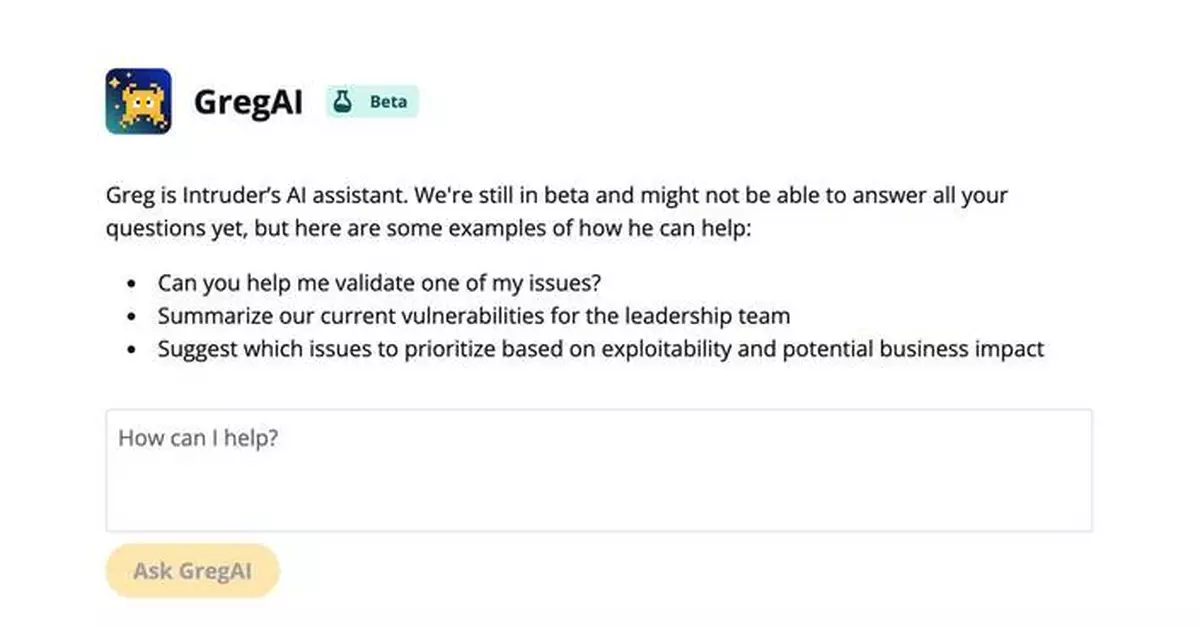
Intruder, a leader in attack surface management, has launched GregAI—an AI-powered security analyst with comprehensive visibility into users’ security infrastructure, now available in beta. Unlike generic AI assistants, GregAI integrates directly with Intruder’s exposure management platform data, providing contextual security intelligence that helps lean security teams efficiently manage vulnerability workflows while maintaining a strong cybersecurity posture.

This press release features multimedia. View the full release here: https://www.businesswire.com/news/home/20250729643148/en/

Security teams face an overwhelming volume of vulnerability data while operating with limited resources. Manual processes for vulnerability validation, risk assessment and stakeholder communication consume significant time that could be spent on actual remediation. GregAI accelerates these workflows by combining AI intelligence with real-time platform data.

“Every minute you spend wrestling with cumbersome tools is a minute you’re not patched,” said Chris Wallis, Intruder’s CEO and founder. “GregAI represents our commitment to making cybersecurity accessible and efficient for companies of all sizes. Unlike generic AI assistants that lack security context, GregAI understands your actual environment and can provide actionable guidance based on your real vulnerabilities and infrastructure.”

Platform-Integrated AI Delivers Contextual Security Intelligence

GregAI’s key differentiator lies in its comprehensive access to users’ security data within the Intruder platform. This visibility enables the AI assistant to deliver tailored insights and recommendations based on their current infrastructure, latest security scan results, external threat intelligence, applicable compliance frameworks and more. With robust insight into customers’ security posture, GregAI can support security workflows in ways that standalone AI tools such as ChatGPT can’t.

Security teams can make natural language requests such as “Show me the critical vulnerabilities for our web apps and suggest which to prioritize based on exploitability and business impact,” and receive responses tailored to their actual environment and risk profile.

The AI assistant supports four critical workflow areas where manual processes typically create bottlenecks: issue prioritization, vulnerability validation, remediation guidance and executive reporting. For vulnerability validation, GregAI provides step-by-step guidance specific to detected issues, such as “Guide me through reproducing the SQL injection vulnerability” with instructions relevant to the user’s technology stack.

Automated Reporting and Remediation Guidance

GregAI tackles a persistent challenge for security professionals: stakeholder communication. The AI assistant generates executive summaries and progress reports based on actual platform data, enabling teams to respond efficiently to leadership inquiries with requests such as “Summarize our current vulnerabilities and cyber hygiene progress over the past three months for the leadership team.”

For remediation, GregAI provides guidance tailored to users’ specific technology environments. When teams request, “Provide a remediation plan tailored to our current tech stack,” the AI assistant reviews the current infrastructure configuration to deliver relevant, actionable advice rather than generic recommendations.

The First Step in Intruder’s AI Vision

The company’s vision for AI extends beyond current functionality to create a fully-fledged virtual security analyst. Near-term development plans include enabling GregAI to execute platform actions directly—launching scans, adding targets and managing security workflows through natural language commands rather than manual interface navigation.

“Our vision for AI at Intruder is to empower lean security teams with a fully-fledged virtual security analyst,” said Andy Hornegold, vice president of product at Intruder. “GregAI’s skillset is developing rapidly, and we’ve started work on automated false positive validation and other AI-driven functionality that frees up even more time for security teams.”

Available Now Within the Intruder Platform

GregAI is available today for free trial users and Intruder customers on the Cloud, Pro and Enterprise plans, allowing security teams to experience contextual, AI-powered vulnerability and security workflow management. Organizations can access GregAI directly within the Intruder platform.

More information about GregAI’s capabilities and implementation can be found on Intruder’s company blog. Security teams interested in experiencing contextual AI security analysis can access GregAI with an Intruder free trial.

About Intruder

Intruder’s exposure management platform helps lean security teams stop breaches before they start by proactively discovering attack surface weaknesses. By unifying attack surface management, cloud security and continuous vulnerability management in one intuitive platform, Intruder makes it easy to stay secure by cutting through the noise and complexity. Founded in 2015 by Chris Wallis, a former ethical hacker turned corporate blue teamer, Intruder is now protecting over 3,000 companies worldwide. Learn more at https://intruder.io.
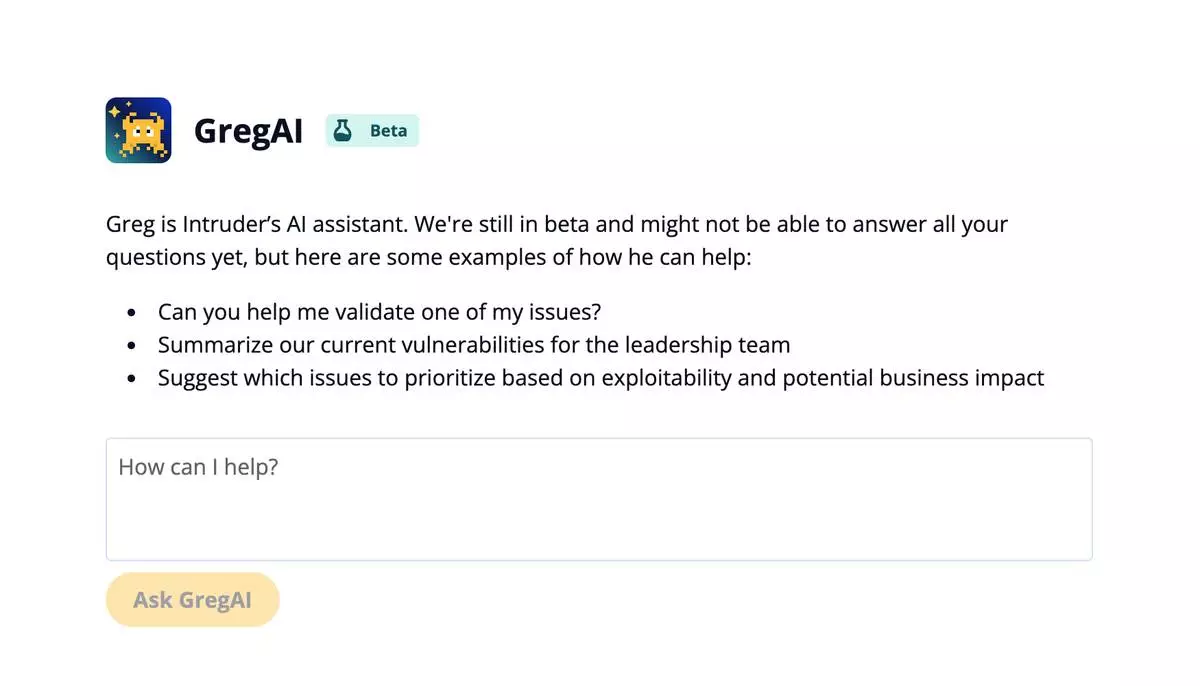
GregAI is available today for free trial users and Intruder customers on the Cloud, Pro and Enterprise plans, allowing security teams to experience contextual, AI-powered vulnerability and security workflow management.


GregAI is available today for free trial users and Intruder customers on the Cloud, Pro and Enterprise plans, allowing security teams to experience contextual, AI-powered vulnerability and security workflow management.

MADISON, Wis. (AP) — Wisconsin's Democratic Gov. Tony Evers on Tuesday called on the Republican-controlled Legislature to act on a broad array of his priorities in his final year in office, even if it means working for longer than they are scheduled to be in session.

Republicans are unlikely to follow Evers' call to action on many of the proposals he outlined in a letter, just a year after they rejected the same or similar ideas in his state budget. But Evers expressed optimism that bipartisan agreement is near on several issues, including protecting funding for SNAP, the country’s main food aid program, and combating water pollution caused by PFAS chemicals.

“We have a year left and it’s not all about me,” Evers, who opted against seeking a third term, told reporters on Monday. “All of the things that need to be addressed, many of them can be.”

Evers has served as the swing state's governor since 2019, helping Democrat Joe Biden narrowly win the state on the way to becoming president in 2020. President Donald Trump carried Wisconsin in 2024 and in 2016, both times by less than 1 percentage point.

Evers' term ends in a year, but he's focused on setting up his party to take back the legislative majority for the first time since they lost it in 2010.

Evers signed new district maps in 2024 that helped Democrats chip into Republican majorities in the Assembly and Senate. Democrats are also counting on anger toward Trump helping them in the midterm.

The Legislature is scheduled to be done with its session by mid-March, giving lawmakers more time to campaign for the fall election. The Assembly is planning to quit in mid-February. But Evers said Monday that there's still time to advance Democratic priorities.

“I think it’s bad politics to say we’re done in February, we’re done in March, and we’ll see you at the polls,” Evers said. “That doesn’t work. I don’t think it’s a good message. We have the opportunity to do some good things.”

Evers called for bipartisanship to tackle issues that have long been Democratic priorities, such as increasing public school funding, lowering health care costs and enacting gun control laws.

While many of his proposals are likely to be summarily rejected, Evers said Democrats and Republicans were close on reaching deals to release $125 million in funding to combat PFAS pollution. He also said both sides were close to an agreement that would put additional safeguards in place to ensure Wisconsin isn't penalized by the federal government for errors in who gets SNAP food assistance.

Evers called on lawmakers to spend $1.3 billion more on public schools in an effort to reduce property taxes, a month after homeowners across the state received higher tax bills. Republicans blame Evers because of a veto he issued that allows schools to increase spending limits for 400 years. But that is only one part of the complicated school aid formula. Evers and school officials have said funding from the state has not kept pace with expenses, forcing schools to ask voters to approve referendums for an increase in property taxes to make up the difference.

If schools aren't given more money, Evers said “we're in a world of hurt” because property taxes will only continue to increase.

Republican legislative leaders, in interviews with The Associated Press last month, did not express support for increasing general school aid funding.

“We have to have a bigger conversation about how we’re going to fund schools long term than just saying we’re gonna put more money to the same formula doing the same thing,” Assembly Speaker Robin Vos said.

Evers also urged the Legislature to make progress on his plan to close a 128-year-old prison in Green Bay as part of a larger overhaul of the correctional system. In October, the state building commission approved $15 million for planning. But once that is spent, absent further action, the work will stall, Evers said.

“We have to get this across the finish line,” he said.

Wisconsin's Democratic Gov. Tony Evers discusses his call on the Republican-controlled Legislature to act on a broad array of his priorities in his final year in office on Monday, Jan. 12, 2026, in Madison, Wis. (AP Photo/Scott Bauer)

Wisconsin's Democratic Gov. Tony Evers discusses his call on the Republican-controlled Legislature to act on a broad array of his priorities in his final year in office on Monday, Jan. 12, 2026, in Madison, Wis. (AP Photo/Scott Bauer)

Wisconsin's Democratic Gov. Tony Evers discusses his call on the Republican-controlled Legislature to act on a broad array of his priorities in his final year in office on Monday, Jan. 12, 2026, in Madison, Wis. (AP Photo/Scott Bauer)

Wisconsin's Democratic Gov. Tony Evers discusses his call on the Republican-controlled Legislature to act on a broad array of his priorities in his final year in office on Monday, Jan. 12, 2026, in Madison, Wis. (AP Photo/Scott Bauer)

Recommended Articles