Skip to Content Facebook Feature Image

Why there hasn't been a formal declaration of famine in Gaza

News

Why there hasn't been a formal declaration of famine in Gaza
News

News

Why there hasn't been a formal declaration of famine in Gaza

2025-07-30 03:06 Last Updated At:03:10

The leading international authority on food crises said Tuesday that the “worst-case scenario of famine is currently playing out in Gaza." It predicted “widespread death” without immediate action.

The Integrated Food Security Phase Classification, or IPC, said Gaza has been on the brink of famine for two years, and that recent developments, including “increasingly stringent blockades” by Israel, have “dramatically worsened” the situation.

Even though Israel eased a 2 1/2-month blockade on the territory in May, aid groups say only a trickle of assistance is getting into the enclave and that Palestinians face catastrophic levels of hunger 21 months into the Israeli offensive launched after Hamas' Oct. 7 attack.

Hundreds have been killed by Israeli forces as they try to reach aid sites or convoys, according to witnesses, health officials and the United Nations' human rights office. The military says it has only fired warning shots.

The IPC warning stopped short of a formal declaration of famine. Here's why:

Gaza’s population of roughly 2 million Palestinians relies almost entirely on outside aid. Israel's offensive has wiped out what was already limited local food production. Israel's blockade, along with ongoing fighting and chaos inside the territory, has further limited people's access to food.

The U.N. World Food Program says Gaza’s hunger crisis has reached “new and astonishing levels of desperation." Nearly 100,000 women and children are suffering from severe acute malnutrition, and a third of Gaza’s population is going days without eating, Ross Smith, the agency’s director for emergencies, said Monday.

The Gaza Health Ministry says there have been 82 malnutrition-related deaths in Gaza this month, including 24 children. It did not give their exact cause of death. The ministry, part of the Hamas-run government, is staffed by medical professionals and its figures on war deaths are seen by the U.N. and other experts as the most reliable estimate of casualties.

The IPC was first set up in 2004 during the famine in Somalia. It includes more than a dozen U.N. agencies, aid groups, governments and other bodies.

Famine can appear in pockets — sometimes small ones — and a formal classification requires caution.

The IPC has only declared famine a few times — in Somalia in 2011, and South Sudan in 2017 and 2020, and last year in parts of Sudan’s western Darfur region. Tens of thousands are believed to have died in Somalia and South Sudan.

It rates an area as in famine when all three of these conditions are confirmed:

— 20% of households have an extreme lack of food, or are essentially starving.

— At least 30% of children 6 months to 5 years old suffer from acute malnutrition, based on a weight-to-height measurement; or 15% of that age group suffer from acute malnutrition based on the circumference of their upper arm.

— At least two people, or four children under 5, per 10,000 are dying daily due to starvation or the interaction of malnutrition and disease.

Gaza poses a major challenge for experts because Israel severely limits access to the territory, making it difficult and in some cases impossible to gather data.

The IPC said Tuesday that data indicate famine thresholds have been reached for food consumption in most of Gaza, and for acute malnutrition in Gaza City.

While the IPC says it is the “primary mechanism” used by the international community to conclude whether a famine is happening or projected, it typically doesn’t make such a declaration itself.

Often, U.N. officials together with governments will make a formal statement based on an analysis from the IPC.

But the IPC says once a famine is declared it's already too late. While it can prevent further deaths, it means many people will have died by the time a famine is declared.

Most cases of severe malnutrition in children arise through a combination of lack of nutrients along with an infection, leading to diarrhea and other symptoms that cause dehydration, said Alex de Waal, author of “Mass Starvation: The History and Future of Famine” and executive director of the World Peace Foundation.

“There are no standard guidelines for physicians to classify cause of death as ‘malnutrition’ as opposed to infection," he said.

When famine occurs, there are often relatively few deaths from hunger alone. Far more people die from a combination of malnutrition, disease and other forms of deprivation. All of these count as excess deaths — separate from violence — that can be attributed to a food crisis or famine, he said.

Israel's offensive has gutted Gaza's health system and displaced some 90% of its population. With hospitals damaged and overwhelmed by war casualties, it can be difficult to screen people for malnutrition and collect precise data on deaths.

“Data and surveillance systems are incomplete and eroded," said James Smith, an emergency doctor and lecturer in humanitarian policy at the University College London who spent more than two months in Gaza.

“Which means that all health indicators — and the death toll — are known to be an underestimation,” he said.

A declaration of famine should in theory galvanize the international community to rush food to those who need it. But with aid budgets already stretched, and war and politics throwing up obstacles, that doesn't always happen.

“There is not a big, huge bank account” to draw on, said OCHA’s Laerke. “The fundamental problem is that we build the fire engine as we respond.”

Aid groups say plenty of food and other aid has been gathered on Gaza's borders, but Israel is allowing only a small amount to enter. Within Gaza, gunfire, chaos and looting have plagued the distribution of food.

The international pressure led Israel to announce new measures over the weekend, including daily humanitarian pauses in fighting in parts of Gaza and airdrops of food. Israel says there’s no limit on how many aid trucks can enter Gaza.

U.N. agencies say Israeli restrictions, and the breakdown of law and order, make it difficult to distribute the food that does come in.

“Only a massive scale-up in food aid distributions can stabilize this spiraling situation, calm anxieties and rebuild the trust within communities that more food is coming,” the World Food Program said. “An agreed ceasefire is long overdue.”

Associated Press writers Bassem Mroue in Beirut and Edith M. Lederer at the United Nations contributed.
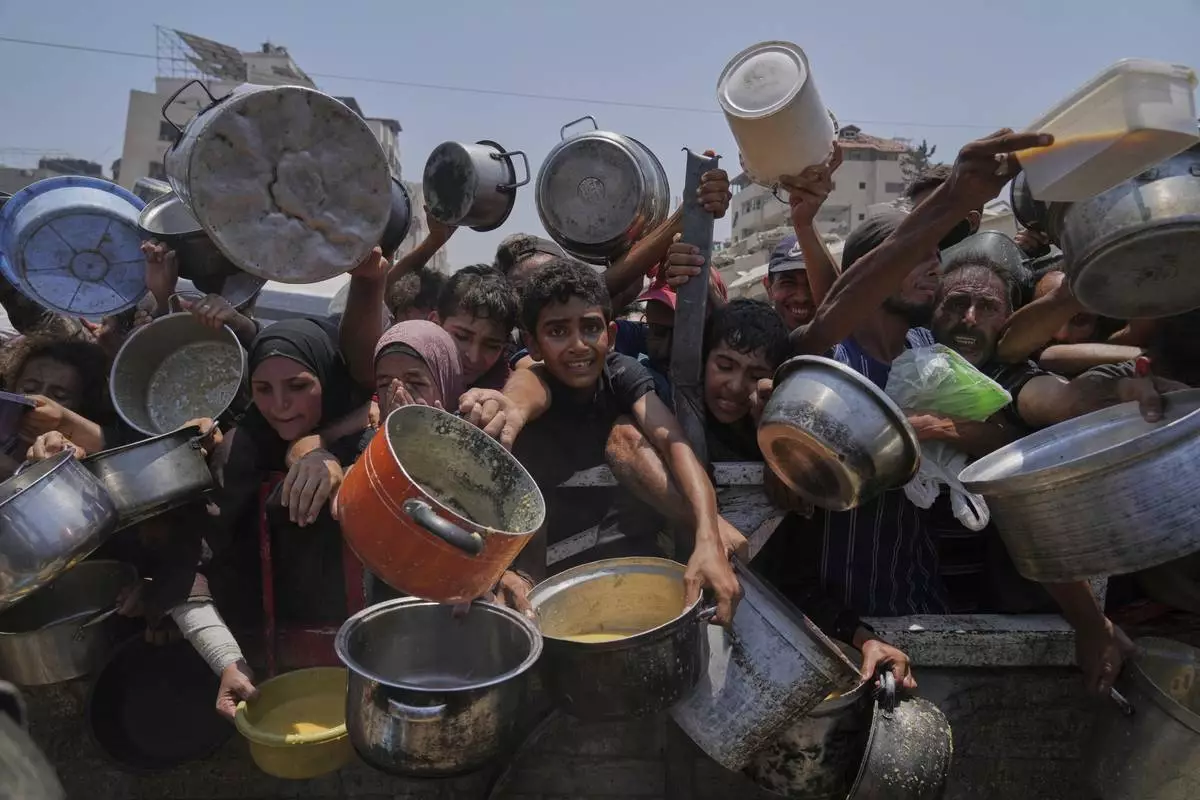
Palestinians struggle to get donated food at a community kitchen, in Gaza City, northern Gaza Strip, Saturday, July 26, 2025. (AP Photo/Abdel Kareem Hana)
Palestinians struggle to get donated food at a community kitchen, in Gaza City, northern Gaza Strip, Saturday, July 26, 2025. (AP Photo/Abdel Kareem Hana)

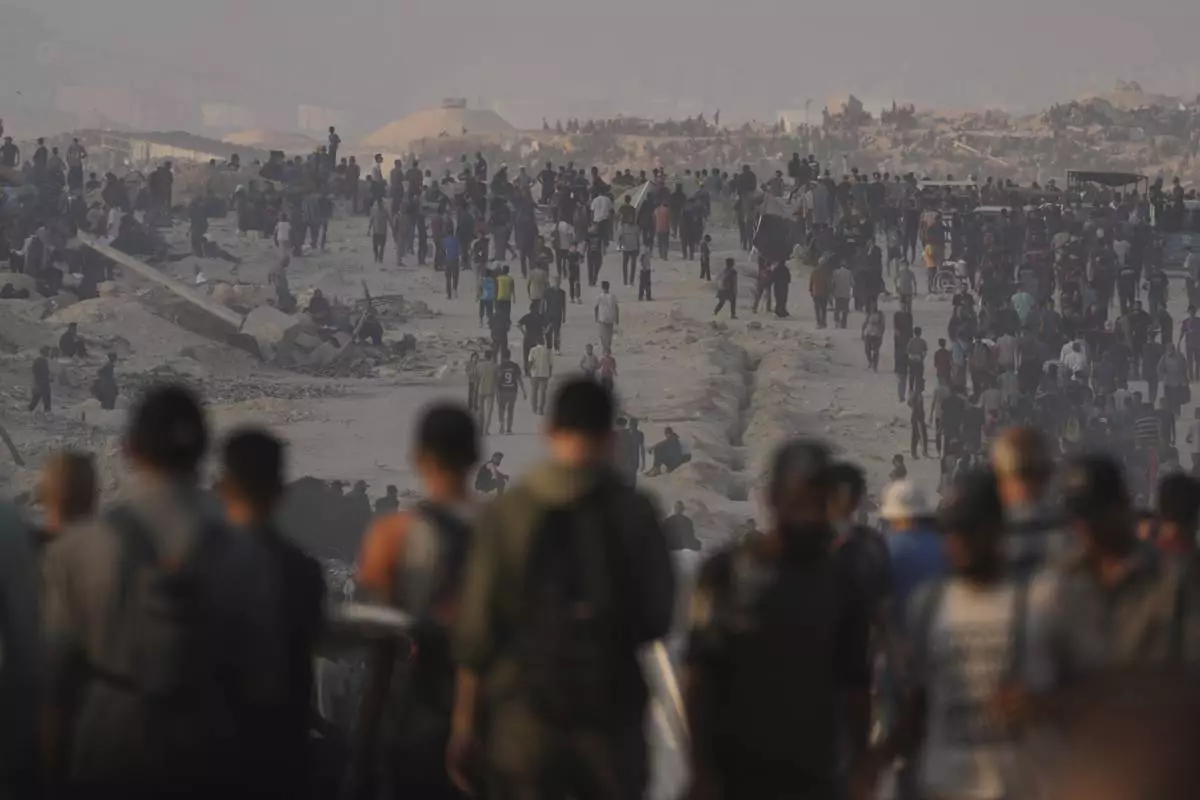
Palestinians walk along a road toward an area in the northern Gaza Strip where trucks are entering with humanitarian aid, in Gaza City, Friday, July 25, 2025. (AP Photo/Abdel Kareem Hana)
Palestinians walk along a road toward an area in the northern Gaza Strip where trucks are entering with humanitarian aid, in Gaza City, Friday, July 25, 2025. (AP Photo/Abdel Kareem Hana)

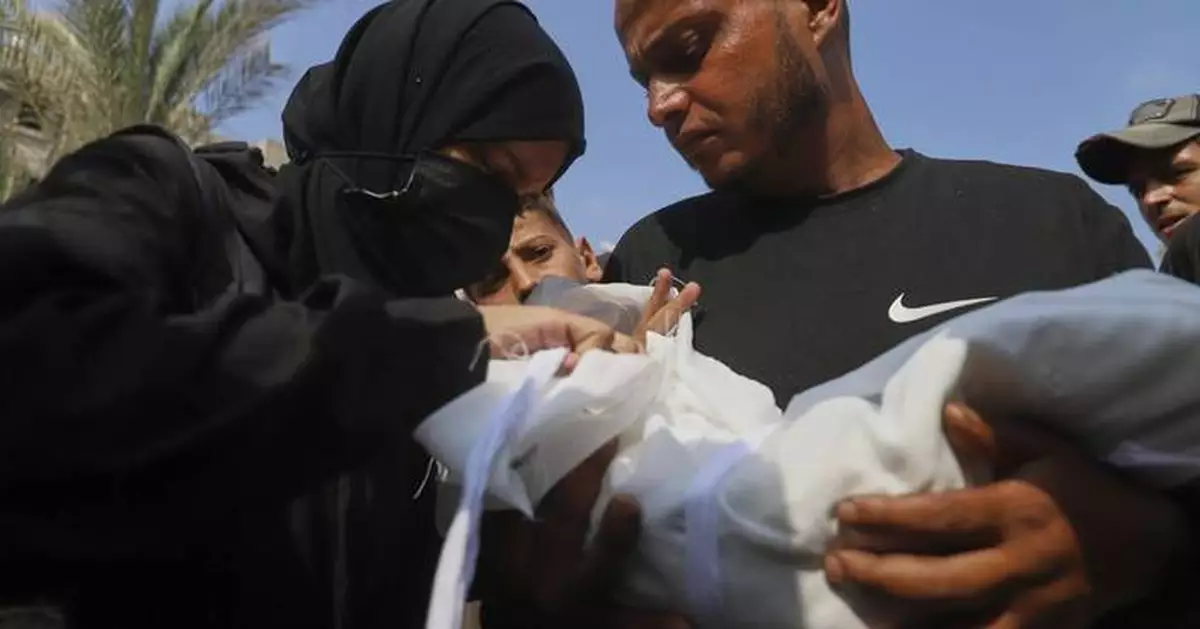
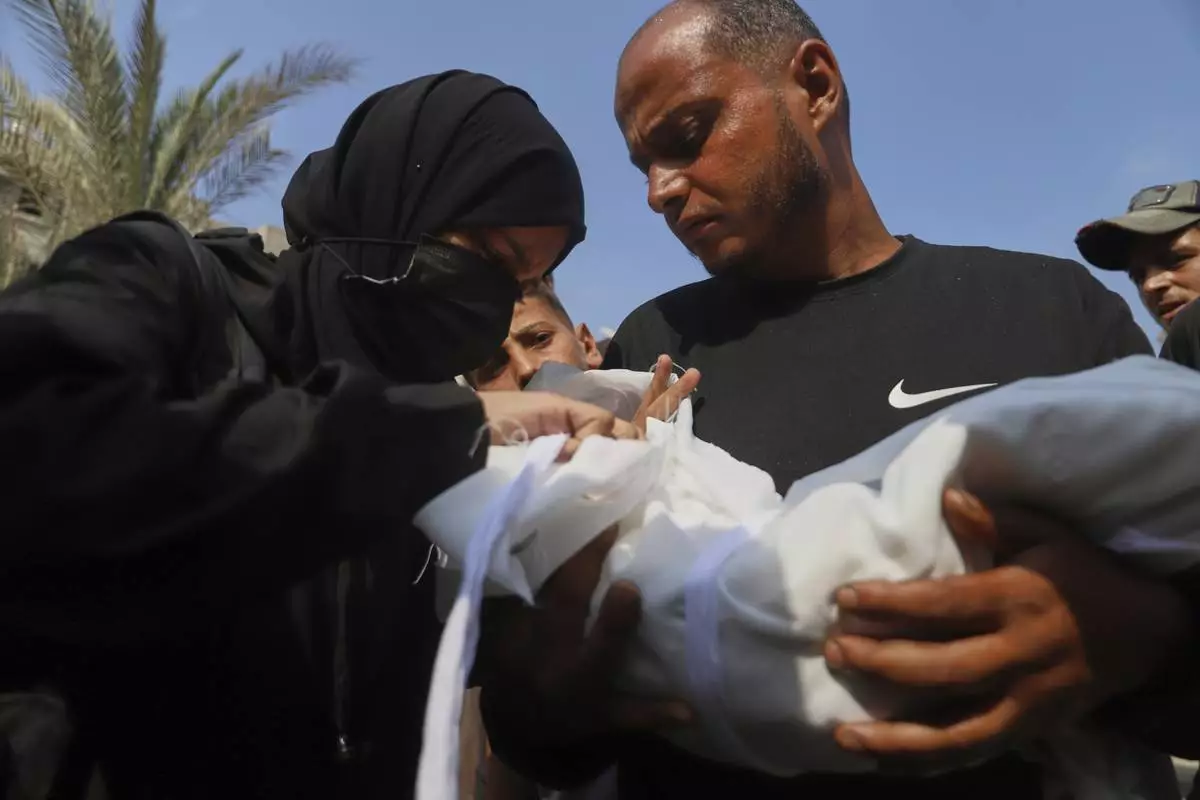
Ahmed Abu Halib and his wife Esraa Abu Halib, left, mourn over the body of their 5-month-old baby, Zainab, who died from malnutrition-related causes, according to the family and the hospital, during her funeral outside the Nasser Hospital, in Khan Younis, Gaza Strip, Saturday, July 26, 2025. (AP Photo/Mariam Dagga)

Ahmed Abu Halib and his wife Esraa Abu Halib, left, mourn over the body of their 5-month-old baby, Zainab, who died from malnutrition-related causes, according to the family and the hospital, during her funeral outside the Nasser Hospital, in Khan Younis, Gaza Strip, Saturday, July 26, 2025. (AP Photo/Mariam Dagga)

VILNIUS, Lithuania (AP) — Belarusian authorities on Saturday freed Nobel Peace Prize laureate Ales Bialiatski, key opposition figure Maria Kolesnikova and other prominent political prisoners, a human rights group confirmed.

Their release comes as authoritarian President Alexander Lukashenko seeks to improve relations with Washington. The U.S. earlier on Saturday announced lifting sanctions on the country’s potash sector. In exchange, Lukashenko pardoned a total of 123 prisoners, the Belta state news agency reported.

A close ally of Russia, Minsk has faced Western isolation and sanctions for years. Lukashenko has ruled the nation of 9.5 million with an iron fist for more than three decades, and the country has been repeatedly sanctioned by Western countries both for its crackdown on human rights and for allowing Moscow to use its territory in the invasion of Ukraine in 2022. Belarus has released hundreds of prisoners since July 2024.

John Coale, the U.S. special envoy for Belarus, announced the lifting of sanctions on potash after meeting Lukashenko in Minsk on Friday and Saturday.

Speaking with journalists, Coale described the two-day talks as “very productive,” Belarus’ state news agency Belta reported Saturday. He said that normalizing relations between Washington and Minsk was “our goal.”

“We’re lifting sanctions, releasing prisoners. We’re constantly talking to each other,” he said, according to Belta. He also said that the relationship between the countries was moving from “baby steps to more confident steps” as they increased dialogue.

Pavel Sapelka, an advocate with the Viastan rights group, confirmed to The Associated Press that Bialiatski and Kolesnikova were released from prison.

Human rights advocate Bialiatski won the Nobel Peace Prize in 2022, along with the prominent Russian rights group Memorial and Ukraine’s Center for Civil Liberties.

Bialiatski, awarded the prize while in jail awaiting trial, was later convicted of smuggling as well as financing actions that violate public order — charges widely denounced as politically motivated — and sentenced to 10 years in 2023.

Kolesnikova was a key figure in the mass protests that rocked Belarus in 2020, and is a close ally of an opposition leader in exile, Sviatlana Tsikhanouskaya.

Kolesnikova, known for her close-cropped hair and trademark gesture of forming a heart with her hands, became an even greater symbol of resistance when Belarusian authorities tried to deport her in September 2020. Driven to the Ukrainian border, she briefly broke away from security forces at the frontier, tore up her passport and walked back into Belarus.

The 43-year-old professional flautist was convicted in 2021 on charges including conspiracy to seize power and sentenced to 11 years in prison.

Others who were released, according to Viasna, include Viktar Babaryka — an opposition figure who had sought to challenge Lukashenko in the 2020 presidential election, widely seen as rigged, before being convicted and sentenced to 14 years in prison on charges he rejected as political.

Viasna said that the group's imprisoned advocates, Valiantsin Stefanovic and Uladzimir Labkovich, and prominent opposition figure Maxim Znak, were released as well.

Most of them were brought into Ukraine, Franak Viachorka, Tsikhanouskaya’s senior adviser, told the AP.

“I think Lukashenko decided to deport people to Ukraine to show that he is in control of the situation,” Viachorka said.

Eight or nine others, including Bialiatski, will be brought to Lithuania on Saturday, and more prisoners will be taken to Lithuania in the next few days, Viachorka said.

Ukrainian authorities confirmed that Belarus handed over 114 civilians. Ukrainian President Volodymyr Zelenskyy said five of them were Ukrainian nationals.

The last time U.S. officials met with Lukashenko in September 2025, Washington announced easing some of the sanctions against Belarus while Mink released more than 50 political prisoners into Lithuania. With that September release, the number of prisoners freed by Belarus since July 2024 exceeded 430, in what was widely seen as an effort at a rapprochement with the West.

“The freeing of political prisoners means that Lukashenko understands the pain of Western sanctions and is seeking to ease them,” Tsikhanouskaya told the AP on Saturday.

She added: “But let’s not be naive: Lukashenko hasn’t changed his policies, his crackdown continues and he keeps on supporting Russia’s war against Ukraine. That’s why we need to be extremely cautious with any talk of sanctions relief, so that we don't reinforce Russia's war machine and encourage continued repressions.”

Tsikhnouskaya also described European Union sanctions against Belarusian potash fertilizers as far more painful for Minsk that those imposed by the U.S, saying that while easing U.S. sanctions could lead to the release of political prisoners, European sanctions should push for long-term, systemic changes in Belarus and the end of Russia's war in Ukraine.

Belarus, which previously accounted for about 20% of global potash fertilizer exports, has faced sharply reduced shipments since Western sanctions targeted state producer Belaruskali and cut off transit through Lithuania’s Klaipeda port, the country’s main export route.

“Sanctions by the U.S., EU and their allies have significantly weakened Belarus’s potash industry, depriving the country of a key source of foreign exchange earnings and access to key markets,” Anastasiya Luzgina, an analyst at the Belarusian Economic Research Center BEROC, told AP.

“Minsk hopes that lifting U.S. sanctions on potash will pave the way for easing more painful European sanctions; at the very least, U.S. actions will allow discussions to begin,” she said.

The latest round of U.S.-Belarus talks also touched on Venezuela, as well as Russia's ongoing invasion of Ukraine, Belta reported.

Coale told reporters that Lukashenko had given “good advice” on how to address the Ukraine war, saying that Lukashenko and Russian President Vladimir Putin were “longtime friends” with “the necessary level of relationship to discuss such issues.”

"Naturally, President Putin may accept some advice and not others,” Coale said.

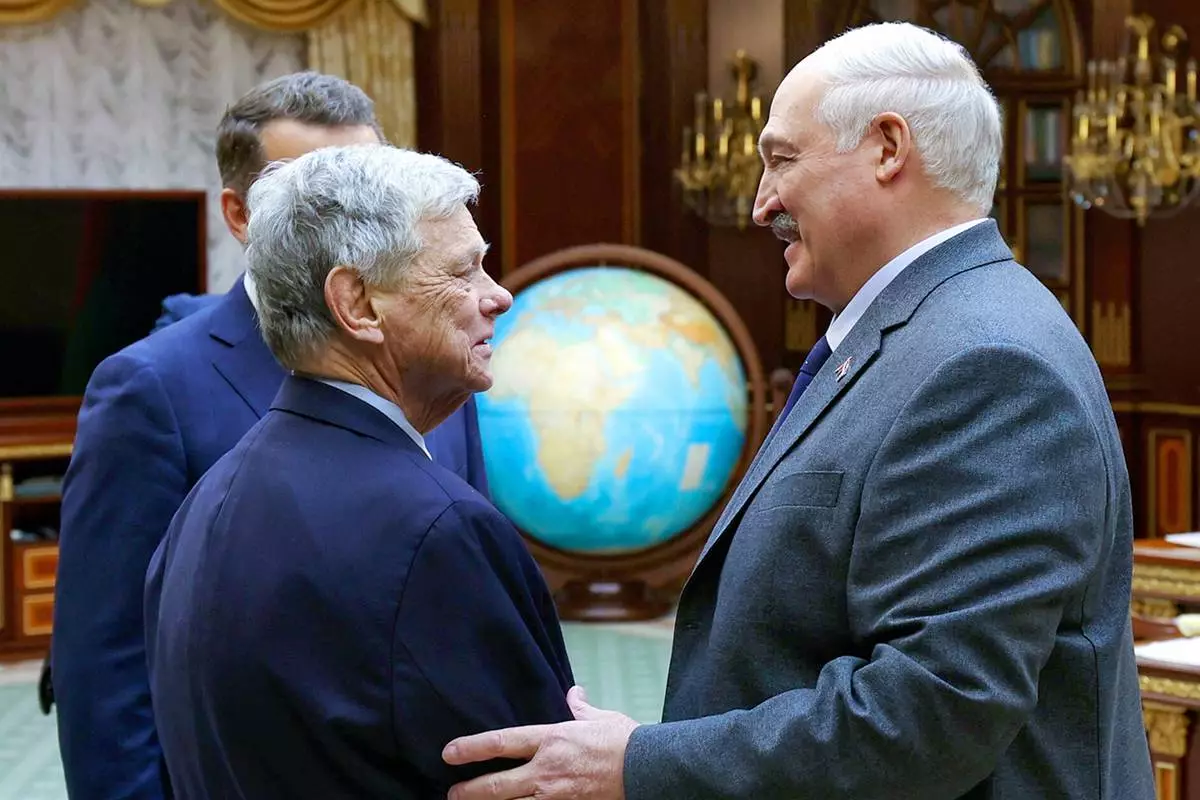
In this photo released by Belarusian presidential press service, Belarusian President Alexander Lukashenko, right, and U.S. Presidential envoy John Coale shake hands during their meeting in Minsk, Belarus, Friday, Dec. 12, 2025. (Belarusian Presidential Press Service via AP)

In this photo released by Belarusian presidential press service, Belarusian President Alexander Lukashenko, right, and U.S. Presidential envoy John Coale shake hands during their meeting in Minsk, Belarus, Friday, Dec. 12, 2025. (Belarusian Presidential Press Service via AP)

Recommended Articles