NAIROBI, Kenya--(BUSINESS WIRE)--Jul 30, 2025--
As the UN Food Systems Summit +4 wraps up in Addis Ababa, Wawira Njiru, Founder and CEO of Food4Education, takes the TED stage with a powerful message: Africa is not waiting for answers, it’s creating them.
This press release features multimedia. View the full release here: https://www.businesswire.com/news/home/20250730384724/en/
In her TED Talk released today [ go.ted.com/wawiranjiru ], food systems trailblazer Njiru tells the story of how a simple act of care — feeding 25 children in a makeshift kitchen — sparked a bold, locally-led solution now delivering over 500,000 meals every day. Today, Food4Education is the backbone of Kenya’s school feeding infrastructure and a blueprint for countries across Africa investing in nutrition, education, and opportunity all at once.
“School feeding isn’t charity, it’s strategy, it’s infrastructure,” said Njiru. “It’s how we nourish children, support farmers, strengthen education, and build systems that last. We’ve created a sustainable solution that shows Africa isn’t just solving its own challenges — we’re setting precedents the world can learn from.”
Built on public–private partnership, Food4Education combines government co-investment, parent contributions, and philanthropic force to power its industry-redefining solution. Its green kitchens run on clean energy. Its meals are sourced from local smallholder farmers. Its systems are digital, dignified, and built for scale, with every plate powering learning, livelihoods, and long-term opportunity.
Taking the stage as part of The Audacious Project 2024’s cohort, Njiru’s TED Talk comes at a time of renewed global attention on school feeding as a proven lever for inclusive, sustainable development. With Africa home to the youngest population on Earth, and 1 in 4 people projected to be African by 2050, how the continent feeds its children today will shape the future we all share.
“There’s no debate: school meals are among the most effective, scalable tools to strengthen food systems, linking education, nutrition, agriculture, and local economies,” said Shalom Ndiku, Director of Public Affairs at Food4Education. “At UNFSS+4, it was a proud moment for our whole team to see our work recognized as a flagship intervention in Kenya’s national report. It’s a testament to the collective effort driving sustainable, African-led school feeding systems.”
This is not just a Kenyan story. It’s a global opportunity. This TED milestone reflects a growing movement and global recognition that African solutions, grown and led locally, can transform systems at scale.
TED2025’s theme, Humanity Reimagined, celebrates bold ideas redefining the future. Njiru’s TED Talk, From Origin to Opportunity, reframes hunger through three bold provocations:
Watch the TED Talk: Understand the depth and impact of Food4Education’s work and engage with the vision go.ted.com/wawiranjiru
Support the movement: Contribute to the ongoing efforts to make classroom hunger history and to empower the next generation of African leaders www.food4education.org/donate
About Food4Education
Hungry kids can’t learn or grow.
Food4Education is an award-winning, locally rooted, and African-led solution to end classroom hunger. Building on more than a decade of learning by doing, we’re powering a new school feeding industry and sharing our blueprint to scale sustainable, nutritious, and affordable school feeding programs across Africa.
Today, we serve half a million kids DAILY in Kenya. But every day, we deliver more than a meal — improving nutrition and education outcomes for children while also creating jobs and opportunities for whole communities.
We are an experienced and trusted non-profit partner that operates with the excellence of a global business, reinvesting the value we create into local economies.
To learn more, please visit www.food4education.org.

Wawira Njiru, Founder and CEO of Food4Education, spotlights Tap2Eat — the NFC wristband powering Kenya’s school feeding infrastructure for over 500,000 children — giving them dignified, cashless access to school meals while using real‑time data to connect education, nutrition, and local economies.
CAIRO (AP) — Iranians began to regain internet access on Wednesday after authorities ended a monthslong shutdown. But users said service was slow and spotty in some areas, with apps like YouTube and Instagram heavily restricted, as they were before the cutoff began during nationwide protests in January.
Authorities justified the outage as a military imperative after the United States and Israel attacked Iran on Feb. 28. Their decision to lift some restrictions this week came as negotiators appeared to be closing in on a more permanent truce. But many Iranians feared access could be cut off again at a moment's notice.
Internet tracking company Netblocks said Iran’s connectivity, which measures the ability of devices to connect to the internet, is at around 86% of capacity from before the cutoff. Internet analysis firm Kentik said internet traffic, which measures the amount of data transferred and is a good illustration of usage, was at around 40%.
Amir Rashidi, an Iranian cybersecurity analyst, said there were still widespread disruptions. “It's too early to say the shutdown is over,” he wrote on X.
Iran’s roughly 90 million people have been cut off from the internet for most of 2026, one of the world’s longest and strictest national shutdowns. Young people with online careers saw their incomes evaporate. Job losses and the closure of online businesses added to the war's steep economic costs.
The cutoff made it difficult for Iranian families to communicate through months of unrest and war. At some points, phone lines were also cut off, though they were later restored.
A woman living in Tehran said that for months she was barely able to speak to her sons living abroad. She couldn't believe authorities had restored access, saying she had assumed they would find some justification to prolong the outage.
A taxi driver said service was restored but weak. He expressed hope it would improve so he could use messaging apps with family and friends. Both spoke on condition of anonymity for security reasons.
Prices spiked during the shutdown, with residents in Tehran at times paying around $7.50 per gigabyte. Prices are back down to around $2.25 for 30 gigabytes, roughly where they were before the protests.
Even then, Iran tightly controlled access to popular social media sites, leading many to rely on virtual private networks, or VPNs. The cost of those workarounds soared during the shutdown, making them unaffordable for many as the economy was battered.
Businesses have started reappearing online, announcing their return with posts on sites like Instagram and Telegram.
A gamer and tech influencer in the central city of Isfahan said the shutdown had caused him to lose a lot of his audience on YouTube and Instagram, where he had spent years building up a large following.
“All my views and interactions are way down. I’ve been erased from the algorithm,” he said in a voice note sent by WhatsApp, adding that his internet connection was still slower than before the shutdown.
“The situation is such that many content producers have had their income reduced to zero, have moved on to other jobs, or have been forced to sell their equipment to survive,” he said. He spoke on condition of anonymity for fear of reprisal.
Iranian authorities first shut down the internet in January during mass anti-government protests that were eventually stamped out in a violent crackdown. Thousands of people were killed and tens of thousands detained.
That cutoff was just starting to ease when the government imposed a complete internet blackout after the start of the war, when U.S. and Israeli strikes killed Iran's supreme leader and other top officials.
The government faced criticism for the prolonged shutdown, which caused even more harm to an economy devastated by inflation, strikes on key industries and a U.S. blockade on Iranian ports.
The internet cutoff cost an estimated $30-40 million daily, with indirect losses likely twice that much, a member of Iran’s Chamber of Commerce, Afshin Kolahi, told a local newspaper last month. About 10 million people have jobs that depend on internet connectivity, according to Communications Minister Sattar Hashemi.
Iranians still had access to a national net, but that has a far narrower reach, and users complained of poor service and heavy censorship. Senior government officials are given SIM cards granting them access to the global internet. Under pressure, the government expanded access to the SIM cards to some professions during the shutdown.
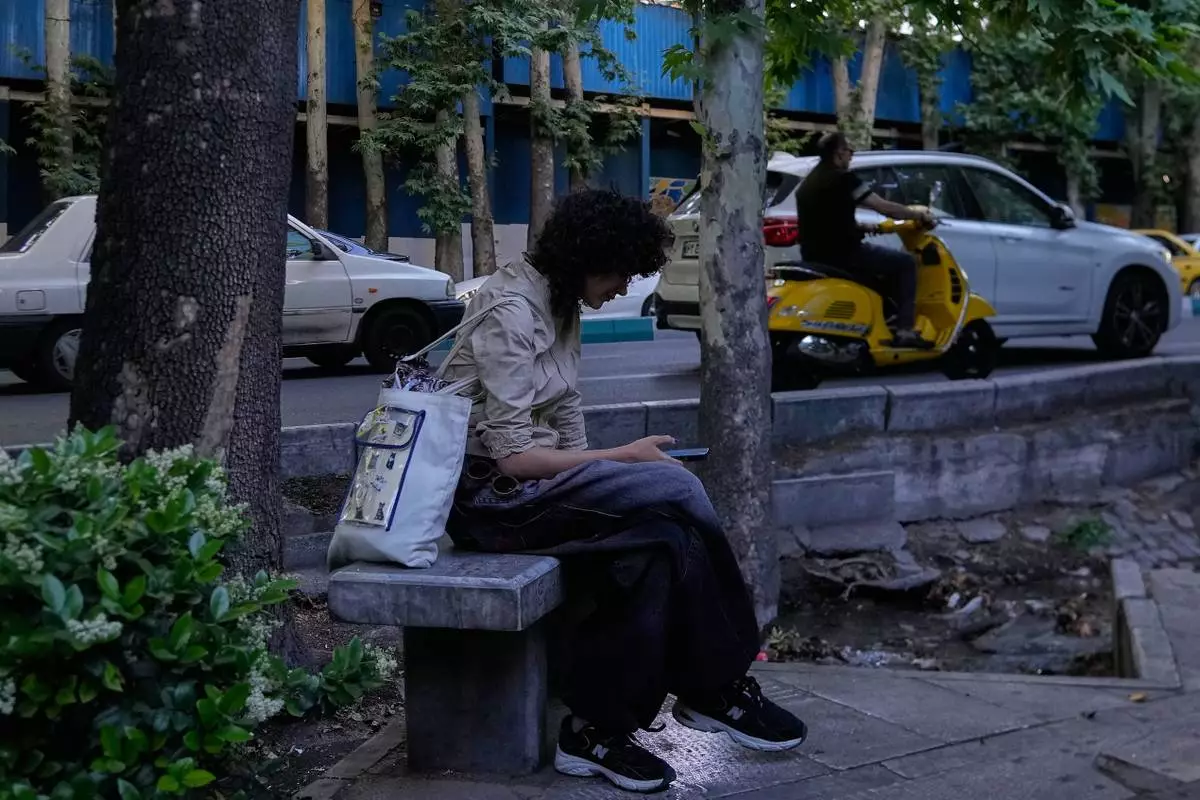
A woman checks her smartphone while sitting on a bench along a sidewalk in northern Tehran, Iran, Tuesday, May 26, 2026. (AP Photo/Vahid Salemi)