AUSTIN, Texas (AP) — Texas Republicans on Wednesday unveiled plans for a new U.S. House map that would deliver on President Donald Trump's goal of creating more winnable GOP seats before the 2026 elections, pushing ahead with a fast and unusual summer redrawing that Democrats have few options to blunt.
The new map would create five new Republican-leaning seats that Trump is seeking as his party looks to bolster its chances of maintaining its slim House majority. Republicans hope to pass it during a special 30-day session of the GOP-dominated Legislature called by GOP Gov. Greg Abbott.
The state's four Democratic-leaning major metropolitan areas — where the bulk of the booming state's 30 million people live — each would be sliced up among at least four congressional districts each under the new map, nearly all of which would be Republican-majority. One district would link a thin piece of Austin with oil-town Odessa, 340 miles (547 kilometers) to the west.
Trump had urged Texas to help the GOP, and his team has signaled that efforts could expand to other states, with a similar push underway in Missouri.
“My understanding is that there is a path forward for a Republican to win five more of those seats,” said Republican state Rep. Cody Vasut, chair of the Texas House’s redistricting committee, on the new maps.
Republicans hold 25 of the state’s 38 seats, and the new map ups the total they could win to 30. Had the same lines been in place in 2024, Trump would have carried each of the 30 districts by at least 10 percentage points, leading to conservative optimism despite what’s likely to be a tough midterm environment for the party.
U.S. House Democratic Leader Hakeem Jeffries accused Republicans of seeking to disenfranchise Black and Hispanic communities across the state, something the GOP disputes.
Jeffries, from New York, and Democratic California Gov. Gavin Newsom accused Trump and Abbott of trying to rig the 2026 midterm elections.
“The American people will not let them get away with it,” Jeffries said in a statement.
Democrats are pushing in both California and New York to consider redrawing their districts as well to counter the GOP efforts.
Democrats in Texas also are considering walking out to prevent the GOP from passing new maps before the special session ends Aug. 19, though Abbott could simply call another one.
Legislators in Texas and other states have walked out of legislative sessions before, hoping to thwart the other party, with mixed results.
In 2003, when Texas Republicans also sought to redraw district lines in place for only one congressional election, Democrats fled to Oklahoma and New Mexico but failed to overturn the GOP plan. Republicans had taken full control of the Legislature in the 2002 elections for the first time since the 1870s, and their new congressional map allowed the GOP to pick up six seats in 2004, meaning they held 21 to the Democrats’ 11.
Democratic Rep. Lloyd Doggett, dean of the Texas congressional delegation, said in a statement that Trump is taking a “hatchet” to his Austin district with the “sole objective of maintaining his one-man rule.” Doggett would be drawn into a district with another Democrat representing Austin, Rep. Greg Casar.
“My sole focus is on defeating this Trump-imposed gerrymandering, which relies on crooked lines instead of honest votes,” Doggett said.
Casar called the merger “illegal voter suppression.” The state would go from having two districts with a piece of Austin that extend at least 100 miles into more conservative, rural areas to having three, all farther-flung.
The new seats come from making two Rio Grande Valley seats that have been narrowly won by Democrats recently slightly more Republican, collapsing the seats held by Casar and Doggett and turning two Democratic-held seats in the Dallas-Ft. Worth area into GOP-majority ones.
Linking part of liberal Austin to conservative areas far to the west mimics something Republicans did in Kansas in 2022. Over Democratic Gov. Laura Kelly's veto, they put the liberal enclave with the main University of Kansas campus, 40 miles (64 kilometers) outside Kansas City, in a district with the western two-thirds of the state.
But Adam Kincaid, executive director of the National Republican Redistricting Trust overseeing GOP mapmaking, defended the new Texas proposal as beneficial for minority communities in big metropolitan areas. He said the new map would create two new Black-majority seats, one in Dallas and the other in the Houston area, and one new majority Hispanic one.
“If you go through it, you’re going to see that a lot of the communities that were broken up in the previous map were put together in this one,” he said.
Trump has been pushing for redistricting in Texas with the explicit goal of making it easier for Republicans to defend their U.S. House majority. And Democrats are limited in their options for countering the GOP's efforts.
Newsom has talked about redistricting, but an independent commission draws political boundaries.
In New York, Democrats introduced a proposal this week that would allow a new map ahead of schedule, but it would require amending the state constitution, a change that must pass the Legislature twice and be approved by voters. The soonest new lines could be in place would be 2028.
Democratic state Sen. Michael Gianaris, who is sponsoring the proposal, acknowledged the 2026 shortcomings of his legislation but said “we can’t just sit there and watch” as Texas redraws its maps.
“There may be opportunities elsewhere but this is not a battle that’s going to be over in a year,” he said in a phone interview after Texas proposed its new map. “Unfortunately this is just a new front in the manipulation in our democracy to gain political advantage.”
Cappelletti reported from Washington and Hanna, from Topeka, Kansas. Associated Press writers Anthony Izaguirre in Albany, New York, and Nicholas Riccardi in Denver contributed.
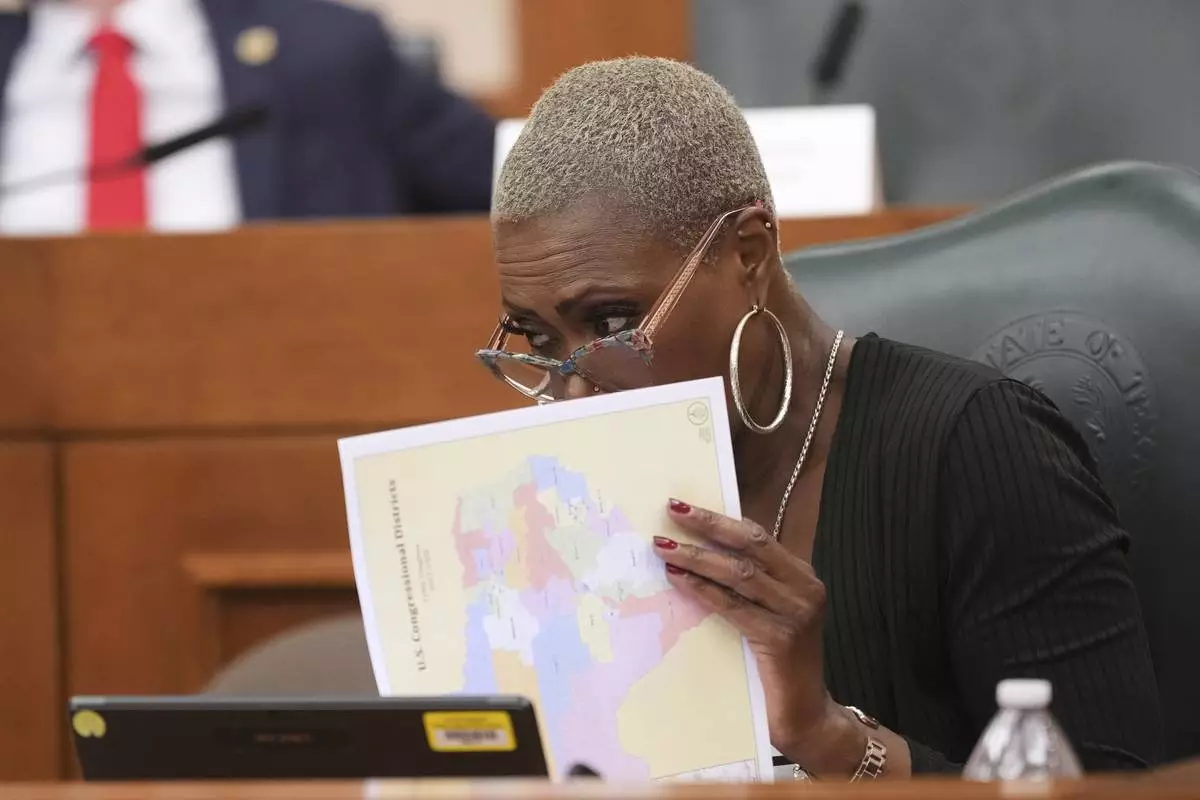
Texas state Rep. Jolanda "Jo" Jones looks through U.S. Congressional District maps during a redistricting hearing at the Texas Capitol, Thursday, July 24, 2025, in Austin, Texas. (AP Photo/Eric Gay)
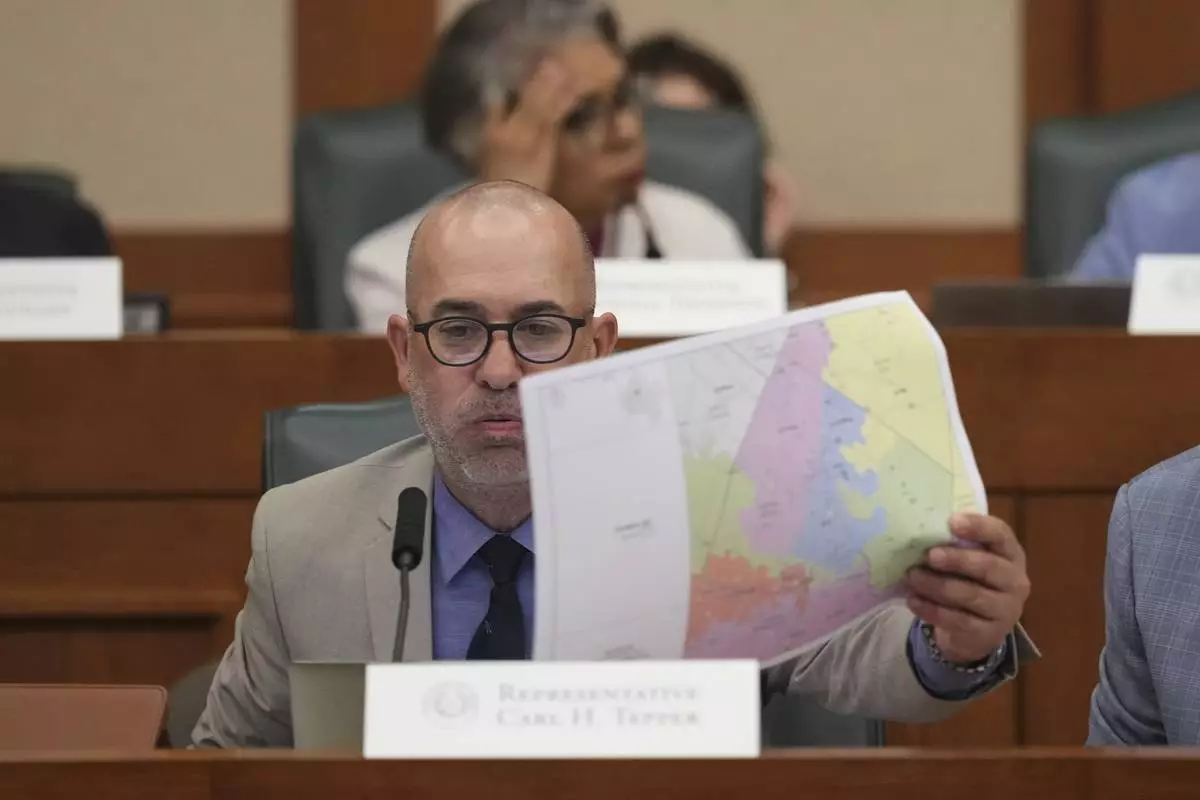
Texas state Rep. Carl H. Tepper, R-Lubbock, looks through U.S. Congressional District maps during a redistricting hearing at the Texas Capitol, Thursday, July 24, 2025, in Austin, Texas. (AP Photo/Eric Gay)