Typhoon Co-May unleashed torrential rains across east China's Shanghai and the provinces of Jiangsu and Anhui, disrupting transportation and prompting rainstorm alerts.
Co-May, the eighth typhoon of this year, made landfall for the second time in East China's Shanghai municipality on Wednesday afternoon after it made landfall in Zhejiang province in early Wednesday morning, according to the Shanghai central meteorological observatory.
On Thursday, heavy rain suddenly hit many areas in Shanghai, with the rainfall exceeding 50 millimeters within an hour, causing water to pool in residential areas and flood roads.
At a crossroad in Putuo District, the water depth reached 60 centimeters, stranding nearly 10 vehicles. Responding to the alarm, firefighters quickly arrived to rescue trapped individuals and clear the vehicles.
In Chongming District, heavy flooding drenched several homes, requiring firefighters an hour to pump out the accumulated water. Though Co-May further weakened into a tropical depression on Thursday afternoon, rainfall is still expected to continue in Jiangsu and Anhui until Sunday, with a Level-IV emergency response for flood control activated for Anhui on Thursday.
China's national observatory on Friday continued to issue a yellow alert for rainstorms.It is expected that in the next two days, some areas in the southern and eastern parts of Anhui Province, as well as the central, northern and southwestern parts of Jiangsu Province, will experience heavy rainstorms.
Additionally, some areas in the southwestern part of Guangdong Province, the southeastern coastal areas of Guangxi Zhuang Autonomous Region, and the southern part of Taiwan will also experience heavy rainstorms.

Typhoon Co-May unleashes torrential rains across east China
Chinese logistics companies are scaling back operations in the Middle East and reallocating resources to Africa, Southeast Asia, and the Americas as the region's geopolitical risks continue to intensify, driving up freight rates.
A senior executive of an international logistics company with a full-chain operation in Dubai, UAE, said that the company operates a customs brokerage, overseas warehouses, container truck fleets, and pickup truck fleets in the region, with a team of over 100 people.
Due to the current situation, most of their Dubai-based colleagues are now working on a flexible basis, and some staff have already returned home early for holidays.
"In light of the development trends of the Middle East war, our business footprint in the region will further shrink. Therefore, we will increasingly allocate our resources to routes serving Africa, Southeast Asia, and the Americas, including redeploying personnel to other countries as part of our new layout," said Fan Jiansheng, head of an international logistics company based in Shenzhen, Guangdong Province.
While companies are actively adjusting their layouts and shifting to other regional routes, the pressure of rising freight rates cannot be ignored.
"On other routes - the U.S., Europe, South America, and Southeast Asia - freight rates have risen by 10 to 20 percent or even more, whether by air, courier, or sea, due to rising fuel surcharges. From the end of February to the beginning of April, rates have gone up four or five times in just one month. All these costs have become uncontrollable for us, posing a huge challenge to sellers," said Li Liangjuan, head of a freight forwarding company based in Shenzhen, Guangdong Province.
In response to the continuing trend of rising freight rates, many European and American trading companies and cross-border e-commerce businesses have begun bulk purchasing and stockpiling in advance to hedge against further rate increases.
"Domestic cargo owners or cross-border e-commerce business owners are preparing their goods much earlier than in previous years and stockpiling for longer periods. Combined with current order demand, many of our warehouses in North America are now completely overloaded," said Zhao Kaijie, head of a warehousing and logistics company based in Shenzhen, Guangdong Province.
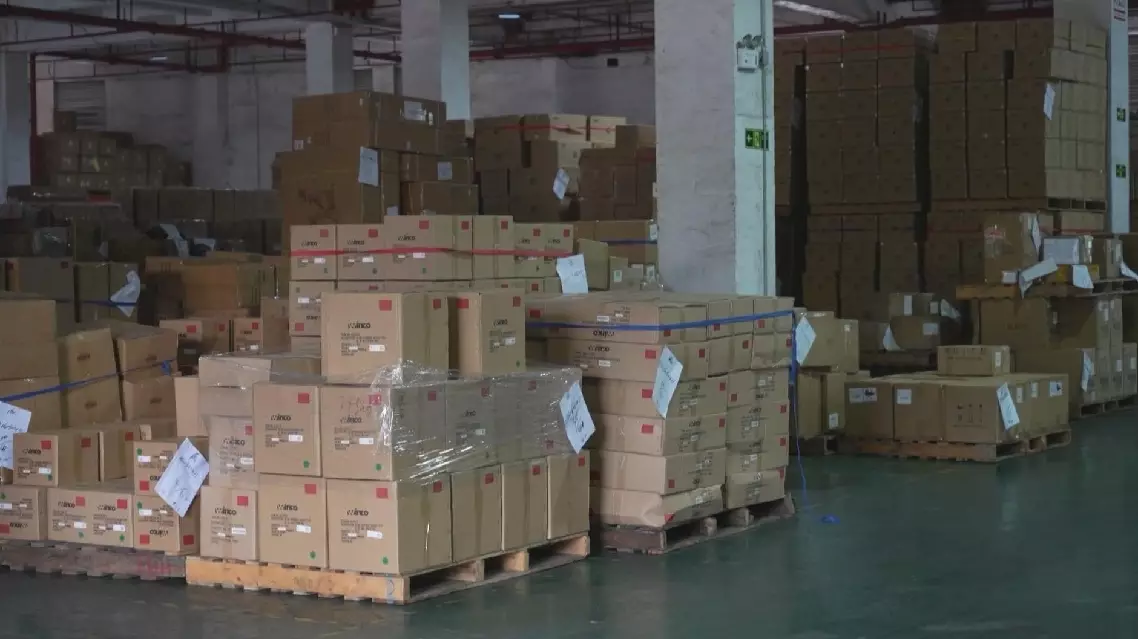
Logistics firms shift away from Middle East as conflict raises costs