Skip to Content Facebook Feature Image

Corporation for Public Broadcasting to shut down after being defunded by Congress, targeted by Trump

ENT

Corporation for Public Broadcasting to shut down after being defunded by Congress, targeted by Trump
ENT

ENT

Corporation for Public Broadcasting to shut down after being defunded by Congress, targeted by Trump

2025-08-02 08:45 Last Updated At:08:50

WASHINGTON (AP) — The Corporation for Public Broadcasting, a cornerstone of American culture for three generations, announced Friday it would take steps toward its own closure after being defunded by Congress — marking the end of a nearly six-decade era in which it fueled the production of renowned educational programming, cultural content and even emergency alerts.

The demise of the corporation, known as CPB, is a direct result of President Donald Trump's targeting of public media, which he has repeatedly said is spreading political and cultural views antithetical to those the United States should be espousing. The closure is expected to have a profound impact on the journalistic and cultural landscape — in particular, public radio and TV stations in small communities across the United States.

CPB helps fund both PBS and NPR, but most of its funding is distributed to more than 1,500 local public radio and television stations around the country.

The corporation also has deep ties to much of the nation’s most familiar programming, from NPR’s “All Things Considered” to, historically, “Sesame Street,” “Mister Rogers' Neighborhood” and the documentaries of Ken Burns.

The corporation said its end, 58 years after being signed into law by President Lyndon B. Johnson, would come in an “orderly wind-down.” In a statement, it said the decision came after the passage through Congress of a package that clawed back its funding for the next two budget years — about $1.1 billion. Then, the Senate Appropriations Committee reinforced that policy change Thursday by excluding funding for the corporation for the first time in more than 50 years as part of a broader spending bill.

“Despite the extraordinary efforts of millions of Americans who called, wrote, and petitioned Congress to preserve federal funding for CPB, we now face the difficult reality of closing our operations,” said Patricia Harrison, the corporation’s president and CEO.

Democratic members of the Senate Appropriations Committee made a last-ditch effort this week to save the CBP's funding.

As part of Thursday's committee deliberations, Sen. Tammy Baldwin, D-Wis., authored but then withdrew an amendment to restore CPB funding for the coming budget year. She said she still believed there was a path forward “to fix this before there are devastating consequences for public radio and television stations across the country.”

“It's hard to believe we’ve ended up in the situation we’re in,” she said. “And I’m going to continue to work with my colleagues to fix it.”

But Sen. Shelley Moore Capito, R-W.Va., sounded a less optimistic tone.

“I understand your concerns, but we all know we litigated this two weeks ago,” Capito said. “Adopting this amendment would have been contrary to what we have already voted on.”

CPB said it informed employees Friday that most staff positions will end with the fiscal year on Sept. 30. It said a small transition team will stay in place until January to finish any remaining work — including, it said, “ensuring continuity for music rights and royalties that remain essential to the public media system.”

“Public media has been one of the most trusted institutions in American life, providing educational opportunity, emergency alerts, civil discourse, and cultural connection to every corner of the country,” Harrison said. “We are deeply grateful to our partners across the system for their resilience, leadership, and unwavering dedication to serving the American people.”

NPR stations use millions of dollars in federal money to pay music licensing fees. Now, many will have to renegotiate these deals. That could impact, in particular, outlets that build their programming around music discovery. NPR President and CEO Katherine Maher estimated recently, for example, that some 96% of all classical music broadcast in the United States is on public radio stations.

Federal money for public radio and television has traditionally been appropriated to the Corporation for Public Broadcasting, which distributes it to NPR and PBS. Roughly 70% of the money goes directly to the 330 PBS and 246 NPR stations across the country, although that’s only a shorthand way to describe its potential impact.

Trump, who has called the CPB a “monstrosity,” has long said that public broadcasting displays an extreme liberal bias, helped create the momentum in recent months for an anti-public broadcasting groundswell among his supporters in Congress and around the country. It is part of a larger initiative in which he has targeted institutions — particularly cultural ones — that produce content or espouse attitudes that he considers “un-American.” The CPB’s demise represents a political victory for those efforts.

His impact on the media landscape has been profound. He has also gone after U.S. government media that had independence charters, including the venerable Voice of America, ending that media outlet’s operations after many decades.

Trump also fired three members of the corporation’s board of directors in April. In legal action at the time, the fired directors said their dismissal was governmental overreach targeting an entity whose charter guarantees it independence.

FILE - A stuffed Cookie Monster is seated in a control room at the Arizona PBS offices at the Walter Cronkite School of Journalism and Mass Communication in Phoenix, Friday, May 2, 2025. (AP Photo/Katie Oyan, File)

FILE - A stuffed Cookie Monster is seated in a control room at the Arizona PBS offices at the Walter Cronkite School of Journalism and Mass Communication in Phoenix, Friday, May 2, 2025. (AP Photo/Katie Oyan, File)

FILE - An entrance to the Arizona PBS offices in the Walter Cronkite School of Journalism and Mass Communication in Phoenix is photographed, May 2, 2025. (AP Photo/Katie Oyan, File)

FILE - An entrance to the Arizona PBS offices in the Walter Cronkite School of Journalism and Mass Communication in Phoenix is photographed, May 2, 2025. (AP Photo/Katie Oyan, File)

FILE - One of the control rooms at the Arizona PBS offices at the Walter Cronkite School of Journalism and Mass Communication in Phoenix is seen Friday, May 2, 2025. (AP Photo/Katie Oyan, File)

FILE - One of the control rooms at the Arizona PBS offices at the Walter Cronkite School of Journalism and Mass Communication in Phoenix is seen Friday, May 2, 2025. (AP Photo/Katie Oyan, File)
CAPE CANAVERAL, Fla. (AP) — An ailing astronaut returned to Earth with three others on Thursday, ending their space station mission more than a month early in NASA’s first medical evacuation.

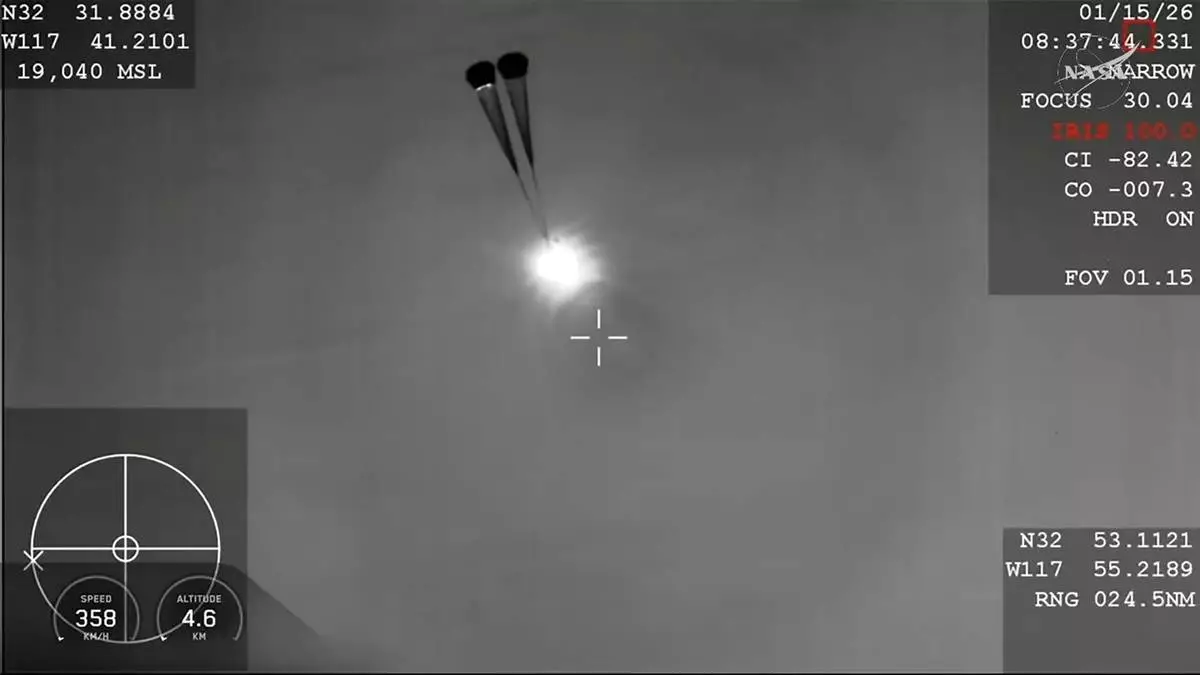
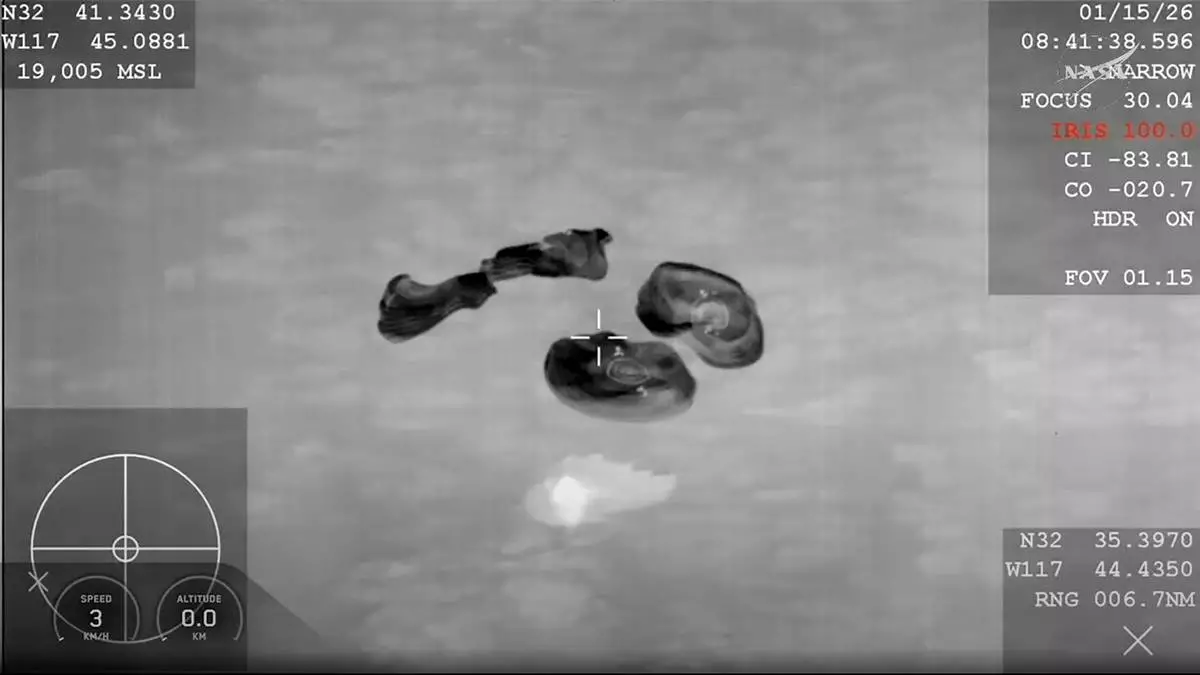
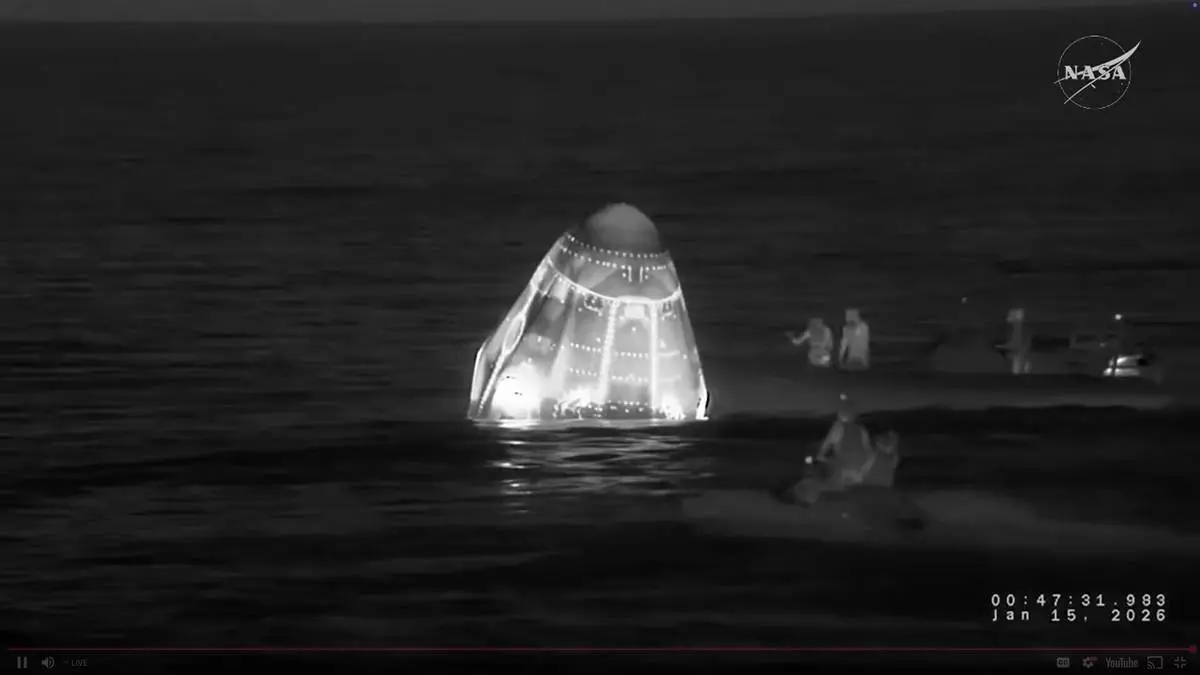
SpaceX guided the capsule to a middle-of-the-night splashdown in the Pacific near San Diego, less than 11 hours after the astronauts exited the International Space Station.

“It’s so good to be home,” said NASA astronaut Zena Cardman, the capsule commander.

It was an unexpected finish to a mission that began in August and left the orbiting lab with only one American and two Russians on board. NASA and SpaceX said they would try to move up the launch of a fresh crew of four; liftoff is currently targeted for mid-February.

Cardman and NASA’s Mike Fincke were joined on the return by Japan’s Kimiya Yui and Russia’s Oleg Platonov. Officials have refused to identify the astronaut who had the health problem or explain what happened, citing medical privacy.

While the astronaut was stable in orbit, NASA wanted them back on Earth as soon as possible to receive proper care and diagnostic testing. The entry and splashdown required no special changes or accommodations, officials said, and the recovery ship had its usual allotment of medical experts on board. It was not immediately known when the astronauts would fly from California to their home base in Houston. Platonov’s return to Moscow was also unclear.

NASA stressed repeatedly over the past week that this was not an emergency. The astronaut fell sick or was injured on Jan. 7, prompting NASA to call off the next day’s spacewalk by Cardman and Fincke, and ultimately resulting in the early return. It was the first time NASA cut short a spaceflight for medical reasons. The Russians had done so decades ago.

The space station has gotten by with three astronauts before, sometimes even with just two. NASA said it will be unable to perform a spacewalk, even for an emergency, until the arrival of the next crew, which has two Americans, one French and one Russian astronaut.

The Associated Press Health and Science Department receives support from the Howard Hughes Medical Institute’s Department of Science Education and the Robert Wood Johnson Foundation. The AP is solely responsible for all content.

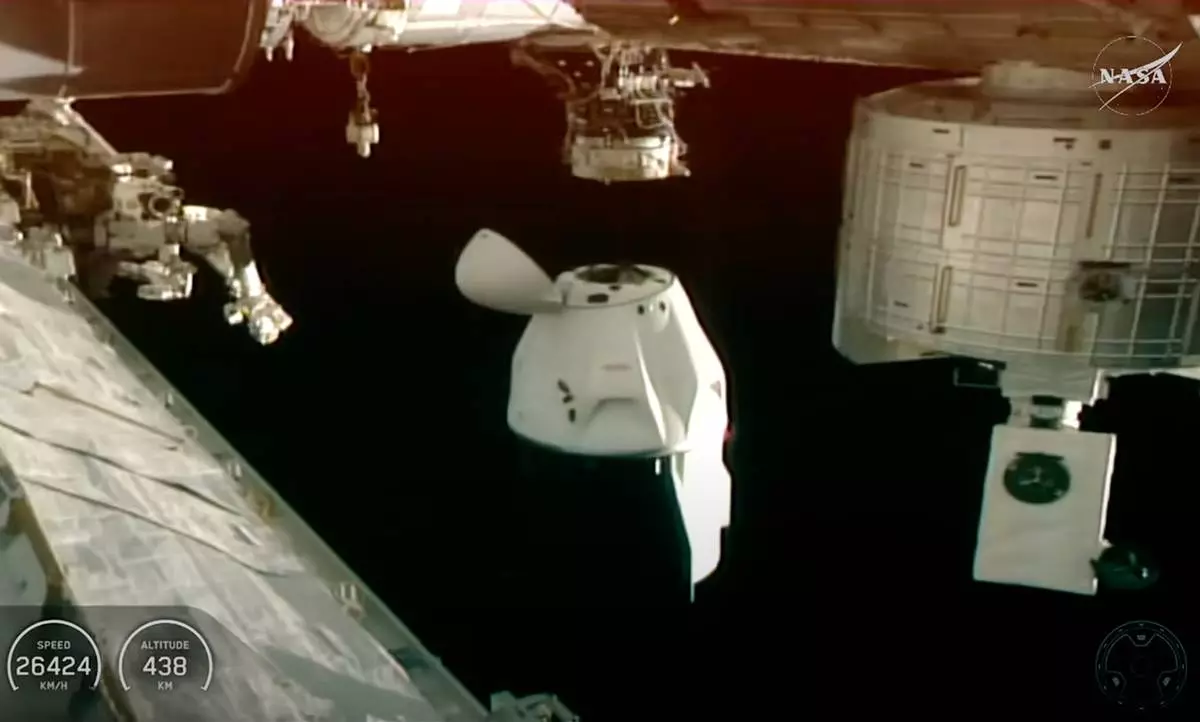
This screengrab from video provided by NASA TV shows the SpaceX Dragon departing from the International Space Station shortly after undocking with four NASA Crew-11 members inside on Wednesday, Jan. 14, 2026. (NASA via AP)

This screengrab from video provided by NASA TV shows the SpaceX Dragon departing from the International Space Station shortly after undocking with four NASA Crew-11 members inside on Wednesday, Jan. 14, 2026. (NASA via AP)

This photo provided by NASA shows clockwise from bottom left are, NASA astronaut Mike Fincke, Roscosmos cosmonaut Oleg Platonov, NASA astronaut Zena Cardman, and JAXA (Japan Aerospace Exploration Agency) astronaut Kimiya Yui gathering for a crew portrait wearing their Dragon pressure suits during a suit verification check inside the International Space Station’s Kibo laboratory module, Wednesday, Jan. 14, 2026. (NASA via AP)

This photo provided by NASA shows clockwise from bottom left are, NASA astronaut Mike Fincke, Roscosmos cosmonaut Oleg Platonov, NASA astronaut Zena Cardman, and JAXA (Japan Aerospace Exploration Agency) astronaut Kimiya Yui gathering for a crew portrait wearing their Dragon pressure suits during a suit verification check inside the International Space Station’s Kibo laboratory module, Wednesday, Jan. 14, 2026. (NASA via AP)

This screengrab from video provided by NASA shows recovery vessels approaching the NASA's SpaceX Crew-11 capsule to evacuate one of the crew members after they re-entered the earth in a middle-of-the-night splashdown near San Diego, Calif., Thursday, Jan. 15, 2026. (NASA via AP)

This screengrab from video provided by NASA shows recovery vessels approaching the NASA's SpaceX Crew-11 capsule to evacuate one of the crew members after they re-entered the earth in a middle-of-the-night splashdown near San Diego, Calif., Thursday, Jan. 15, 2026. (NASA via AP)

This screengrab from video provided by NASA shows the NASA's SpaceX Crew-11 members re entering the earth in a middle-of-the-night splashdown near San Diego, Calif., Thursday, Jan. 15, 2026. (NASA via AP)

This screengrab from video provided by NASA shows the NASA's SpaceX Crew-11 members re entering the earth in a middle-of-the-night splashdown near San Diego, Calif., Thursday, Jan. 15, 2026. (NASA via AP)

This screengrab from video provided by NASA shows the NASA's SpaceX Crew-11 members re entering the earth in a middle-of-the-night splashdown near San Diego, Calif., Thursday, Jan. 15, 2026. (NASA via AP)

This screengrab from video provided by NASA shows the NASA's SpaceX Crew-11 members re entering the earth in a middle-of-the-night splashdown near San Diego, Calif., Thursday, Jan. 15, 2026. (NASA via AP)

Recommended Articles