Skip to Content Facebook Feature Image

Wikipedia unveils new AI licensing deals as it marks 25th birthday

TECH

Wikipedia unveils new AI licensing deals as it marks 25th birthday
TECH

TECH

Wikipedia unveils new AI licensing deals as it marks 25th birthday

2026-01-15 16:30 Last Updated At:17:03

LONDON (AP) — Wikipedia unveiled new business deals with a slew of artificial intelligence companies on Thursday as it marked its 25th anniversary.

The online crowdsourced encyclopedia revealed that it has signed licensing deals with AI companies including Amazon, Meta Platforms, Perplexity, Microsoft and France's Mistral AI.

More Images
Outgoing Wikimedia Foundation CEO Maryana Iskander speaks in an interview with the Associated Press in Johannesburg, South Africa, Tuesday Jan. 13, 2026. (AP Photo/Alfonso Nqunjana)

Outgoing Wikimedia Foundation CEO Maryana Iskander speaks in an interview with the Associated Press in Johannesburg, South Africa, Tuesday Jan. 13, 2026. (AP Photo/Alfonso Nqunjana)

Emeline Brule, volunteer Wikipedia editor, sits below a Wikipedia logo displayed at the Wikimedia Foundation office in San Francisco, Monday, Jan. 12, 2026. (AP Photo/Jeff Chiu)

Emeline Brule, volunteer Wikipedia editor, sits below a Wikipedia logo displayed at the Wikimedia Foundation office in San Francisco, Monday, Jan. 12, 2026. (AP Photo/Jeff Chiu)

Jimmy Wales, founder of Wikipedia, speaks during an interview with The Associated Press on the occasion of Wikipedia's 25th anniversary in London, Monday, Jan. 12, 2026. (AP Photo/Frank Augstein)
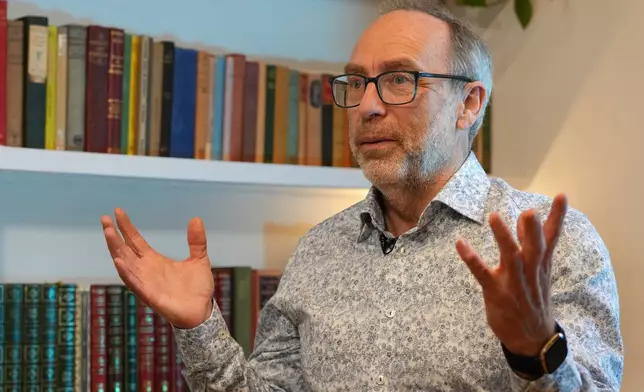
Jimmy Wales, founder of Wikipedia, speaks during an interview with The Associated Press on the occasion of Wikipedia's 25th anniversary in London, Monday, Jan. 12, 2026. (AP Photo/Frank Augstein)

Jimmy Wales, founder of Wikipedia, gestures during an interview with The Associated Press on the occasion of Wikipedia's 25th anniversary in London, Monday, Jan. 12, 2026. (AP Photo/Frank Augstein)

Jimmy Wales, founder of Wikipedia, gestures during an interview with The Associated Press on the occasion of Wikipedia's 25th anniversary in London, Monday, Jan. 12, 2026. (AP Photo/Frank Augstein)

Jimmy Wales, founder of Wikipedia, gestures during an interview with The Associated Press on the occasion of Wikipedia's 25th anniversary in London, Monday, Jan. 12, 2026. (AP Photo/Frank Augstein)

Jimmy Wales, founder of Wikipedia, gestures during an interview with The Associated Press on the occasion of Wikipedia's 25th anniversary in London, Monday, Jan. 12, 2026. (AP Photo/Frank Augstein)

Wikipedia is one of the last bastions of the early internet, but that original vision of a free online space has been clouded by the dominance of Big Tech platforms and the rise of generative AI chatbots trained on content scraped from the web.

Aggressive data collection methods by AI developers, including from Wikipedia's vast repository of free knowledge, has raised questions about who ultimately pays for the artificial intelligence boom.

The nonprofit that runs the site signed Google as one of its first customers in 2022 and announced other agreements last year with smaller AI players like search engine Ecosia.

The new deals will help one of the world's most popular websites monetize heavy traffic from AI companies. They're paying to access Wikipedia content “at a volume and speed designed specifically for their needs,” the Wikimedia Foundation said. It did not provide financial or other details.

While AI training has sparked legal battles elsewhere over copyright and other issues, Wikipedia founder Jimmy Wales said he welcomes it.

“I'm very happy personally that AI models are training on Wikipedia data because it’s human curated," Wales told The Associated Press in an interview. "I wouldn’t really want to use an AI that’s trained only on X, you know, like a very angry AI,” Wales said, referring to billionaire Elon Musk's social media platform.

Wales said the site wants to work with AI companies, not block them. But "you should probably chip in and pay for your fair share of the cost that you’re putting on us."

The Wikimedia Foundation, a nonprofit group that runs Wikipedia, last year urged AI developers to pay for access through its enterprise platform and said human traffic had fallen 8%. Meanwhile, visits from bots, sometimes disguised to evade detection, were heavily taxing its servers as they scrape masses of content to feed AI large language models.

The findings highlighted shifting online trends as search engine AI overviews and chatbots summarize information instead of sending users to sites by showing them links.

Wikipedia is the ninth most visited site on the internet. It has more than 65 million articles in 300 languages that are edited by some 250,000 volunteers.

The site has become so popular in part because its free for anyone to use.

“But our infrastructure is not free, right?" Wikimedia Foundation CEO Maryana Iskander said in a separate interview in Johannesburg, South Africa.

It costs money to maintain servers and other infrastructure that allows both individuals and tech companies to “draw data from Wikipedia,” said Iskander, who's stepping down on Jan. 20, and will be replaced by Bernadette Meehan.

The bulk of Wikipedia's funding comes from 8 million donors, most of them individuals.

“They're not donating in order to subsidize these huge AI companies,” Wales said. They're saying, "You know what, actually you can’t just smash our website. You have to sort of come in the right way.”

Editors and users could benefit from AI in other ways. The Wikimedia Foundation has outlined an AI strategy that Wales said could result in tools that reduce tedious work for editors.

While AI isn’t good enough to write Wikipedia entries from scratch, it could, for example, be used to update dead links by scanning the surrounding text and then searching online to find other sources.

“We don’t have that yet but that’s the kind of thing that I think we will see in the future.”

Artificial intelligence could also improve the Wikipedia search experience, by evolving from the traditional keyword method to more of a chatbot style, Wales said.

“You can imagine a world where you can ask the Wikipedia search box a question and it will quote to you from Wikipedia," he said. It could respond by saying "here’s the answer to your question from this article and here’s the actual paragraph. That sounds really useful to me and so I think we’ll move in that direction as well. ”

Reflecting on the early days, Wales said it was a thrilling time because many people were motivated to help build Wikipedia after he and co-founder Larry Sanger, who departed long ago, set it up as an experiment.

However, while some might look back wistfully on what seems now to be a more innocent time, Wales said those early days of the internet also had a dark side.

“People were pretty toxic back then as well. We didn’t need algorithms to be mean to each other,” he said. “But, you know, it was a time of great excitement and a real spirit of possibility.”

Wikipedia has lately found itself under fire from figures on the political right, who have dubbed the site “Wokepedia” and accused it of being biased in favor of the left.

Republican lawmakers in the U.S. Congress are investigating alleged “manipulation efforts” in Wikipedia’s editing process that they said could inject bias and undermine neutral points of view on its platform and the AI systems that rely on it.

A notable source of criticism is Musk, who last year launched his own AI-powered rival, Grokipedia. He has criticized Wikipedia for being filled with “propaganda” and urged people to stop donating to the site.

Wales said he doesn't consider Grokipedia a “real threat” to Wikipedia because it's based on large language models, which are the troves of online text that AI systems are trained on.

“Large language models aren’t good enough to write really quality reference material. So a lot of it is just regurgitated Wikipedia,” he said. “It often is quite rambling and sort of talks nonsense. And I think the more obscure topic you look into, the worse it is.”

He stressed that he wasn't singling out criticism of Grokipedia.

“It’s just the way large language models work.”

Wales say he's known Musk for years but they haven't been in touch since Grokipedia launched.

“I should probably ping him,” Wales said.

What would he say?

“'How’s your family?' I’m a nice person, I don’t really want to pick a fight with anybody.”

AP writer Mogomotsi Magome in Johannesburg contributed to this report

Outgoing Wikimedia Foundation CEO Maryana Iskander speaks in an interview with the Associated Press in Johannesburg, South Africa, Tuesday Jan. 13, 2026. (AP Photo/Alfonso Nqunjana)

Outgoing Wikimedia Foundation CEO Maryana Iskander speaks in an interview with the Associated Press in Johannesburg, South Africa, Tuesday Jan. 13, 2026. (AP Photo/Alfonso Nqunjana)

Emeline Brule, volunteer Wikipedia editor, sits below a Wikipedia logo displayed at the Wikimedia Foundation office in San Francisco, Monday, Jan. 12, 2026. (AP Photo/Jeff Chiu)

Emeline Brule, volunteer Wikipedia editor, sits below a Wikipedia logo displayed at the Wikimedia Foundation office in San Francisco, Monday, Jan. 12, 2026. (AP Photo/Jeff Chiu)

Jimmy Wales, founder of Wikipedia, speaks during an interview with The Associated Press on the occasion of Wikipedia's 25th anniversary in London, Monday, Jan. 12, 2026. (AP Photo/Frank Augstein)

Jimmy Wales, founder of Wikipedia, speaks during an interview with The Associated Press on the occasion of Wikipedia's 25th anniversary in London, Monday, Jan. 12, 2026. (AP Photo/Frank Augstein)

Jimmy Wales, founder of Wikipedia, gestures during an interview with The Associated Press on the occasion of Wikipedia's 25th anniversary in London, Monday, Jan. 12, 2026. (AP Photo/Frank Augstein)
Jimmy Wales, founder of Wikipedia, gestures during an interview with The Associated Press on the occasion of Wikipedia's 25th anniversary in London, Monday, Jan. 12, 2026. (AP Photo/Frank Augstein)

Jimmy Wales, founder of Wikipedia, gestures during an interview with The Associated Press on the occasion of Wikipedia's 25th anniversary in London, Monday, Jan. 12, 2026. (AP Photo/Frank Augstein)

Jimmy Wales, founder of Wikipedia, gestures during an interview with The Associated Press on the occasion of Wikipedia's 25th anniversary in London, Monday, Jan. 12, 2026. (AP Photo/Frank Augstein)
BEIJING (AP) — In China, the names of things are often either ornately poetic or jarringly direct. A new, wildly popular app among young Chinese people is definitively the latter.

It's called, simply, “Are You Dead?"

In a vast country whose young people are increasingly on the move, the new, one-button app — which has taken the country by digital storm this month — is essentially exactly what it says it is. People who live alone in far-off cities and may be at risk — or just perceived as such by friends or relatives — can push an outsized green circle on their phone screens and send proof of life over the network to a friend or loved one. The cost: 8 yuan (about $1.10).

It's simple and straightforward — essentially a 21st-century Chinese digital version of those American pendants with an alert button on them for senior citizens that gave birth to the famed TV commercial: “I've fallen, and I can't get up!”

Developed by three young people in their 20s, “Are You Dead?” became the most downloaded paid app on the Apple App Store in China last week, according to local media reports. It is also becoming a top download in places as diverse as Singapore and the Netherlands, Britain and India and the United States — in line with the developers' attitude that loneliness and safety aren't just Chinese issues.

“Every country has young people who move to big cities to chase their dreams,” Ian Lü, 29, one of the app's developers, said Thursday.

Lü, who worked and lived alone in the southern city of Shenzhen for five years, experienced such loneliness himself. He said the need for a frictionless check-in is especially strong among introverts. “It's unrealistic,” he said, “to message people every day just to tell them you're still alive.”

Against the backdrop of modern and increasingly frenetic Chinese life, the market for the app is understandable.

Traditionally, Chinese families have tended to live together or at least in close proximity across generations — something embedded deep in the nation's culture until recent years. That has changed in the last few decades with urbanization and rapid economic growth that have sent many Chinese to join what is effectively a diaspora within their own nation — and taken hundreds of millions far from parents, grandparents, aunts and uncles.

Today, the country has more than 100 million households with only one person, according to an annual report from the National Bureau of Statistics of China in 2024.

Consider Chen Xingyu, 32, who has lived on her own for years in Kunming, the capital of southern China’s Yunnan province. “It is new and funny. The name ’Are You Dead?' is very interesting,” Chen said.

Chen, a “lying flat” practitioner who has rejected the grueling, fast-paced career of many in her age group, would try the app but worries about data security. “Assuming many who want to try are women users, if information of such detail about users gets leaked, that’d be terrible,” she said.

Yuan Sangsang, a Shanghai designer, has been living on her own for a decade and describes herself as a “single cow and horse.” She's not hoping the app will save her life — only help her relatives in the event that she does, in fact, expire alone.

"I just don’t want to die with no dignity, like the body gets rotten and smelly before it is found," said Yuan, 38. “That would be unfair for the ones who have to deal with it.”

While such an app might at first seem best suited to elderly people — regardless of their smartphone literacy — all reports indicate that “Are You Dead?” is being snapped up by younger people as the wry equivalent of a social media check-in.

“Some netizens say that the 'Are you dead?' greeting feels like a carefree joke between close friends — both heartfelt and gives a sense of unguarded ease,” the business website Yicai, the Chinese Business Network, said in a commentary. ""It likely explains why so many young people unanimously like this app."

The commentary, by writer He Tao, went further in analyzing the cultural landscape. He wrote that the app's immediate success “serves as a darkly humorous social metaphor, reminding us to pay attention to the living conditions and inner world of contemporary young people. Those who downloaded it clearly need more than just a functional security measure; they crave a signal of being seen and understood.”

Death is a taboo subject in Chinese culture, and the word itself is shunned to the point where many buildings in China have no fourth floor because the word for “four” and the word for “death” sound the same — “si.” Lü acknowledged that the app's name sparked public pressure.

“Death is an issue every one of us has to face,” he said. “Only when you truly understand death do you start thinking about how long you can exist in this world, and how you want to realize the value of your life.”

A few days ago, though, the developers said on their official account on China’s Weibo social platform that they’d pivot to a new name. Their choice: the more cryptic “Demumu,” which they said they hoped could "serve more solo dwellers globally.”

Then, a twist: Late Wednesday, the app team posted on its Weibo account that workshopping the name Demumu didn’t turn out “as well as expected.” The app team is offering a reward for whoever offers a new name that will be picked this weekend. Lü said more than 10,000 people have weighed in.

The reward for the new moniker: $96 — or, in China, 666 yuan.

Fu Ting reported from Washington. AP researcher Shihuan Chen in Beijing contributed.

The app Are You Dead? is seen on a smartphone in Beijing, China, Thursday, Jan. 15, 2026. (AP Photo/Ng Han Guan)

The app Are You Dead? is seen on a smartphone in Beijing, China, Thursday, Jan. 15, 2026. (AP Photo/Ng Han Guan)

A woman looks at her smartphone in a cafe in Beijing, China, Thursday, Jan. 15, 2026. (AP Photo/Ng Han Guan)

A woman looks at her smartphone in a cafe in Beijing, China, Thursday, Jan. 15, 2026. (AP Photo/Ng Han Guan)

A woman looks at her smartphone outside a restaurant in Beijing, China, Thursday, Jan. 15, 2026. (AP Photo/Ng Han Guan)

A woman looks at her smartphone outside a restaurant in Beijing, China, Thursday, Jan. 15, 2026. (AP Photo/Ng Han Guan)

A man looks down near his smartphone in Beijing, China, Thursday, Jan. 15, 2026. (AP Photo/Ng Han Guan)

A man looks down near his smartphone in Beijing, China, Thursday, Jan. 15, 2026. (AP Photo/Ng Han Guan)

A man reacts while holding his smartphone in Beijing, China, Thursday, Jan. 15, 2026. (AP Photo/Ng Han Guan)

A man reacts while holding his smartphone in Beijing, China, Thursday, Jan. 15, 2026. (AP Photo/Ng Han Guan)

Recommended Articles