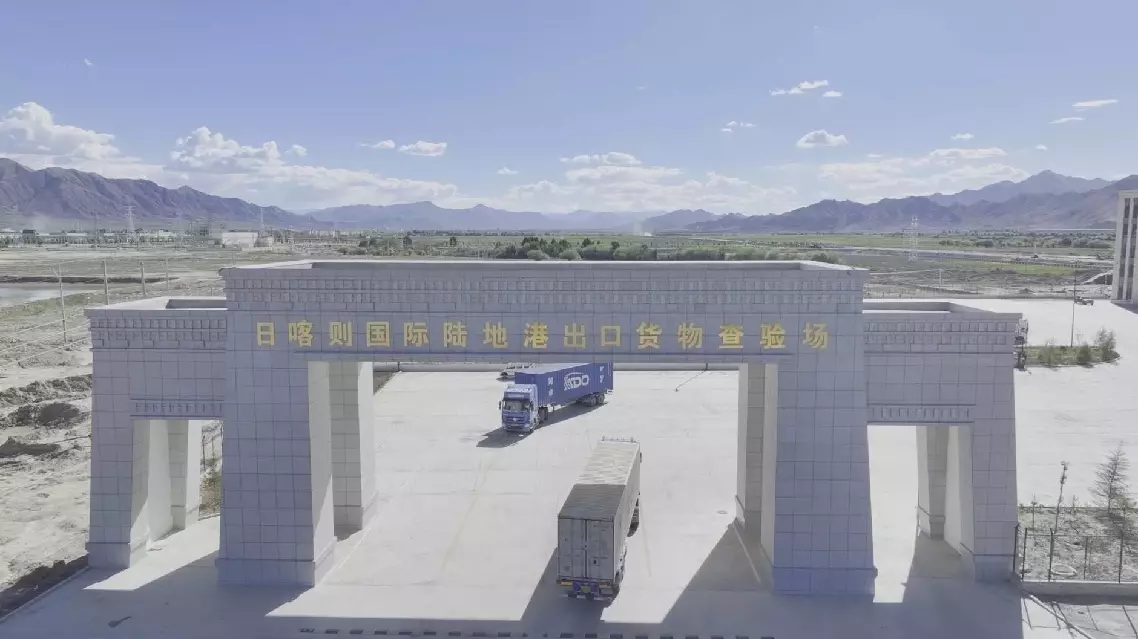
The Xigaze International Land Port has better linked trading partners from China and South Asian countries, accelerating the development and upgrading of foreign trade in southwest China's Xizang (Tibet) Autonomous Region while driving regional economic development.
Located in the southern part of Xigaze City, this plateau-based port is a core logistics hub that connects Xizang and South Asian countries, integrating multiple functions including customs clearance, inspection, transshipment and storage.
Standing 300 kilometers away from Lhasa, the regional capital of Xizang, the international logistics center enjoys favorable geographical advantages. It is just five kilometers from downtown Xigaze and can be reached in half an hour from the local airport. The passengers and cargo stations of the Lhasa-Xigaze Peace Airport Railway are located within the port area, while the road network provides direct access to important border ports including Gyirong, Zhangmy and Lizi. This strategic location enhances its role as a key logistic hub in the region.
In addition to geographical advantages, the land port has also optimized cargo inspection process with the application of the advanced H986 inspection system, to improve customs efficiency and significantly shortened the waiting time for this process.
"The vehicles are weighed over there, and thorough inspections are conducted to check for prohibited items. [Previously], the process took about an hour to complete," said Phurbu Samdrup, a truck driver.
The H986 is the most advanced intelligent customs inspection system in China, which uses X-ray to scan containers, dispensing with the need to open the box. The scanning results are displayed in real time on screens in the monitor center, enabling the inspections to be completed in just a few minutes.
"If the company's documentation is complete, the process takes only one to two minutes on our end. Once the cargo enters the H986 inspection and supervision equipment, it requires just three to four minutes for scanning. After declaring here at the land port, the cargo is directly routed to the border, allowing for seamless export in a single container," said Tsering Tsomo, deputy director of the Comprehensive Business Section of Xigaze Customs.
By integrating logistics, storage and customs inspection, the declaration and inspection time required for products exporting from the land port has been significantly shortened.
The operation model that streamlines processes of customs declaration at the land port, inspection by local customs and direct access to the border relieves pressure at border ports, greatly improving customs clearance efficiency.
Since the export goods inspection site was put into operation on Aug. 1, 2024, the land port has operated six freight trains to South Asian countries, exporting goods including unique Tibetan incense and wool products, as well as new energy vehicles (NEVs).
In 2024, 11,718 NEVs were exported through the Gyirong and Zhangmu ports, while in the first quarter of 2025, the land port handled export procedures for 2,842 NEVs, establishing Xizang as a major channel for China's NEV export to Nepal.
The opening of the land port has driven a transformation and upgrade in the structure of export products, while providing more options of routes for exporters.
"In China-India trade, maritime transport has traditionally been dominant. Through investigations, we learned that maritime transport takes about 45 days. While, through land transportation with the operation model of declaration at land port and direct access to the border in a single container, it takes only 15 days, significantly reducing transportation costs," said Tsering Tsomo.
Int'l land port bridges trade cooperation between China, South Asia