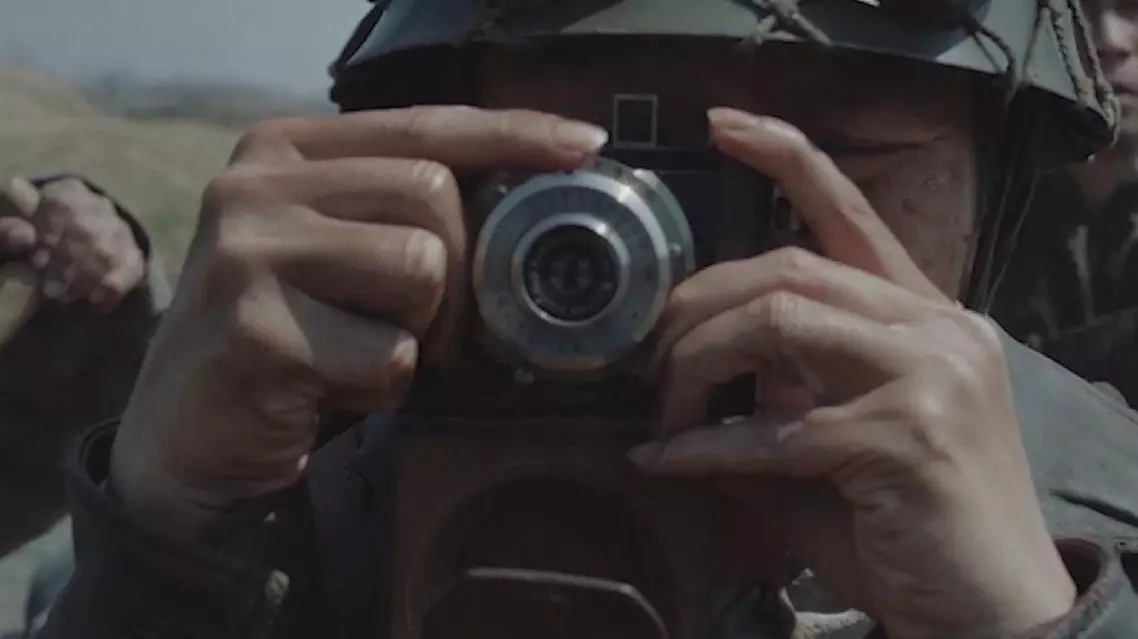
As China deepens efforts to safeguard historical memory through film and culture, the country's latest war-themed film "Dead To Rights" stands as a new attempt to faithfully recreate one of the most tragic chapters in modern Chinese history - the Nanjing Massacre.
The film depicts the mass murder of Chinese civilians, noncombatants, and surrendered prisoners of war in December 1937 after the invading Japanese army occupied Nanjing, the then Chinese capital, during the Chinese People's War of Resistance against Japanese Aggression (1931-1945).
Speaking in an interview with China Central Television (CCTV), the film's art director Li Anran shed light on the creative philosophy behind the production design, highlighting the team's firm commitment to historical accuracy, emotional depth, and the spirit of national resilience.
From the outset, the production team aimed to reconstruct the cityscape of Nanjing as it was during the winter of 1937 - shattered by the brutal invasion of Japanese troops.
Li noted that the visual tone was set to reflect the pain and devastation suffered by the people of Nanjing.
"In terms of visual tone, first of all, I wanted to present a dim and shattered Nanjing - such as mountains of corpses, broken city walls, bombed and ruined buildings, and rivers of blood. That was the general vision. We actually advanced the entire design plan based on a logical progression of historical time and spatial sequence," he said.
Recreating the war-torn city not only required emotional fortitude, but also posed significant technical challenges.
The film's set spanned over 30,000 square meters, and every detail was carefully designed to preserve the realism of civilian life before it was upended by violence.
Li emphasized the importance of grounding the audience in the lived reality of the time.
"Our entire set covered about 30,000 square meters. You need to convey that sense of destruction, while also allowing the audience to feel that these streets were once where people lived their everyday lives in Nanjing. For example, there were shoe stores, tea houses, restaurants, and clothing shops. In almost every region of southern China, there were sauce shops. We found out that back then, there was a 'Wuhe Sauce Shop' in Nanjing, so we recreated that. I think this brings a greater sense of immersion," he said.
To heighten the realism of key scenes, the production team used a blend of practical effects and location-based shooting, to meet ecological and artistic considerations.
"This river [appearing red with blood] demonstrated in the film is actually one inside our film studio, and we could decide what to do with it. So we used real, environmentally-friendly dye to turn the river red. And there was another scene shot at a river in Nanjing - we actually went there to find such a location. The river is a water source, so we took these factors into account, and in the end decided to use visual effects," said the art director.
Looking back at the materials used during the production, Li said that viewing the original historical photographs of the massacre left a deep emotional impression on him and the team. These images served as a constant reminder of the gravity of their work.
"Seeing those extremely brutal historical photos, it was honestly hard to bear. But I believe that is the significance of this film, to allow the audience to feel a connection with the civilians of 1937. I believe it can inspire a sense of self-strengthening among people today," said Li.
Nanjing Massacre film "Dead to Rights" aims to recreate history: art director