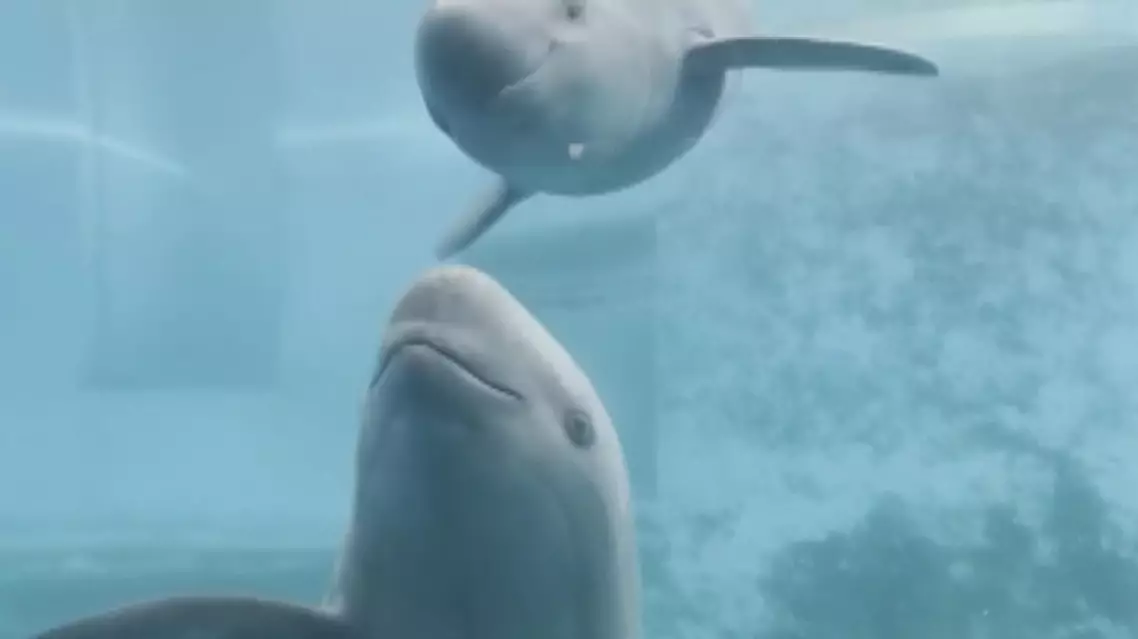
China has made significant progress in conserving the rare and endangered Yangtze finless porpoise, a freshwater cetacean endemic to the country's Yangtze River, thanks to the gradual advancement of artificial breeding technology.
The freshwater porpoise, characterized by its lack of a dorsal fin, is native to China. They only pulse through waters in the central and eastern parts of the Yangtze River.
With its mouth fixed in a permanent grin, the rotund, finless porpoise is adored in China, but this fleshy aquatic animal is now critically endangered, rarer even than the country's poster child for species conservation, the giant panda, and is under top-level state protection.
At the Baiji Dolphin Hall, under the Institute of Hydrobiology of the Chinese Academy of Sciences (CAS), researchers typically use ultrasonic imaging technology to conduct health checks on Yangtze finless porpoises. After monitoring and analysis, the finless porpoises are in good health. Recently, two female Yangtze finless porpoises have become pregnant, with hopes of welcoming new baby finless porpoises next year.
"This indicates that the Yangtze finless porpoise can thrive in an artificial environment, as the entire natural breeding process is problem-free, including pregnancy, parturition, and the subsequent development of baby finless porpoises, all of which have been successfully completed," said Hao Yujiang, associate researcher with the Institute of Hydrobiology.
Tao Tao is the star of the Baiji Dolphin Hall. As the world's first Yangtze finless porpoise successfully bred in an artificial environment, it has been carefully attended and loved since its birth on July 5, 2005.
Over the years, Tao Tao has provided the research team with significant insights into protection, ex-situ conservation, and management of the entire species.
The institute now has 12 Yangtze finless porpoises, out of which five have been artificially bred.
"So far, we have established eight natural reserves for the Yangtze finless porpoise and three ex-situ conservation areas in the Yangtze. This can be regarded as China's solution to the conservation of rare and endangered small cetaceans," he said.
According to the 2022 comprehensive surveys on the species, there were 1,249 finless porpoises in the Yangtze, marking a significant rebound from 2017, when the figure stood at only 1,012.
The Yangtze finless porpoise is a nationally first-class protected wild animal, and its population status serves as a "barometer" of the ecological environment of the Yangtze River.
Artificial breeding increases endangered Yangtze finless porpoise population