BOGOTA, Colombia (AP) — When Ecuadorians voted two years ago to block oil drilling in Yasuni National Park, it was a triumph for environmentalists seeking to protect one of the most biodiverse places on Earth. And it was in character for a country that was first to enshrine the “rights of nature” in its constitution and is home to parts of the Amazon rain forest and the Galápagos Islands.
But recent moves by President Daniel Noboa have alarmed environmentalists and Indigenous leaders who say the country’s green reputation — and its protections for civil society — are unraveling.
Noboa's administration has moved to scrap the country’s independent Environment Ministry. It's pushing legislation ostensibly aimed at choking off illegal mining, but which critics fear will devastate nonprofits. The National Assembly — pressed by Noboa — approved a law last month allowing private and foreign entities to co‑manage conservation zones that critics say weakens protections and threatens Indigenous land rights. And Ecuador just signed a new oil deal with Peru that could accelerate drilling in sensitive areas.
Natalia Greene, an environmental advocate with the Global Alliance for the Rights of Nature, said Noboa's decision to fold the Environment Ministry into the Ministry of Energy and Mines will speed up mining just as Ecuador is grappling with a surge in illegal gold mining tied to organized crime. She called it “like putting the wolf in charge of the sheep.”
“The government’s intention is very clear — to be a machine gun of extractivism,” she said.
Noboa has defended the ministry moves and other changes as necessary to cut costs, reduce bureaucracy and address Ecuador’s financial crisis. Officials argue that consolidating ministries will make decision‑making more efficient.
Neither the Ministry of Energy and Mines nor Noboa's office responded to questions from The Associated Press.
In July, Peru and Ecuador signed a deal for Ecuador’s state oil company to sell crude directly to Petroperu and link its southern Amazon reserves to Peru’s Norperuano pipeline, with drilling eyed for January 2026. Environmental groups say it could fast‑track drilling in sensitive areas while skirting safeguards and Indigenous consultation.
Peru’s Achuar, Wampis and Chapra nations denounced the plan in a public letter, saying it would gut long-standing protections that require communities be consulted before projects move forward on their lands. They warned the pipeline already averages 146 spills a year and that expanding it would be “a grave threat to the Amazon and to Indigenous livelihoods.”
“They are going to violate all our rights to enter our territories and extract the resources they want," said Nemo Guiquita, a Waorani leader with the Confederation of Indigenous Nationalities of the Ecuadorian Amazon. She said Indigenous communities fear a surge of oil and mining projects across ancestral lands, threatening both ecosystems and livelihoods.
“There will be a weakening of environmental protection,” she said. “There will be a lot of deforestation, contamination of rivers and destruction of the ecosystem, which is vital for our existence as Indigenous peoples.”
Ricardo Buitrón, president of the Quito‑based environmental group Accion Ecologica, noted that the changes come just months after Ecuadorians voted to keep oil in the ground in Yasuni, a decision the government has yet to fully enforce.
“We have gone back decades,” he said. “A development model is being prioritized that does not care about protecting ecosystems, but about extracting natural resources to the maximum.”
The proposed law that has alarmed nonprofits is formally called the Organic Law for the Control of Irregular Capital Flows. But activists call it the “anti-NGO” law, saying it could impose heavy burdens on nonprofits and force many to close.
The measure applies to more than 71,000 organizations nationwide, giving them six months to re‑register with the government, submit detailed financial records and disclose foreign funding sources. The government says the law is needed to prevent money laundering and political destabilization. Critics warn it could instead silence dissent by placing organizations under sweeping controls.
Noboa submitted the bill to the National Assembly on July 29, giving lawmakers until Aug. 28 to act before it automatically becomes law.
“This has been hard for us,” Guiquita said. “Practically, Indigenous organizations live mostly from donations and NGOs. The government is weakening us in every space.”
“It represents a threat because they could dissolve us under any pretext,” Buitrón said. “This reminds us of what we already lived through a decade ago, when they tried to shut down some organizations in the country.”
Kevin Koenig of Amazon Watch, a U.S.-based nonprofit that advocates for Indigenous rights and environmental protection in the Amazon, said the country’s changes are part of a wider rollback.
“We are seeing a sweeping package of regressive reforms that are rolling back environmental protections, Indigenous rights guarantees, and threatening basic civil liberties like the freedom of speech and assembly,” he said. “What it suggests is the massive expansion of oil and mining, particularly in the Amazon region.”
Koenig said the changes send troubling signals ahead of COP30, the United Nations climate summit set for Brazil later this year.
Similar trends are unfolding in Peru and El Salvador, where governments have limited environmental oversight, and in Brazil, where licensing for Amazon projects has been weakened.
Civil society groups are mobilizing against the changes. Greene said organizations have reactivated the Asamblea Nacional Socioambiental, a national coalition of environmental and social movements, and are planning legal challenges, demonstrations and appeals to international bodies.
Many fear Ecuador’s role as a global green pioneer is unraveling.
“Our only crime here has been protecting our territory, protecting our traditions, protecting our way of life,” Guiquita said.
The Associated Press’ climate and environmental coverage receives financial support from multiple private foundations. AP is solely responsible for all content. Find AP’s standards for working with philanthropies, a list of supporters and funded coverage areas at AP.org.

FILE - A type of Pacific green sea turtle swims through the water off of Wolf Island, Ecuador in the Galapagos on June 10, 2024. (AP Photo/Alie Skowronski, File)
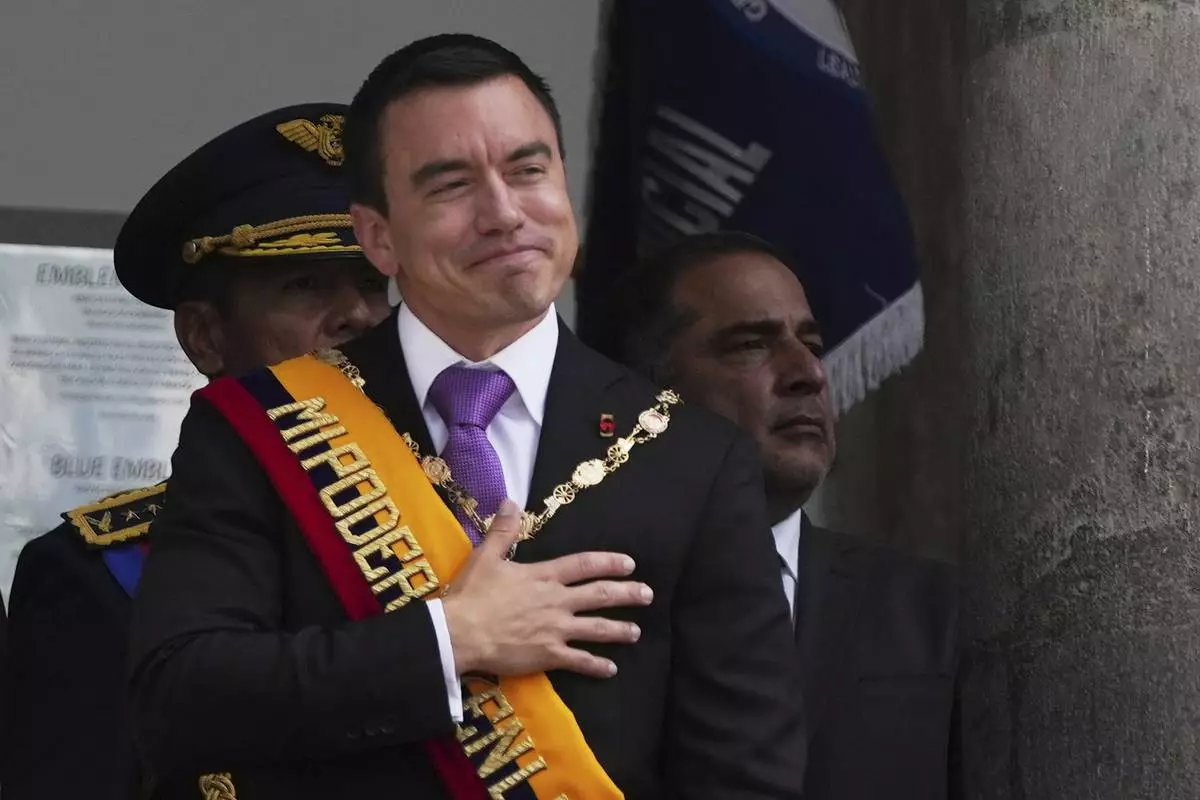
FILE - Ecuador's President Daniel Noboa acknowledges supporters from the balcony of the presidential palace after his swearing-in ceremony for a second term in Quito, Ecuador, May 24, 2025. (AP Photo/Carlos Noriega, File)

FILE - The Yasuni National Park is visible in Ecuador's northeastern jungle on May 17, 2007. (AP Photo/Dolores Ochoa, File)
Several Middle Eastern allies of the United States have urged the Trump administration to hold off on strikes against Iran for the government’s deadly crackdown on protesters, according to an Arab diplomat familiar with the matter.
Top officials from Egypt, Oman, Saudi Arabia and Qatar have raised concerns in the last 48 hours that a U.S. military intervention would shake the global economy and destabilize an already volatile region, said the diplomat who spoke on condition of anonymity to describe the sensitive conversations.
Oil prices fell Thursday as the markets appeared to take note of President Donald Trump’s shifting tone as a sign that he’s leaning away from attacking Iran after days of launching blistering threats at Tehran for its brutal crackdown.
Nevertheless, White House press secretary Karoline Leavitt on Thursday maintained that “all options remain on the table” for Trump as he deals with Iran.
Here's the latest:
The White House and a bipartisan group of governors are pressuring the operator of the mid-Atlantic power grid to take urgent steps to boost energy supply and curb price hikes, holding a Friday event aimed at addressing a rising concern among voters about the enormous amount of power used for artificial intelligence ahead of elections later this year.
The White House said its National Energy Dominance Council and the governors of several states, including Pennsylvania, Ohio and Virginia, want to try to compel PJM Interconnection to hold a power auction for tech companies to bid on contracts to build new power plants.
The Trump administration and governors will sign a statement of principles toward that end Friday.
▶ Read more about the administration and AI-driven power shortages
The Justice Department’s investigation into Federal Reserve Chair Jerome Powell has brought heightened attention to a key drama that will play out at the central bank in the coming months: Will Powell leave the Fed when his term as chair ends, or will he take the unusual step of remaining a governor?
Powell’s term as Fed chair ends May 15, but because of the central bank’s complex structure, he has a separate term as one of seven members of its governing board that lasts until January 31, 2028. Historically, nearly all Fed chairs have stepped down from the board when they’re no longer chair. But Powell could be the first in nearly 50 years to stay on as a governor.
Many Fed-watchers believe the criminal investigation into Powell’s testimony about cost overruns for Fed building renovations was intended to intimidate him out of taking that step. If Powell stays on the board, it would deny the White House a chance to gain a majority, undercutting the Trump administration’s efforts to seize greater control over what has for decades been an institution largely insulated from day-to-day politics.
▶ Read more about Federal Reserve Chair Jerome Powell
Trump on Thursday announced the outlines of a health care plan he wants Congress to take up as Republicans have faced increasing pressure to address rising health costs after lawmakers let subsidies expire.
The cornerstone is his proposal to send money directly to Americans for health savings accounts so they can handle insurance and health costs as they see fit. Democrats have rejected the idea as a paltry substitute for the tax credits that had helped lower monthly premiums for many people.
Trump’s plan also focuses on lowering drug prices and requiring insurers to be more upfront with the public about costs, revenues, rejected claims and wait times for care.
Trump has long been dogged by his lack of a comprehensive health care plan as he and Republicans have sought to unwind former President Barack Obama’s signature legislation, the Affordable Care Act. Trump was thwarted during his first term in trying to repeal and replace the law.
▶ Read more about Trump’s health care plan
Most American presidents aspire to the kind of greatness that prompts future generations to name important things in their honor.
Donald Trump isn’t leaving it to future generations.
As the first year of his second term wraps up, his Republican administration and allies have put his name on the U.S. Institute of Peace, the Kennedy Center performing arts venue and a new class of battleships.
That’s on top of the “Trump Accounts” for tax-deferred investments, the TrumpRx government website soon to offer direct sales of prescription drugs, the “Trump Gold Card” visa that costs at least $1 million and the Trump Route for International Peace and Prosperity, a transit corridor included in a deal his administration brokered between Armenia and Azerbaijan.
On Friday, he plans to attend a ceremony in Florida where local officials will dedicate a 4-mile (6-kilometer) stretch of road from the airport to his Mar-a-Lago estate in Palm Beach as President Donald J. Trump Boulevard.
▶ Read more about Trump’s renaming efforts
Nearly a year into his second term, Trump’s work on the economy hasn’t lived up to the expectations of many people in his own party, according to a new AP-NORC survey.
The poll from The Associated Press-NORC Center for Public Affairs Research finds a significant gap between the economic leadership Americans remembered from Trump’s first term and what they’ve gotten so far as he creates a stunning level of turmoil at home and abroad.
Just 16% of Republicans say Trump has helped “a lot” in addressing the cost of living, down from 49% in April 2024, when an AP-NORC poll asked Americans the same question about his first term.
At the same time, Republicans are overwhelmingly supportive of the president’s leadership on immigration — even if some don’t like his tactics.
There is little sign overall, though, that the Republican base is abandoning Trump. The vast majority of Republicans, about 8 in 10, approve of his job performance, compared with 4 in 10 for adults overall.
▶ Read more about the poll’s findings
Several Middle Eastern allies of the United States have urged the Trump administration to hold off on strikes against Iran for the government’s deadly crackdown on protesters, according to an Arab diplomat familiar with the matter.
Top officials from Egypt, Oman, Saudi Arabia and Qatar have raised concerns in the last 48 hours that a U.S. military intervention would shake the global economy and destabilize an already volatile region, said the diplomat who spoke on condition of anonymity to describe the sensitive conversations.
Oil prices fell on Thursday as the markets appeared to take note of President Donald Trump’s shifting tone as a sign that he’s leaning away from attacking Iran after days of launching blistering threats at Tehran for its brutal crackdown.
Nevertheless, White House press secretary Karoline Leavitt on Thursday maintained that “all options remain on the table” for Trump as he deals with Iran.
▶ Read more about Trump and Iran
— Matthew Lee, Aamer Madhani and Ben Finley
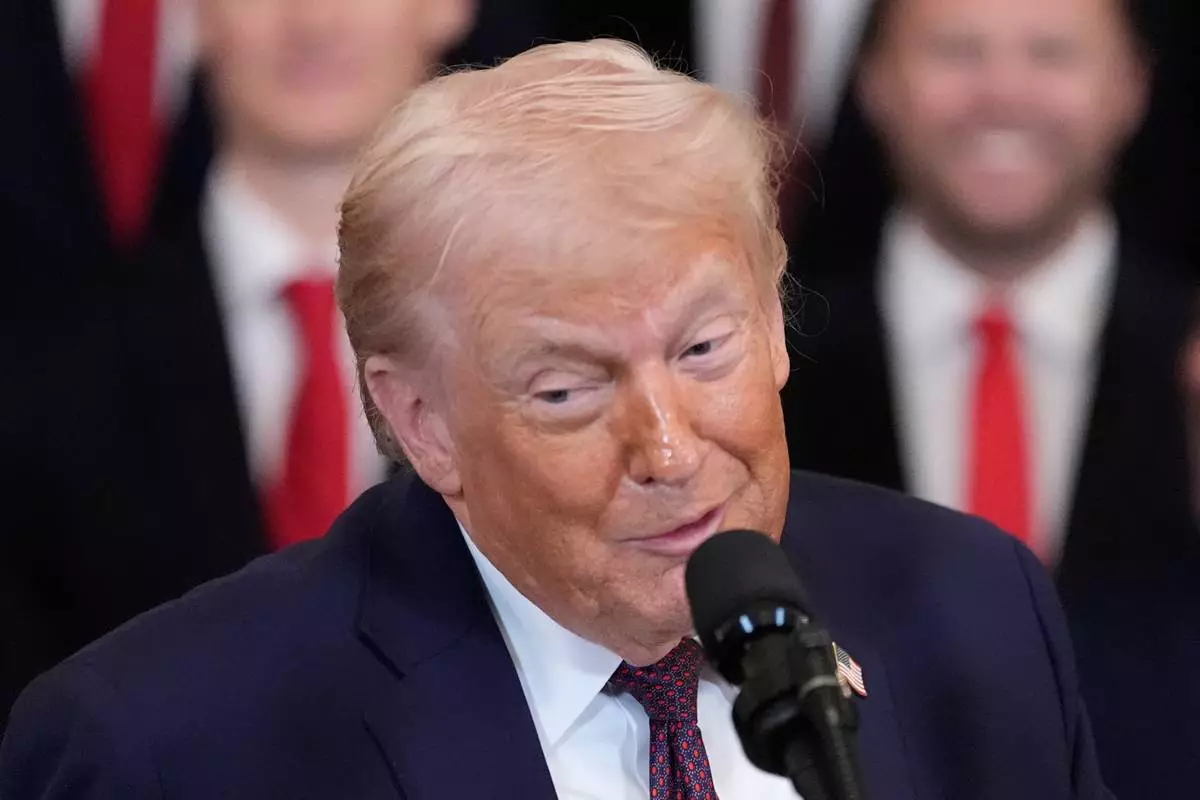
President Donald Trump speaks during an event to honor the 2025 Stanley Cup Champion Florida Panthers in the East Room of the White House, Thursday, Jan. 15, 2026, in Washington. (AP Photo/Alex Brandon)