U.S. stocks closed higher Friday, capping a choppy week of trading with the market’s third winning week in the last four and another milestone.
The S&P 500 rose 0.8%, finishing just shy of the record it set last week. The benchmark index also wiped out its losses from a slide last week.
Click to Gallery
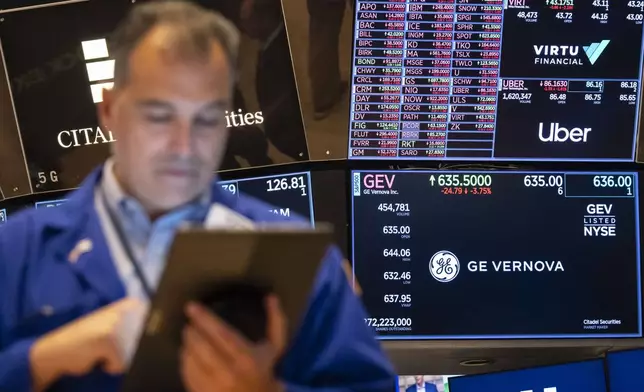
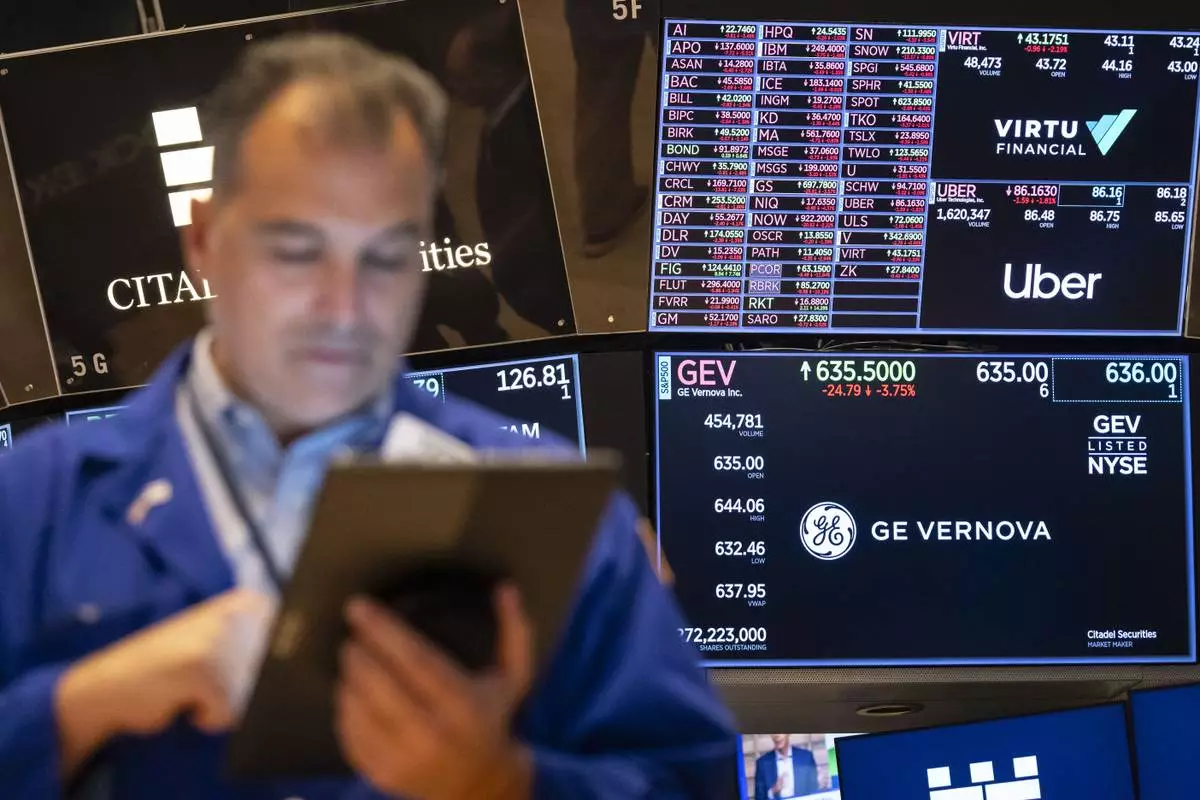
A screen shows stock prices on the floor of the New York Stock Exchange, Friday, Aug. 1, 2025, in New York. (AP Photo/Yuki Iwamura)
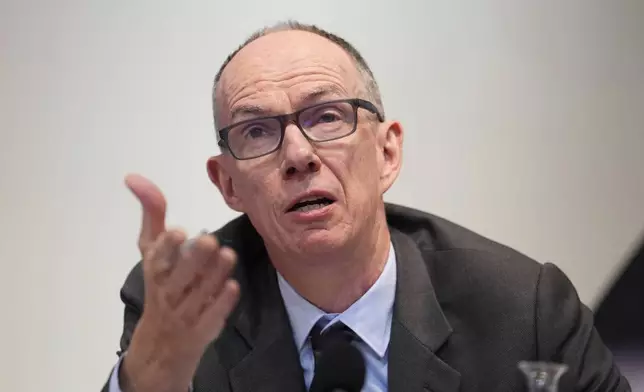
Dave Ramsden, Deputy Governor for Markets and Banking of The Bank of England, attends the financial stability report press conference at the Bank of England, London, Thursday, Aug. 7, 2025. (Jordan Pettitt/Pool Photo via AP)

Currency traders work near a screen showing the Korea Composite Stock Price Index (KOSPI), top left, and the foreign exchange rate between U.S. dollar and South Korean won, top center, at the foreign exchange dealing room of the Hana Bank headquarters in Seoul, South Korea, Friday, Aug. 8, 2025. (AP Photo/Ahn Young-joon)
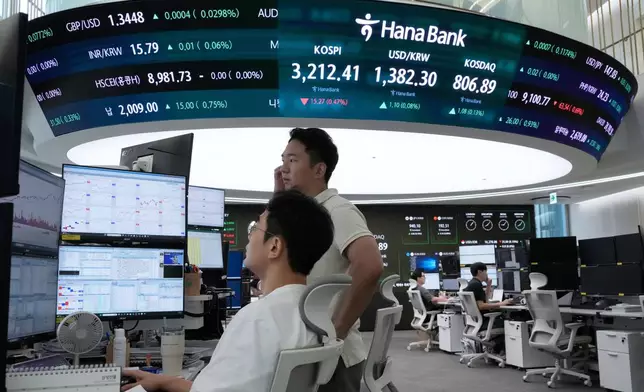
Currency traders watch monitors near a screen showing the Korea Composite Stock Price Index (KOSPI), top center left, and the foreign exchange rate between U.S. dollar and South Korean won, top center, at the foreign exchange dealing room of the Hana Bank headquarters in Seoul, South Korea, Friday, Aug. 8, 2025. (AP Photo/Ahn Young-joon)

Currency traders work near a screen showing the Korea Composite Stock Price Index (KOSPI), top left, and the foreign exchange rate between U.S. dollar and South Korean won, top center, at the foreign exchange dealing room of the Hana Bank headquarters in Seoul, South Korea, Friday, Aug. 8, 2025. (AP Photo/Ahn Young-joon)
The Dow Jones Industrial Average climbed 0.5%, and the Nasdaq composite added 1% to the all-time high it set a day earlier.
Technology companies, with their hefty stock values, did much of the heavy lifting for the market. Nvidia rose 1.1% and Apple gained 4.2%.
Gilead Sciences jumped 8.3% for one of the market's biggest gains. It reported financial results that easily beat analysts' forecasts, while also raising its earnings forecast for the year. Expedia Group rose 4.1% after also reporting encouraging financial results.
They are among the final big batch of companies within the S&P 500 to report mostly strong financial results for the second quarter. Still, many have warned that current tariffs could cut into their profits.
Financial sector stocks also helped drive the market higher. Bank of America gained 2.4% and Mastercard rose 2.3%.
Elsewhere in the market, entertainment giant Paramount Skydance slid 10.5% a day after the company was created by the closing of an $8 billion merger of Skydance and Paramount. Shares in rival Warner Bros. Discovery sank 8%.
The main focus throughout the week has been on President Donald Trump’s trade war and its potential impact on the U.S. economy, as well as the Federal Reserve’s interest rate policy. Trump began imposing higher import taxes on dozens of countries Thursday.
Still, the market appeared to largely shrug off the latest tariff escalation.
“The S&P 500’s rebound this week may highlight the extent to which the market is becoming numb to tariff headlines,” said Daniel Skelly, head of Morgan Stanley’s Wealth Management Market Research & Strategy Team.
The unknown path of the economy amid an unpredictable tariff policy has been the key reason for the Fed to hold its benchmark interest rate steady.
Fed Chair Jerome Powell, though, has been under increasing pressure from Trump to cut interest rates. Policy decisions aren’t made solely by the Fed chair. All 12 members of the Federal Open Market Committee vote on interest rate changes.
Trump has an opportunity to exert more control over the Fed following his nomination of Stephen Miran to a vacancy on the Fed’s board of governors. Miran is a top economic adviser to Trump and is a near-certain vote in support of lower interest rates.
The Fed’s last decision to hold interest rates steady included two votes to lower interest rates. Its next meeting is in September, and Wall Street is overwhelmingly betting that the central bank will cut interest rates by a quarter of a percentage point.
Treasury yields edged higher. The yield on the 10-year Treasury rose to 4.28% from 4.25% late Thursday. The yield on the two-year Treasury which more closely tracks expectations for Fed actions, rose to 3.76% from 3.73% late Thursday.
The expectation for an interest rate cut follows a series of signals last week that the economy could be weakening. That included reports showing that inflation edged higher in June and employers in the U.S. hit the brakes on hiring in July.
Both are key concerns for the Fed, which has been trying to cool inflation down to its target rate of 2% while also fulfilling its “full employment” mandate.
Lower interest rates can give the economy and investment prices a boost, though the downside is that they can also push inflation higher. Concerns about inflation reheating could be overshadowed by worries about a weakening employment market.
Wall Street and the Fed will get more insight next week on inflation's temperature and the economy. The government will release updates on inflation at both the consumer and wholesale levels, along with a report on retail sales.
“We believe stocks will stay supported amid solid fundamentals, but fresh headlines in the coming week may challenge investor sentiment that remains vulnerable to tariff, economic, and geopolitical risks,” said Ulrike Hoffmann-Burchardi, chief investment officer for the Americas and global head of equities at UBS Global Wealth Management.
All told, the S&P 500 rose 49.45 points to 6,389.45. The Dow rose 206.97 points to 44,175.61, and the Nasdaq rose 207.32 points to finish at 21,450.02.
Asian markets closed mostly lower except in Tokyo, where the Nikkei rose 1.9% after Japan’s main trade envoy said the U.S. had agreed to correct a problem over tariffs that will apply to exports to the U.S.
European markets were mixed.
A screen shows stock prices on the floor of the New York Stock Exchange, Friday, Aug. 1, 2025, in New York. (AP Photo/Yuki Iwamura)
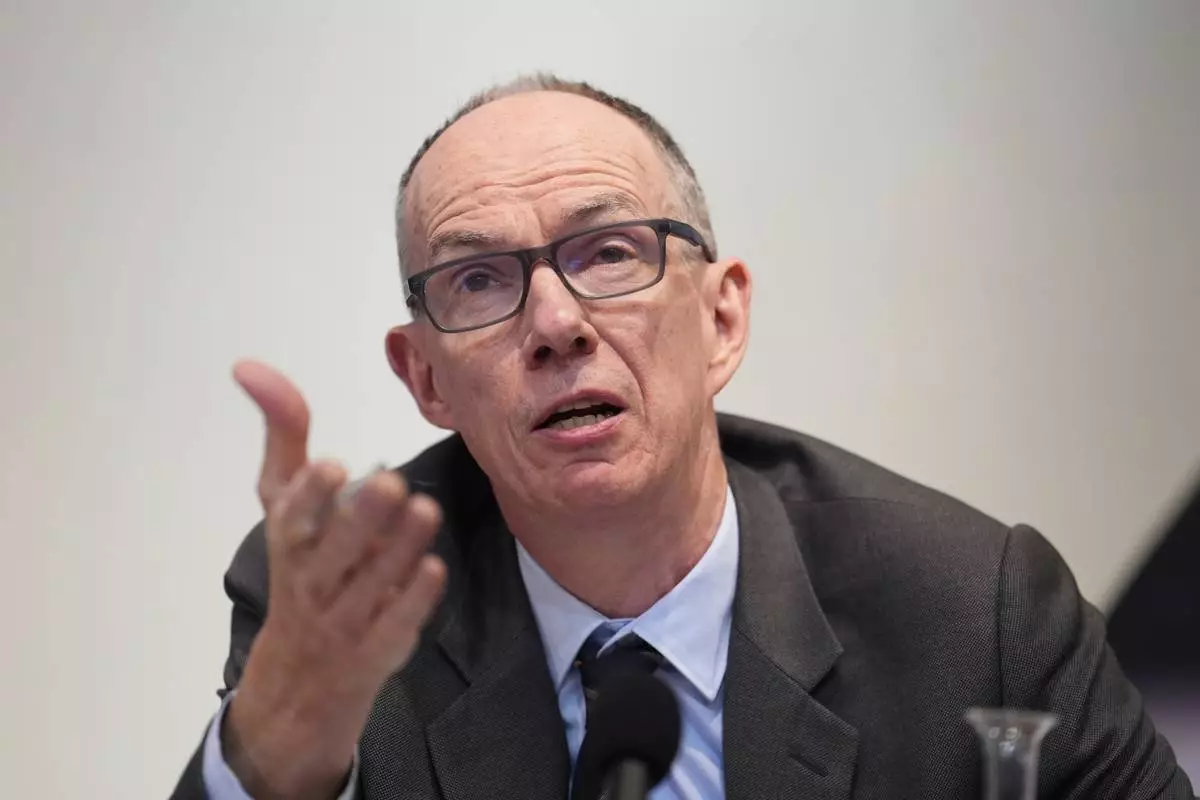
Dave Ramsden, Deputy Governor for Markets and Banking of The Bank of England, attends the financial stability report press conference at the Bank of England, London, Thursday, Aug. 7, 2025. (Jordan Pettitt/Pool Photo via AP)

Currency traders work near a screen showing the Korea Composite Stock Price Index (KOSPI), top left, and the foreign exchange rate between U.S. dollar and South Korean won, top center, at the foreign exchange dealing room of the Hana Bank headquarters in Seoul, South Korea, Friday, Aug. 8, 2025. (AP Photo/Ahn Young-joon)

Currency traders watch monitors near a screen showing the Korea Composite Stock Price Index (KOSPI), top center left, and the foreign exchange rate between U.S. dollar and South Korean won, top center, at the foreign exchange dealing room of the Hana Bank headquarters in Seoul, South Korea, Friday, Aug. 8, 2025. (AP Photo/Ahn Young-joon)

Currency traders work near a screen showing the Korea Composite Stock Price Index (KOSPI), top left, and the foreign exchange rate between U.S. dollar and South Korean won, top center, at the foreign exchange dealing room of the Hana Bank headquarters in Seoul, South Korea, Friday, Aug. 8, 2025. (AP Photo/Ahn Young-joon)