Advancements in unmanned aerial vehicle technology are driving smart construction in Hong Kong – and nowhere has this been more evident than in the Development Bureau’s pioneering use of drones in the management of a large construction site at Nui Po Shan.
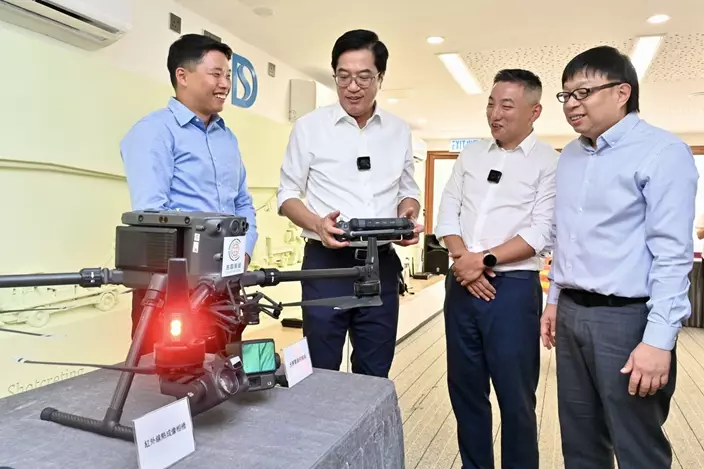
Technological breakthroughs: Deputy Financial Secretary Michael Wong (second left) learns about various technological breakthroughs in the drones used by the Development Bureau. Source from news.gov.hk
The drones at the site – where existing sewage treatment facilities are being relocated to purpose-built underground caverns – have been deployed not only to capture photos and video, but also to record spatial data, enabling remote monitoring of progress and safety.
Click to Gallery
Technological breakthroughs: Deputy Financial Secretary Michael Wong (second left) learns about various technological breakthroughs in the drones used by the Development Bureau. Source from news.gov.hk
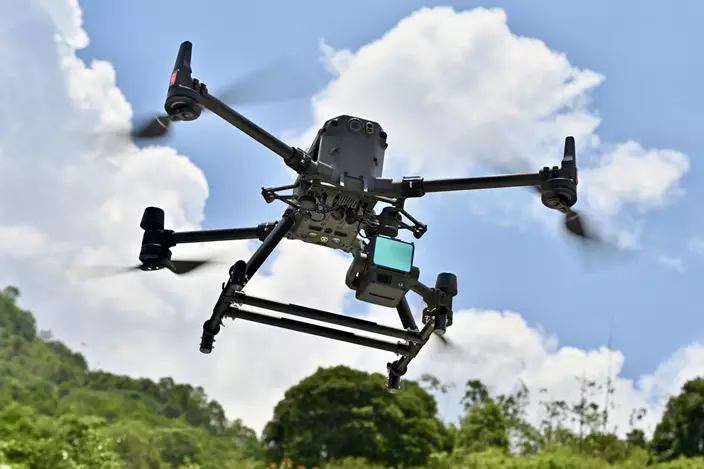
Flying high: The drones have a payload capacity of up to 6kg, meaning they are capable of carrying equipment such as cameras and scanners that collect thermal and spatial data. Source from news.gov.hk
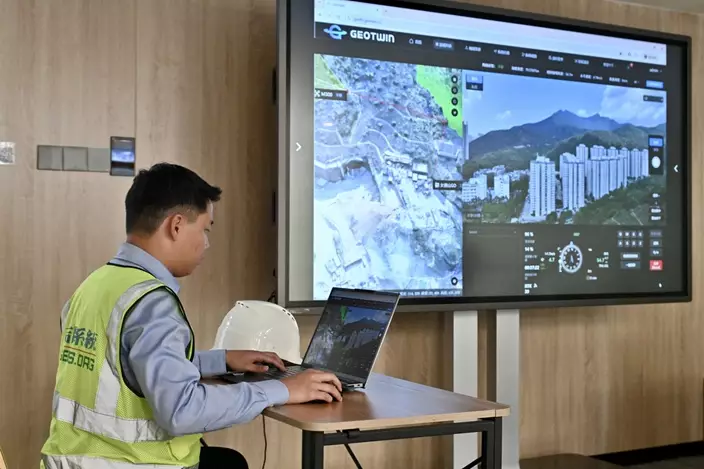
Automated features: The drones can follow pre-determined flight paths at scheduled times and operate automatically even outside an operator’s line of sight. Source from news.gov.hk
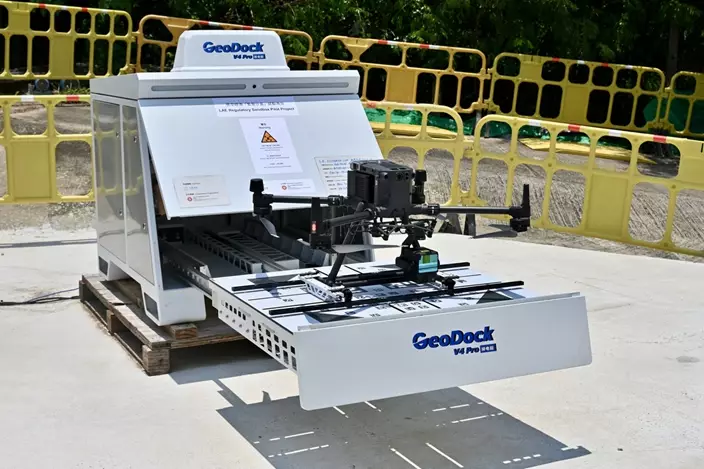
Greater endurance: This advanced docking station allows the drones’ batteries to be replaced automatically in about a minute. Source from news.gov.hk
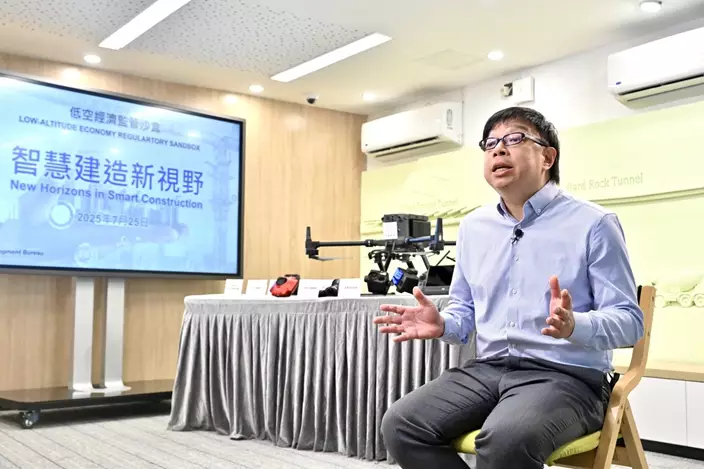
Wider applications: Deputy Secretary for Development Tony Ho says the Development Bureau aims to achieve three goals through the pilot project: using drones for site management, asset management and emergency response, while applying the technology to 12 different pilot sites. Source from news.gov.hk
The deployment is one of the first pilot projects under the Low-altitude Economy Regulatory Sandbox. Deputy Financial Secretary Michael Wong, who chairs the Working Group on Developing Low-altitude Economy, commented when he inspected the project: “Low-altitude economy is a new concept in Hong Kong and the city should seize the opportunity to develop the initiative.”
Flying high: The drones have a payload capacity of up to 6kg, meaning they are capable of carrying equipment such as cameras and scanners that collect thermal and spatial data. Source from news.gov.hk
High payload
Deputy Secretary for Development Tony Ho highlighted three key technological breakthroughs in the bureau’s drones, namely a high payload capacity, use of beyond-visual-line-of-sight (BVLOS) with automatic operation flight technology and cutting-edge docking stations that allow for efficient battery management.
With regard to payload, the aircraft can carry up to 6kg, meaning that they can be equipped with a laser imaging, detection and ranging (LIDAR) scanner, as well as an infrared thermal imaging camera.
Mr Ho added that the bureau’s self-developed smart platform, “SmartEye”, analyses the data collected by comparing images over time to measure soil and rock volumes, slope gradient, the verticality of structures, and more.
Automated features: The drones can follow pre-determined flight paths at scheduled times and operate automatically even outside an operator’s line of sight. Source from news.gov.hk
“For example, if we are excavating a 45-degree slope, we can use the data to verify if the excavation matches the required gradient. This allows us to detect early, follow up timely and resolve issues early.”
Enhanced efficiency
Explaining the benefits of BVLOS technology, Mr Ho said it has allowed the bureau to achieve automated operation of its drones.
“This allows unmanned aircraft to follow pre-determined flight paths and monitor construction sites at scheduled times. As a result, operators can manage multiple drones simultaneously across different sites.”
Moreover, with longer flights requiring greater endurance, the bureau’s advanced docking stations – which enable drone batteries to be replaced automatically in about a minute – make a huge difference.
Greater endurance: This advanced docking station allows the drones’ batteries to be replaced automatically in about a minute. Source from news.gov.hk
“This innovation not only prevents interruptions from long charging times, but also cuts down on labour costs associated with battery management. As a result, the endurance of the drones is greatly enhanced, enabling continuous operations and broader coverage.”
Extensive applicability
The bureau aims to achieve three goals through its participation in the Government’s Low-altitude Economy Regulatory Sandbox Pilot Projects – namely to leverage drones for site management, for asset management and also for emergency response operations.
The Civil Engineering & Development Department, the Drainage Services Department, the Architectural Services Department and the Water Supplies Department will implement the technology across 12 pilot sites, including the Yuen Long Kam Tin River and reservoirs.
Wider applications: Deputy Secretary for Development Tony Ho says the Development Bureau aims to achieve three goals through the pilot project: using drones for site management, asset management and emergency response, while applying the technology to 12 different pilot sites. Source from news.gov.hk