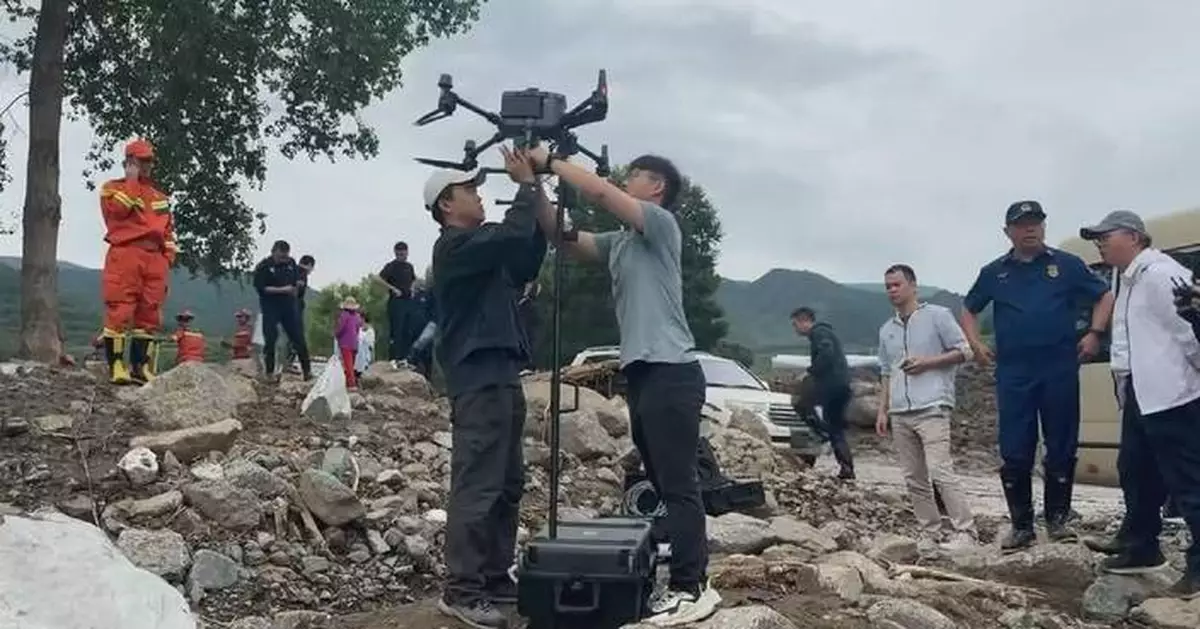
Rescuers are using cutting-edge equipment to enhance the efficiency of searching for missing people in Yuzhong County, northwest China's Gansu Province, after torrential rain triggered mountain torrents.
Torrential rain hit Yuzhong County and other parts of Lanzhou, the provincial capital, on Thursday evening, triggering flash floods and mudslides.
According to the Office of Provincial Flood Control and Drought Relief Headquarters, as of Saturday night, the disaster had resulted in 15 deaths, left 28 people missing, and 15 injured. There are 9,828 people who have been urgently evacuated and resettled.
For the past two days, firefighters have been conducting a dragnet search at the scene, employing a combination of manual and sniffer dogs. The key area of the search was where a two-story building was located, which was completely destroyed by the floodwaters. A nearby one-story house was also completely destroyed in the floods.
Rescuers deployed several high-tech devices to help locate the possible trapped people. Among them is a drone equipped with aeromagnetic detection equipment. Once launched, it scans the area for magnetic field anomalies, searching for areas with high concentrations of metal structures. Rescuers believed that the likelihood of finding the missing was relatively high near such metal structures.
In addition, there are two new devices for detecting weak life signals.
"We first use drone-mounted aeromagnetic detection equipment on-site to locate a high-value area, where there are higher possibilities of trapped personnel. Once this high-value area is identified, we put two other new types of equipment into use. This one, for example, is a body gas detector, which can detect very weak characteristic gases in the human body. The other one is a handhold human body detector. It detects very weak signals, such as breathing, pulse, and heartbeat, to locate trapped personnel," said Ruan Zhen, director of the sci-tech department of the Shanghai Fire Research Institute of the Ministry of Emergency Management, who was guiding the searching work on the scene.
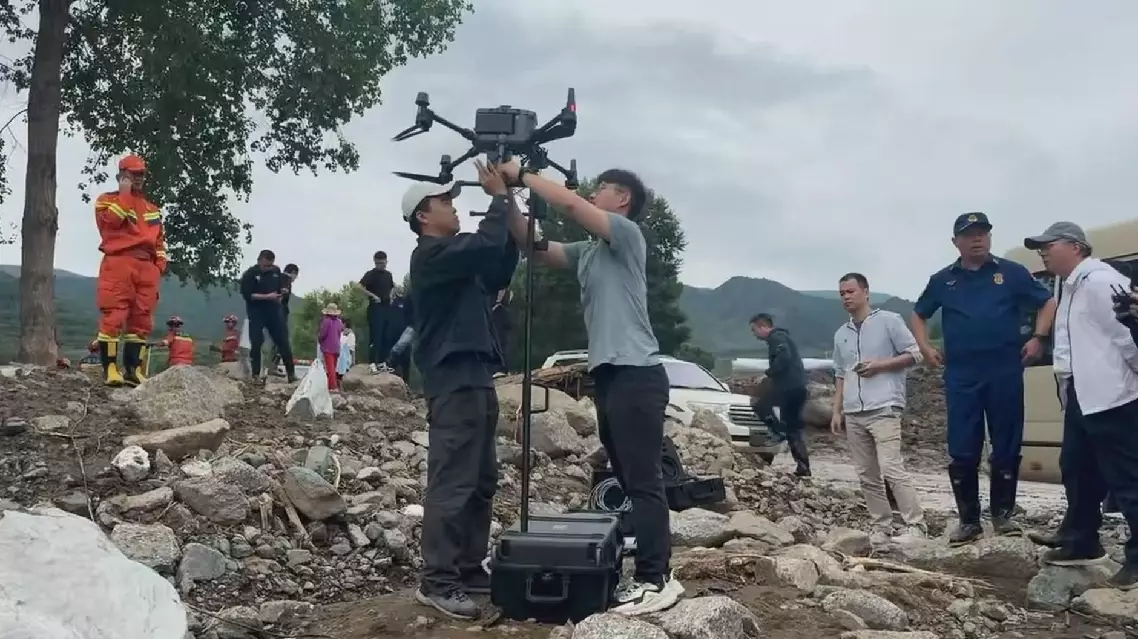
Rescuers use high-tech devices to search for missing people in flood-hit Gansu
A civil group in Japan held a study session on Saturday to tell the historical truth about the Nanjing Massacre and called on the Japanese government and society to reflect on history and avoid repeating the tragedy of war of aggression.
Saturday marks China's 12th National Memorial Day for the Victims of the Nanjing Massacre which took place when Japanese troops occupied the then-Chinese capital on Dec 13, 1937, killing approximately 300,000 Chinese civilians and unarmed soldiers in one of the most barbaric episodes of WWII over the course of six weeks.
"Japan's army committed a brutal atrocity -- the Nanjing Massacre 88 years ago in 1937. Today, on this important day, let us observe a moment of silence for 30 seconds for the victims," said an organizer of the study session.
This study session was led by Jomaru Yoichi, a former journalist with the Asahi Shimbun, a Japanese daily newspaper. Yoichi compiled numerous articles published in Japanese newspapers after the Nanjing Massacre. Among them, an article published on December 24, 1937 detailed the atrocities committed by the invading Japanese army in China.
"Around 08:00, about 400-500 defeated Chinese soldiers fled. The Japanese soldiers drove them into houses and bamboo groves, setting fires on all sides. Many of them were driven out by thick smokes. The Japanese soldiers killed them one by one with rifles and bayonets. The Japanese soldiers lost track of how many they had stabbed and killed all of them by 16:00," Yoichi recounted.
Many Japanese citizens said the Japanese government and society must confront the truth of history, and it's important to disseminate accurate historical information in contemporary Japan.
"The Nanjing Massacre is a real incident. The remarks that 'The Nanjing Massacre didn't exist' or 'The Japanese army was powerful and righteous' ignore historical evidence and deny the facts outright. I believe these are all attempts to hide the truth of history. I think these are all wrong. Facts are facts, and we must face history squarely," said a participant at the study session.
"I used to teach history in high school. In 1988, I spent two weeks in China and visited for the first time the site documenting the war crimes of the invading Japanese army. On the 80th anniversary of the end of World War II, the social atmosphere in Japan is gradually becoming strange. We must seriously examine Japan's past history, and disseminating accurate history has become even more important," said another participant.
Some expressed their concern that the Japanese government's historical revisionism, its attempt to cover up the truth of history, and its path towards military expansion will prevent Japan from facing the future.
"The fact that the Japanese army's war of aggression is not taught in social studies or history courses. I have no choice but to learn this myself even now at my age. The idea of upholding the pacifist constitution is becoming increasingly strong. Current Japanese politicians are pursuing a military expansion strategy, which I find incomprehensible," said another participant.
In 2014, China's top legislature designated December 13 as a national memorial day for the massacre victims.
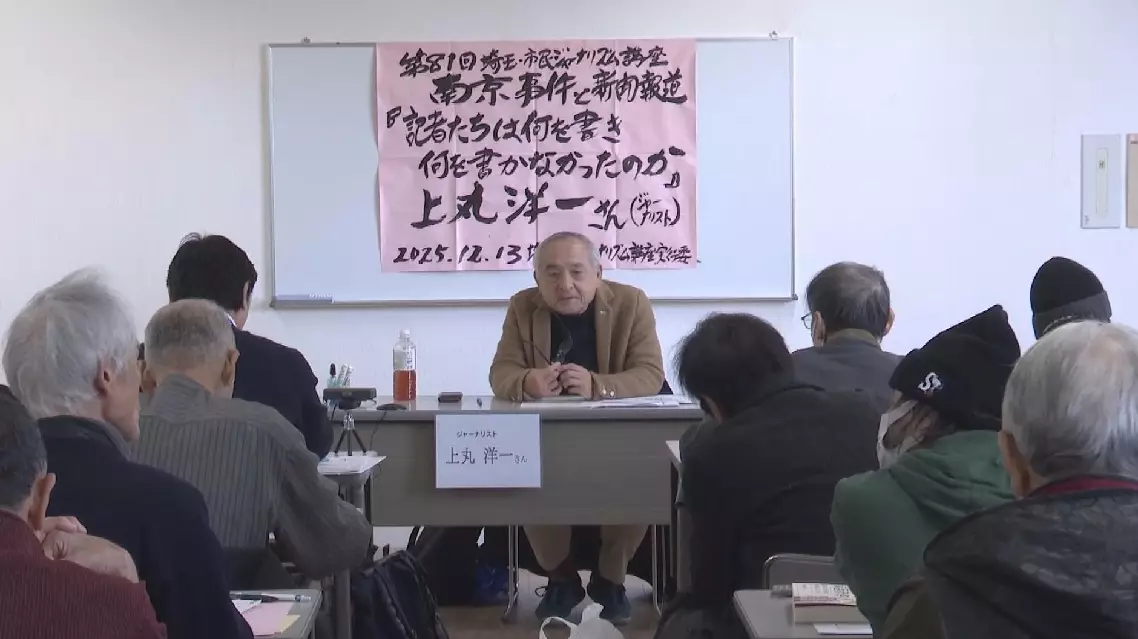
Japanese civil group calls for remembrance of Nanjing Massacre victims