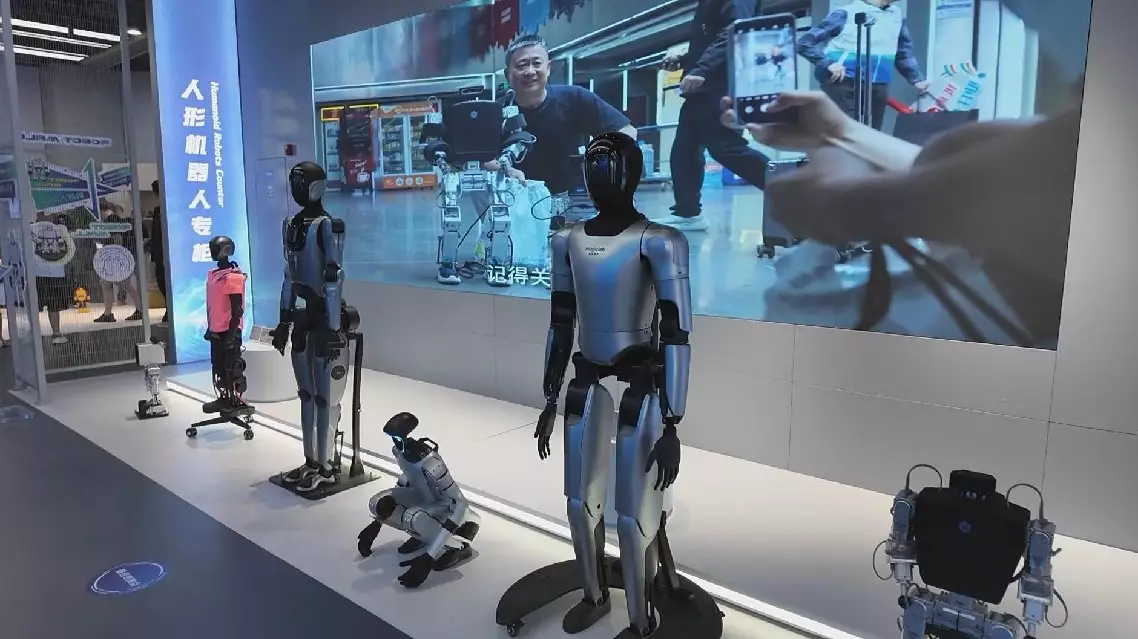
The Chinese capital of Beijing has launched a marketplace exclusively for robots during the World Robot Conference, transforming machines from lab prototypes to consumer products.
Officially opened on last Friday, the shopping mall offers more than 100 kinds of robots, integrating robot sales, spare parts supply, after-sales service, and information feedback.
Every robot has a price tag. For humanoid robots, prices vary dramatically, differing by tenfold.
The supply chain maturity and robotic functionality are critical factors behind pricing, according a manager of the robot mall.
"Most robots currently serve specialized functions. Their capabilities vary significantly across different scenarios like industrial settings, medical applications, and daily companionship. This functional divergence directly impacts production costs," said Meng Yanpei, a manager of the mall.
Consumers to the mall are met with a wide range of robotic solutions, from logistics bots to transport droids, which cost 2 million yuan (about 278,000 U.S. dollars).
The total revenue of the shopping mall has reached nearly 2 million U.S. dollars, said Meng.
"For B2B clients, the majority procure industrial or task-specific robots. E-town currently offers sales subsidies for these professional-grade machines. So, sales of these robots are good. On the consumer side (B2C), chess-playing and companion robots, such as Wukong robot, Loona robot, and SenseRobot, dominate on-site sales," said Meng.
The mall's physical presence allows customers to interact with robots firsthand, compare models side by side, and make informed purchasing decisions—bringing a sense of tangibility to what was once futuristic tech.
"Yes. Yes. We will have a huge demand in the future, because it's the new direction of the whole world, like cars," said a Russian customer.
The 2025 World Robot Conference has brought together more than 200 robotics companies from around the world to present their latest innovations, including more than 50 companies displaying hundreds of humanoid robots.
Co-hosted by the Chinese Institute of Electronics and the World Robot Cooperation Organization, the five-day 2025 World Robot Conference features forums, exhibitions, competitions and networking events.
World's 1st Robot Mall opens in Beijing, boosting hi-tech consumption

China plays a vital role in the wave of artificial intelligence (AI) and the development of future industries, said government officials and business leaders attending the China Development Forum 2026 that opened in Beijing on Sunday.
Speaking at the Symposium on Technological Innovation and Future Industry Development, Minister of Industry and Information Technology Li Lecheng said China will accelerate the innovative development of industries of the future.
"Centering around key areas like artificial general intelligence, quantum sci-tech, and clean, low-carbon hydrogen, we have deployed over 100 innovative research projects of future industries, unveiled the list and appointed leaders for these projects. We will continue to leverage the principal role of enterprises, vigorously nurturing leading technology enterprises and high-tech enterprises that lead in core technologies and possess strong innovation capabilities to drive the industries to advance towards cutting-edge and high-end fields," Li said.
From quantum technology to 6G, China is sharing its sci-tech achievements with countries around the world, working together to promote the development of future industries.
Business leaders from across the world said China is leading the breakthrough in AI technologies and will be fertile ground for the growth of future industries.
"From new energy, electric vehicles and high-end manufacturing to breakthroughs in robotics and artificial intelligence, China is at the best moment to share the fruits of sci-tech development with the world. In 2025, downloads of open-source (AI) models from China led the world, allowing global developers to freely access, fine-tune, and deploy these powerful models, truly making smart technologies a public good for all humanity," said Joseph Tsai, Chairman of Alibaba Group.
"China's complete industrial ecosystem will be fertile ground for the growth of future industries. Take embodied AI robots for example, their development relies not only on breakthroughs in intelligent algorithms but also on supporting components like precision transmission and execution parts like reducers and servo motors. A rich diversity of innovation pathways, a complete industrial system, and robust industrial supporting capabilities will be the fertile ground for the development of future industries," said Lei Jun, founder and chairman of Xiaomi Group.
"Not only manufacturing. So it's AI plus in every space, in every sector, in every industry. For us, we are the company in the world that powers AI in supplying energy systems to AI factories across the world. And therefore for us, the challenge is to make sure that we go fast enough, strong enough to support all the computing that is used by Chinese companies or by Chinese stakeholders," said Jean-Pascal Tricoire, chairman of Schneider Electric.
"Brain-computer interfaces have been listed as one of the six major future industries in China's 15th Five-Year Plan period this year. We are now fully leveraging AI technologies to decode information within the brain, using this capability to better address many issues related to brain diseases. This enables people with disabilities who have lost hands or feet to control prosthetic limbs with their thoughts, allowing them to regain their normal daily life," said Han Bicheng, founder of BrainCo, a Chinese neurotech company.
The two-day China Development Forum 2026 is themed on "China in Its 15th Five-Year Plan Period: Advancing High-Quality Development and Creating New Opportunities Together."
China to accelerate innovative development of future industries: official