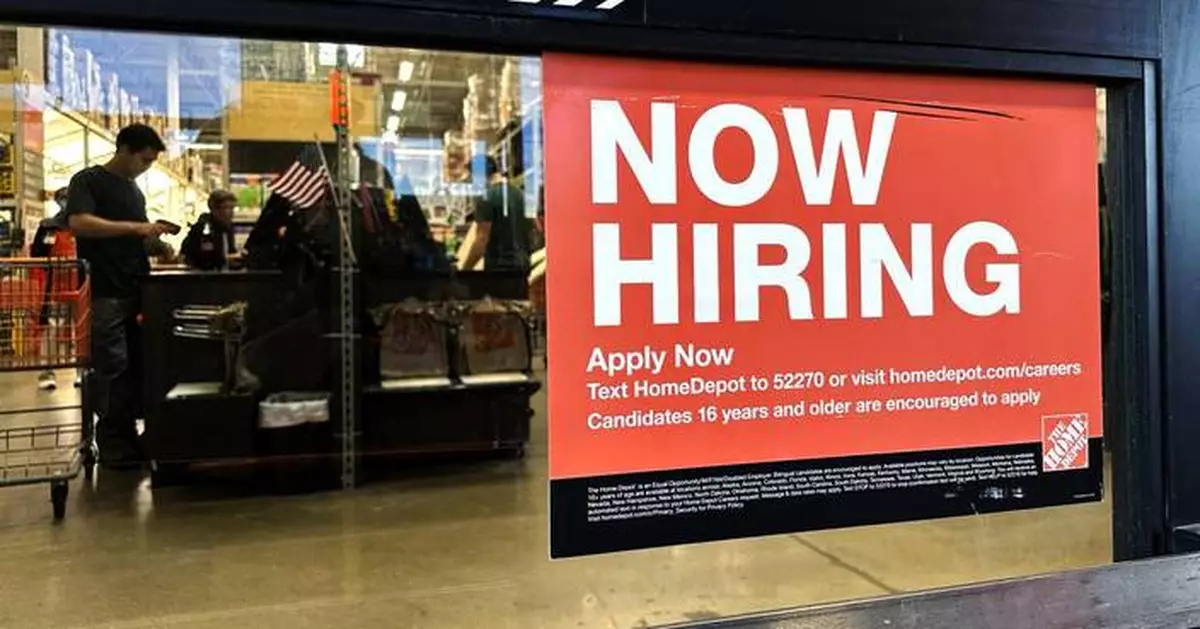
The number of Americans filing for jobless benefits fell modestly last week, remaining in the historically low range since the U.S. economy emerged from the COVID-19 pandemic.
Applications for unemployment benefits for the week ending Aug. 9 fell by 3,000 to 224,000, the Labor Department reported Thursday. That’s below the 230,000 new applications that economists had forecast.
Weekly applications for jobless benefits are seen as a proxy for U.S. layoffs and have mostly settled in a historically healthy range between 200,000 and 250,000 since COVID-19 throttled the economy in the spring of 2020.
Two weeks ago, a grim July jobs report sent financial markets spiraling, spurring President Donald Trump to fire Erika McEntarfer, the head of Bureau of Labor Statistics, which tallies the monthly employment numbers. The BLS does not contribute to the weekly unemployment benefits report except to calculate the annual seasonal adjustments.
U.S. employers added just 73,000 jobs in July, well short of the 115,000 analysts forecast. Worse, revisions to the May and June figures shaved 258,000 jobs off previous estimates and the unemployment rate ticked up to 4.2% from 4.1%.
Without citing evidence, Trump accused McEntarfer of rigging the jobs data for political reasons. On Monday, Trump nominated E.J. Antoni, chief economist at the conservative Heritage Foundation, to head the BLS. Antoni’s nomination was quickly met with a cascade of criticism from economists across the political spectrum.
While layoffs remain low by historical standards, there has been noticeable deterioration in the labor market this year and mounting evidence that people are having difficulty finding jobs.
U.S. employers posted 7.4 million job vacancies in June, down from 7.7 million in May. The number of people quitting their jobs — a sign of confidence in finding a better job — fell in June to the lowest level since December.
Some major companies have announced job cuts this year, including Procter & Gamble, Dow, CNN, Starbucks, Southwest Airlines, Microsoft, Google and Facebook parent company Meta. Intel and The Walt Disney Co. also recently announced staff reductions.
Many economists contend that Trump’s erratic rollout of tariffs against U.S. trading partners has created uncertainty for employers, who have grown reluctant to expand their payrolls.
The deadline on most of Trump’s proposed taxes on imports kicked in last week, though some deals have been made and other deadlines for negotiations — most importantly with China — have been extended. Unless Trump reaches deals with countries to lower the tariffs, economists fear they could act as a drag on the economy and spark another rise in inflation.
Also Thursday, new government data showed that U.S. wholesale inflation surged unexpectedly last month, a sign that Trump’s sweeping taxes on imports are pushing costs higher.
Thursday’s jobless benefits report showed that the four-week average of claims, which smooths out some of the week-to-week volatility, ticked up by 750 to 221,750.
The total number of Americans collecting unemployment benefits for the previous week of Aug. 2 fell by 15,000 to 1.95 million.
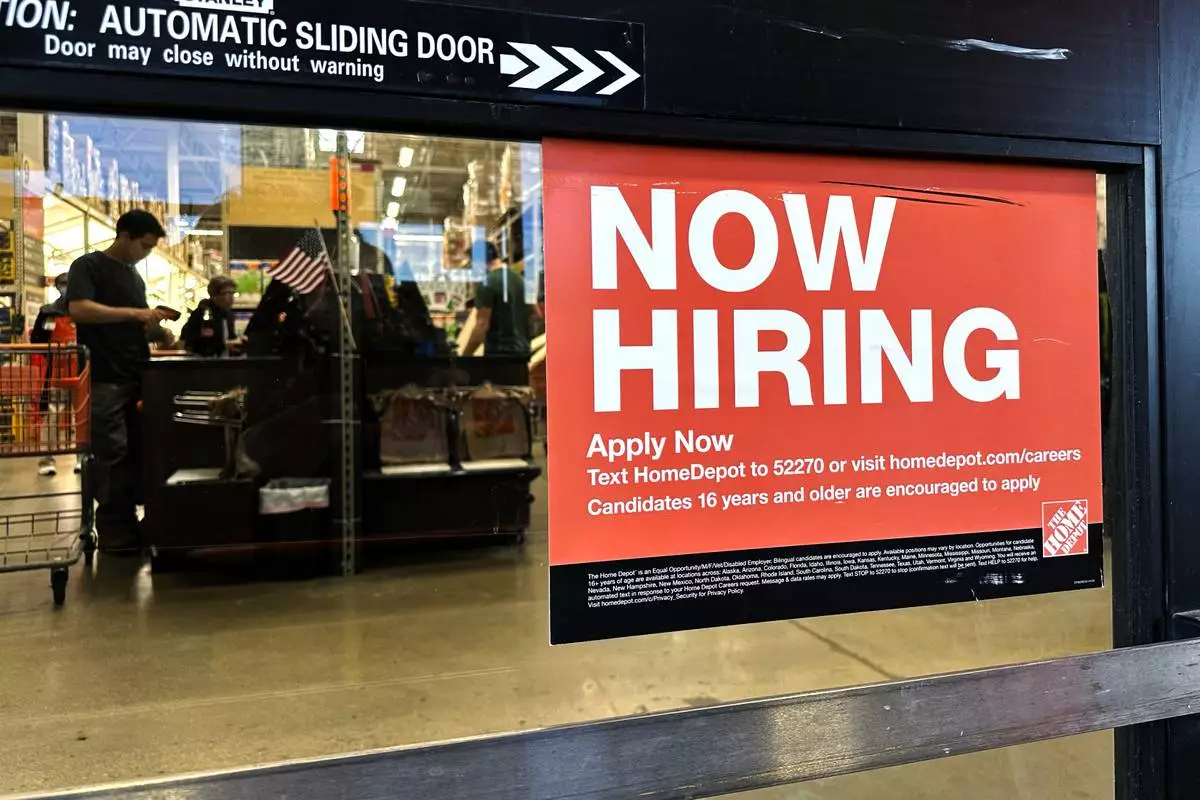
FILE - A hiring sign is displayed at a retail store in Mount Prospect, Ill., Saturday, Nov. 2, 2024. (AP Photo/Nam Y. Huh, File)
CAPE CANAVERAL, Fla. (AP) — An ailing astronaut returned to Earth with three others on Thursday, ending their space station mission more than a month early in NASA’s first medical evacuation.
SpaceX guided the capsule to a middle-of-the-night splashdown in the Pacific near San Diego, less than 11 hours after the astronauts exited the International Space Station.
“It’s so good to be home,” said NASA astronaut Zena Cardman, the capsule commander.
It was an unexpected finish to a mission that began in August and left the orbiting lab with only one American and two Russians on board. NASA and SpaceX said they would try to move up the launch of a fresh crew of four; liftoff is currently targeted for mid-February.
Cardman and NASA’s Mike Fincke were joined on the return by Japan’s Kimiya Yui and Russia’s Oleg Platonov. Officials have refused to identify the astronaut who had the health problem or explain what happened, citing medical privacy.
While the astronaut was stable in orbit, NASA wanted them back on Earth as soon as possible to receive proper care and diagnostic testing. The entry and splashdown required no special changes or accommodations, officials said, and the recovery ship had its usual allotment of medical experts on board. It was not immediately known when the astronauts would fly from California to their home base in Houston. Platonov’s return to Moscow was also unclear.
NASA stressed repeatedly over the past week that this was not an emergency. The astronaut fell sick or was injured on Jan. 7, prompting NASA to call off the next day’s spacewalk by Cardman and Fincke, and ultimately resulting in the early return. It was the first time NASA cut short a spaceflight for medical reasons. The Russians had done so decades ago.
The space station has gotten by with three astronauts before, sometimes even with just two. NASA said it will be unable to perform a spacewalk, even for an emergency, until the arrival of the next crew, which has two Americans, one French and one Russian astronaut.
The Associated Press Health and Science Department receives support from the Howard Hughes Medical Institute’s Department of Science Education and the Robert Wood Johnson Foundation. The AP is solely responsible for all content.
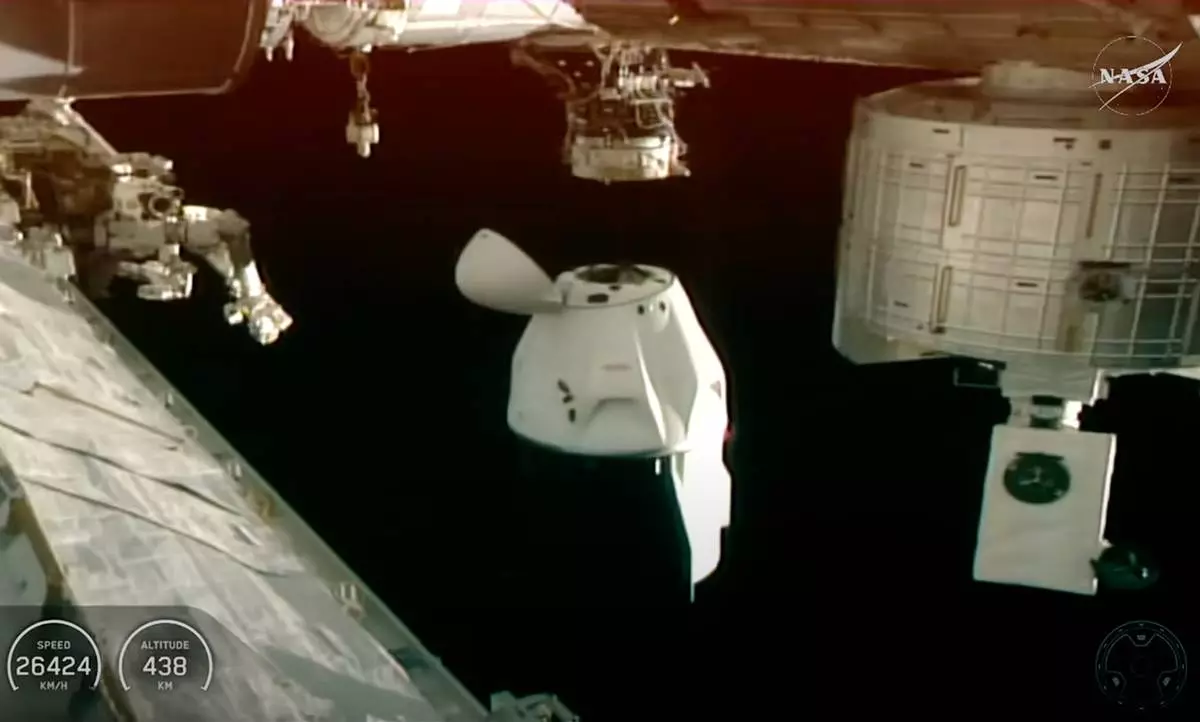
This screengrab from video provided by NASA TV shows the SpaceX Dragon departing from the International Space Station shortly after undocking with four NASA Crew-11 members inside on Wednesday, Jan. 14, 2026. (NASA via AP)
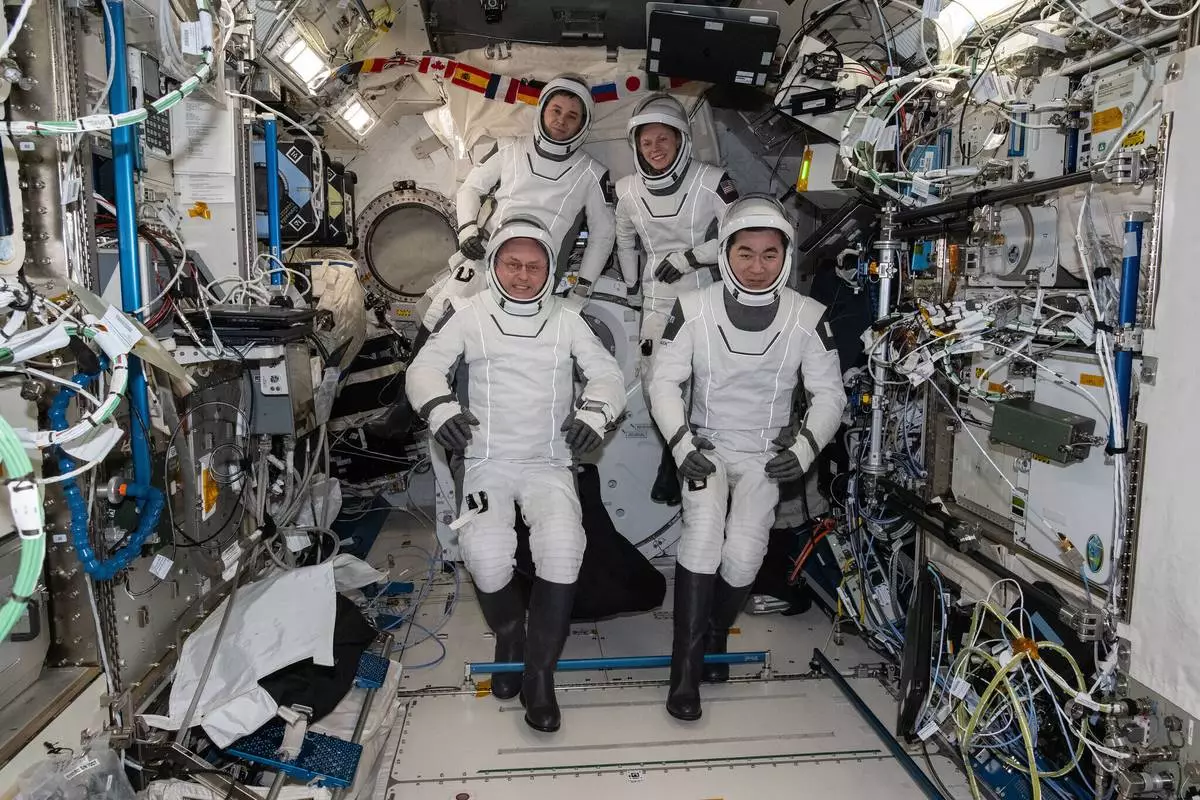
This photo provided by NASA shows clockwise from bottom left are, NASA astronaut Mike Fincke, Roscosmos cosmonaut Oleg Platonov, NASA astronaut Zena Cardman, and JAXA (Japan Aerospace Exploration Agency) astronaut Kimiya Yui gathering for a crew portrait wearing their Dragon pressure suits during a suit verification check inside the International Space Station’s Kibo laboratory module, Wednesday, Jan. 14, 2026. (NASA via AP)
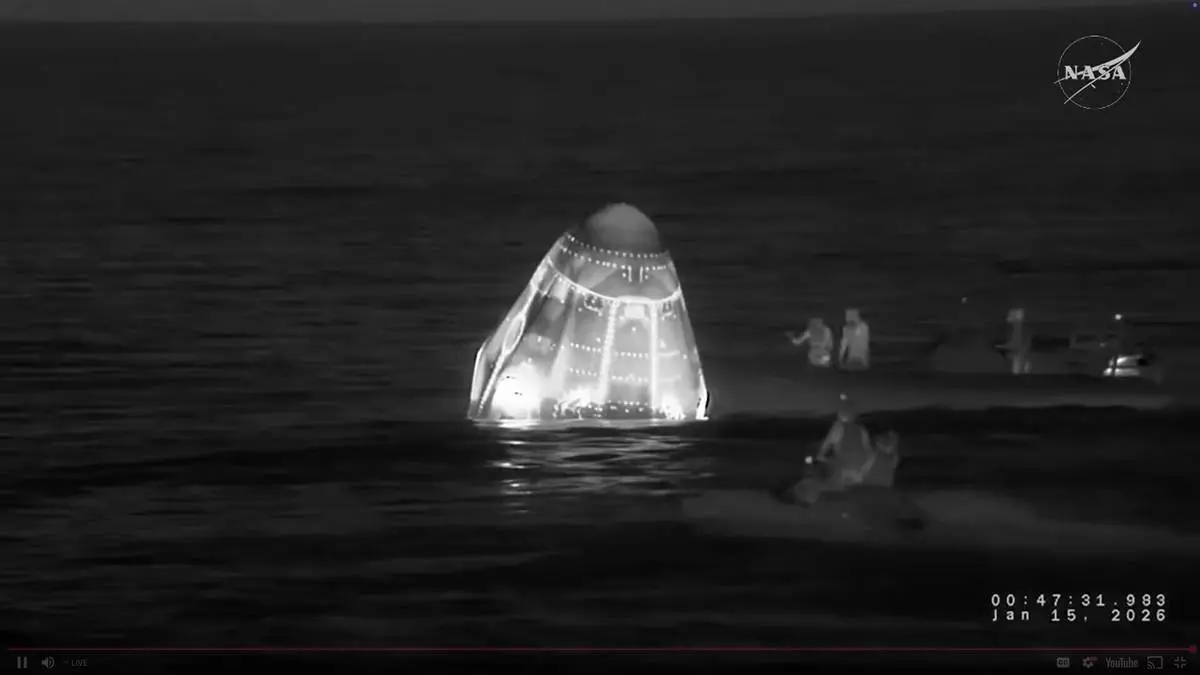
This screengrab from video provided by NASA shows recovery vessels approaching the NASA's SpaceX Crew-11 capsule to evacuate one of the crew members after they re-entered the earth in a middle-of-the-night splashdown near San Diego, Calif., Thursday, Jan. 15, 2026. (NASA via AP)
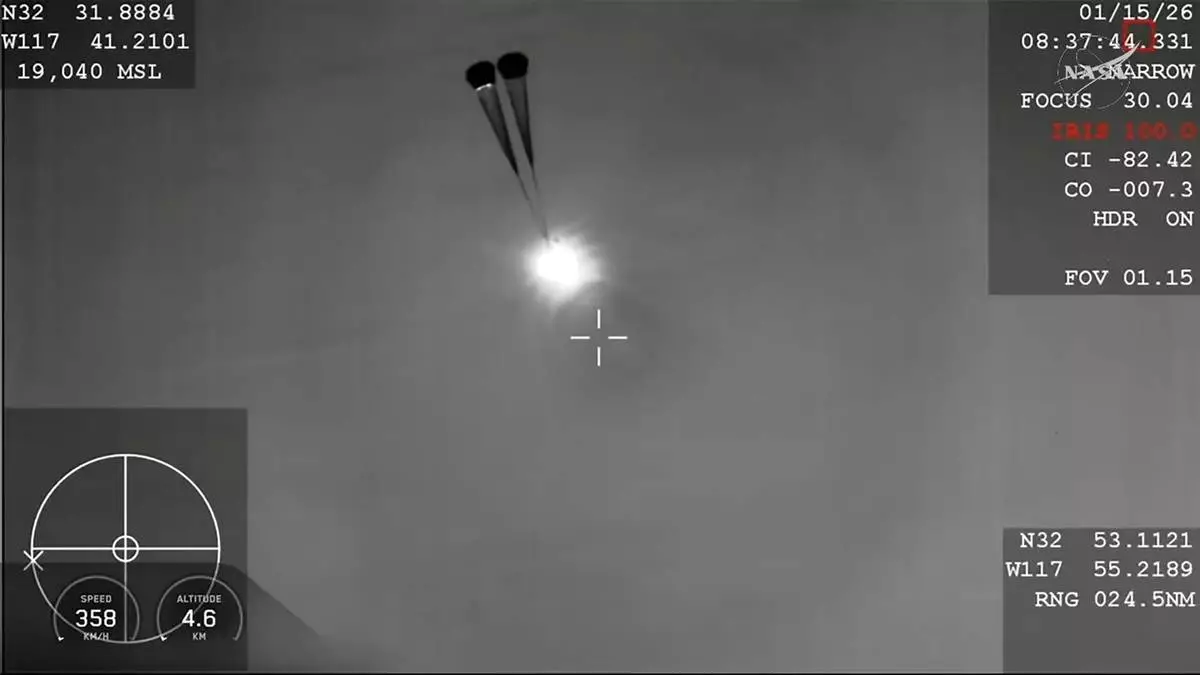
This screengrab from video provided by NASA shows the NASA's SpaceX Crew-11 members re entering the earth in a middle-of-the-night splashdown near San Diego, Calif., Thursday, Jan. 15, 2026. (NASA via AP)
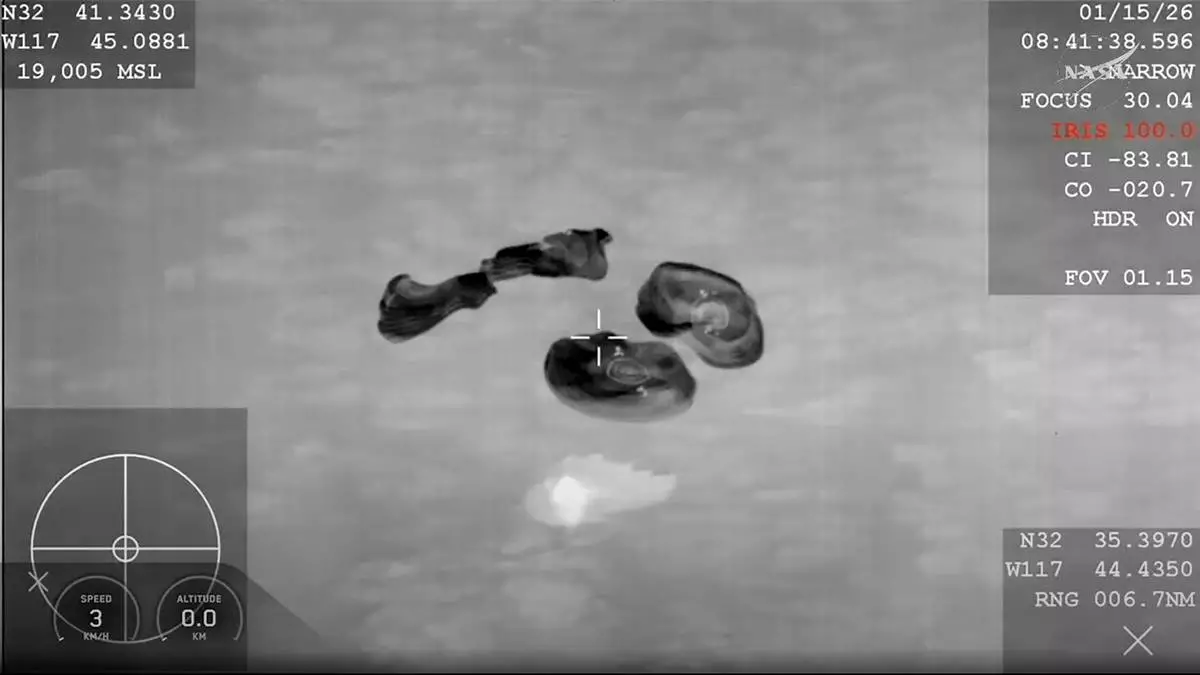
This screengrab from video provided by NASA shows the NASA's SpaceX Crew-11 members re entering the earth in a middle-of-the-night splashdown near San Diego, Calif., Thursday, Jan. 15, 2026. (NASA via AP)