New evidence of Unit 731 -- a Japanese germ-warfare unit that operated during World War II -- was unveiled in Harbin, the capital of northeast China's Heilongjiang Province, on Friday, which marks the 80th anniversary of Japan's unconditional surrender in World War II.
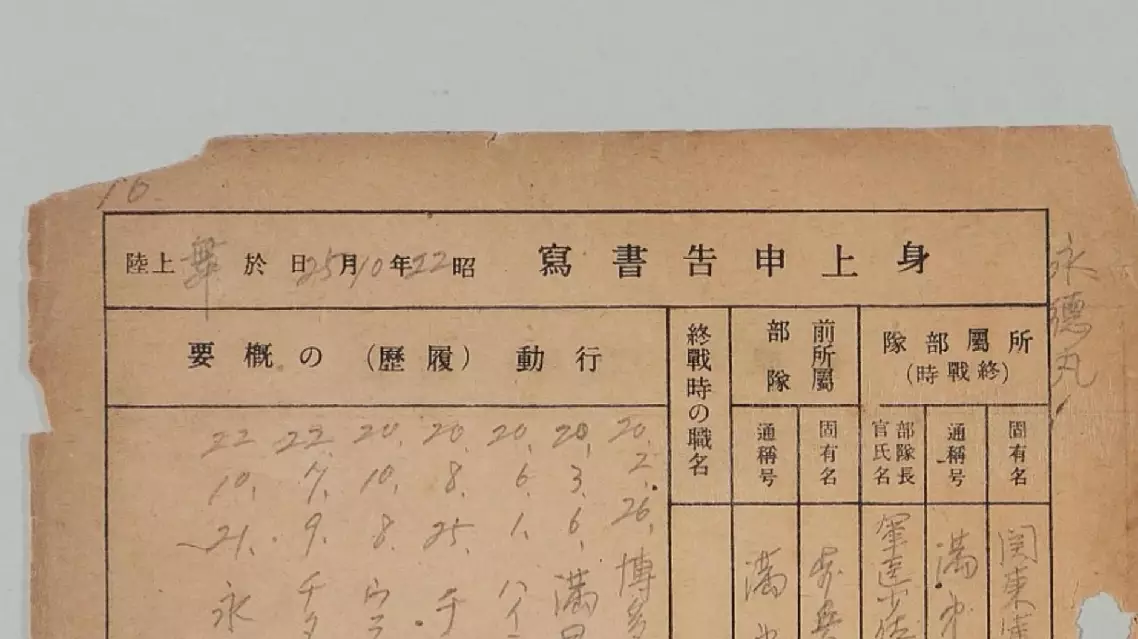
For the first time, the complete version of the "Personal Declaration Form" from Unit 731 is being publicly released in China.
With over 3,000 personnel, the unit conducted horrific human experiments during World War II under the pretense of disease prevention and water purification, engaging in the development of biological weapons and committing crimes against humanity.
The "Personal Declaration Form" from Unit 731 was a standard document that members needed to complete when returning to Japan after demobilization. This document was uncovered by researchers in May 2022 at the National Archives of Japan.
"In August 1945, Unit 731 was ordered to withdraw to Japan ahead of schedule, with the Kwantung Army granting special approval for three military trains. However, by June 1945, the unit's branches had already been placed under local command of the Kwantung Army, which caused them to separate with the Harbin headquarters when they withdrew to Japan. During their retreat, some members were captured by the Soviet Red Army and taken into the Soviet Union, while others stayed behind in China. After the war, as policies changed, they returned to Japan and filled out personal information registration forms," said Jin Shicheng, vice secretary-general of the Harbin Research Association on the History of Japanese Bacterial and Chemical Warfare in China.
Researchers found that the "Personal Declaration Form" from Unit 731 contained information on 759 individuals from Harbin headquarters and various branches, including Linkou, Sunwu, Hailar, Mudanjiang, and Dalian. Of these, 755 were men and four were women. The forms included personal details, military service records, and demobilization information.
Based on the information from the "Personal Declaration Form" of Unit 731, after Japan announced its unconditional surrender on August 15, 1945, 135 members of the unit were captured by the Soviet Red Army and detained in Khabarovsk, where they underwent concentrated interrogation and investigation.
According to the forms, a total of 43 individuals were tried in Khabarovsk, with sentences ranging from three to 25 years. This is the first time such information has been revealed.
The "Personal Declaration Form" of Unit 731 is one of the most comprehensive documents detailing the family backgrounds, military assignments, and post-war activities of its members. It is a key piece of evidence for understanding the personal criminal records associated with Unit 731.
"It particularly tracks the movements of Unit 731 members in China and the Soviet Union after World War II. A lot of this information hasn't come up in previous research, so it's a big step in uncovering their criminal activities," said Jin.
"The study of the inhumane atrocities committed by Unit 731 is a concern shared by scholars of many countries. I believe that the release of the 'Personal Declaration Form,' along with the newly declassified Khabarovsk trial documents from Russia, will significantly advance this research," said Gong Wenjing, director of the International Research Center on the Unit 731 Issues at the Harbin Academy of Social Sciences.
New evidence of Japanese germ-warfare unit released