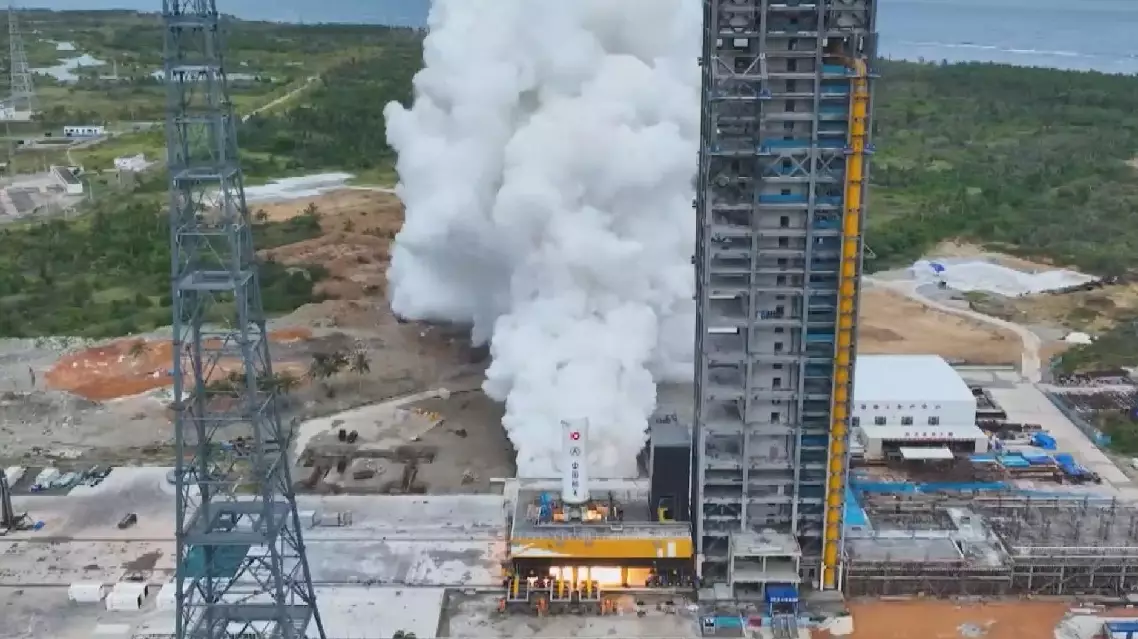
China's Long March-10 carrier rocket, the country's new-generation manned launch vehicle, has successfully completed the first static fire test on Friday at the Wenchang Spacecraft Launch Site in the southern island province of Hainan, the China Manned Space Agency (CMSA) has announced.
This marks a significant new milestone in China's manned lunar exploration program, following the successful zero-altitude escape flight test of the Mengzhou manned spacecraft and the comprehensive landing and takeoff test of the Lanyue manned lunar lander, according to the CMSA.
At 15:00, seven engines of the test product of the rocket's first stage were ignited simultaneously, followed by the completion of multiple scheduled test procedures.
This static fire test evaluated the simultaneous working capacity of the seven parallel engines of the rocket's first stage under standard and high working conditions, as well as obtained complete test data. The test was a complete success, the agency said.
The thrust scale in Friday's test reached nearly 1,000 tonnes, marking the largest such test ever conducted in China.
"Conducting a power system test is one of the most critical steps in rocket development. It mainly assesses the thermal and mechanical environment created by simultaneously operating seven engines on a 5-meter-diameter core stage. It's also a key step to ensure system compatibility and to mitigate risks ahead of the rocket's maiden flight," said Peng Yue, an engineer with the China Aerospace Science and Technology Corporation.
The Long March-10 carrier rocket series is developed to serve China's manned lunar exploration missions, including two configurations -- the Long March-10 rocket and Long March-10A rocket.
The Long March-10 rocket is a type of three-stage rocket with two boosters. It has a diameter of five meters and a maximum height of 92.5 meters. It will undertake the launch missions of the manned spacecraft and the lunar lander.
The Long March-10A, the low earth orbit (LEO) version, is a type of two-stage reusable rocket, with a diameter of five meters and a maximum height of 67 meters. Its first stage can be recycled and reused. It will serve the launch missions of the Mengzhou manned spacecraft and Tianzhou cargo craft in the application and development phase of the country's space station. "This rocket features seven engines on a 5-meter-diameter core stage, providing a total thrust of around 1,000 tonnes. Using three such core modules in parallel, the combined thrust will reach nearly 3,000 tonnes, making it currently China's most powerful launch vehicle in terms of payload capacity and liftoff thrust," said Peng.
The Long March-10 adopts a modular design philosophy applied across China's new-generation launch vehicles. Engineers can configure and assemble different modules according to mission needs, boosting efficiency, flexibility, and cost-effectiveness.
"The first stage and boosters of the Long March-10 rocket are what we call the universal core stage, which essentially consists of three identical core modules bundled together. The bare rod configuration used for the LEO version is based on this universal core stage, with some necessary modifications made to accommodate the requirements of the reusable return section," said Xu Hongping, a fellow engineer with the China Aerospace Science and Technology Corporation.
The success of the static fire test has laid an important technical foundation for the manned lunar exploration mission, the CMSA said.
The agency stated that the Long March-10 series rockets will be fully utilized in the country's manned spaceflight program, working in tandem with the Mengzhou manned spacecraft to achieve the upgrading of China's manned space-Earth round-trip transportation system.
New supporting infrastructure for the country's manned lunar exploration program is under construction at the Wenchang Spacecraft Launch Site, with all work progressing smoothly, the CMSA said.
Success in 1st static fire test paves way for Long March-10 carrier rocket's future missions