Skip to Content Facebook Feature Image

Searing heat draws visitors to California's Death Valley, where it's tough to communicate the risks

News

Searing heat draws visitors to California's Death Valley, where it's tough to communicate the risks
News

News

Searing heat draws visitors to California's Death Valley, where it's tough to communicate the risks

2025-08-16 21:03 Last Updated At:21:10

DEATH VALLEY NATIONAL PARK, Calif. (AP) — Ray Estrada's 11-year-old grandson is used to Las Vegas' scorching summers, but he'd always wanted to experience the heat in one of the Earth's hottest places. So Estrada recently drove him to Death Valley National Park, with an umbrella, extra water and electrolytes in tow. That day, the thermometer soared to 118 F (47.78 C).

“We have to be very careful when we go out there,” Estrada told him. “If you start feeling dizzy or whatever... we’re just gonna turn back and be safe so we can do this again another time.”

More Images
A hiker rests in the shade near Zabriskie Point, Sunday, Aug. 3, 2025, in Death Valley National Park, Calif. (AP Photo/John Locher)
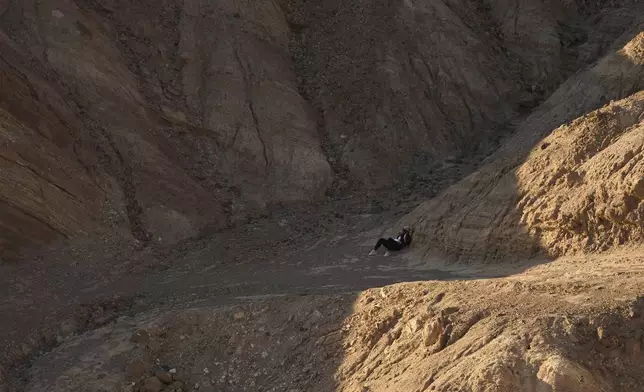
A hiker rests in the shade near Zabriskie Point, Sunday, Aug. 3, 2025, in Death Valley National Park, Calif. (AP Photo/John Locher)

Pedro Luque, of Spain, fills up water bottles at the Furnace Creek Visitor Center, Sunday, Aug. 3, 2025, in Death Valley National Park, Calif. (AP Photo/John Locher)
Pedro Luque, of Spain, fills up water bottles at the Furnace Creek Visitor Center, Sunday, Aug. 3, 2025, in Death Valley National Park, Calif. (AP Photo/John Locher)

A person walks on sand dunes Sunday, Aug. 3, 2025, in Death Valley National Park, Calif. (AP Photo/John Locher)
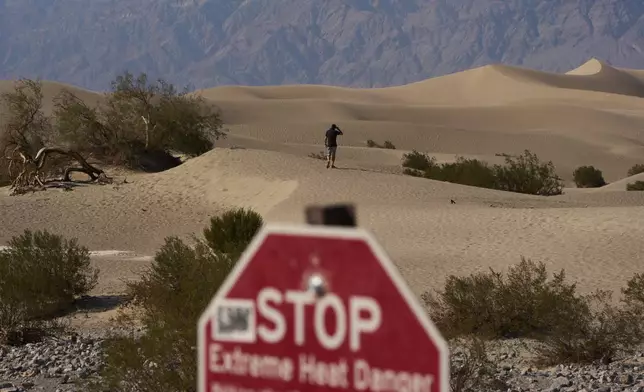
A person walks on sand dunes Sunday, Aug. 3, 2025, in Death Valley National Park, Calif. (AP Photo/John Locher)

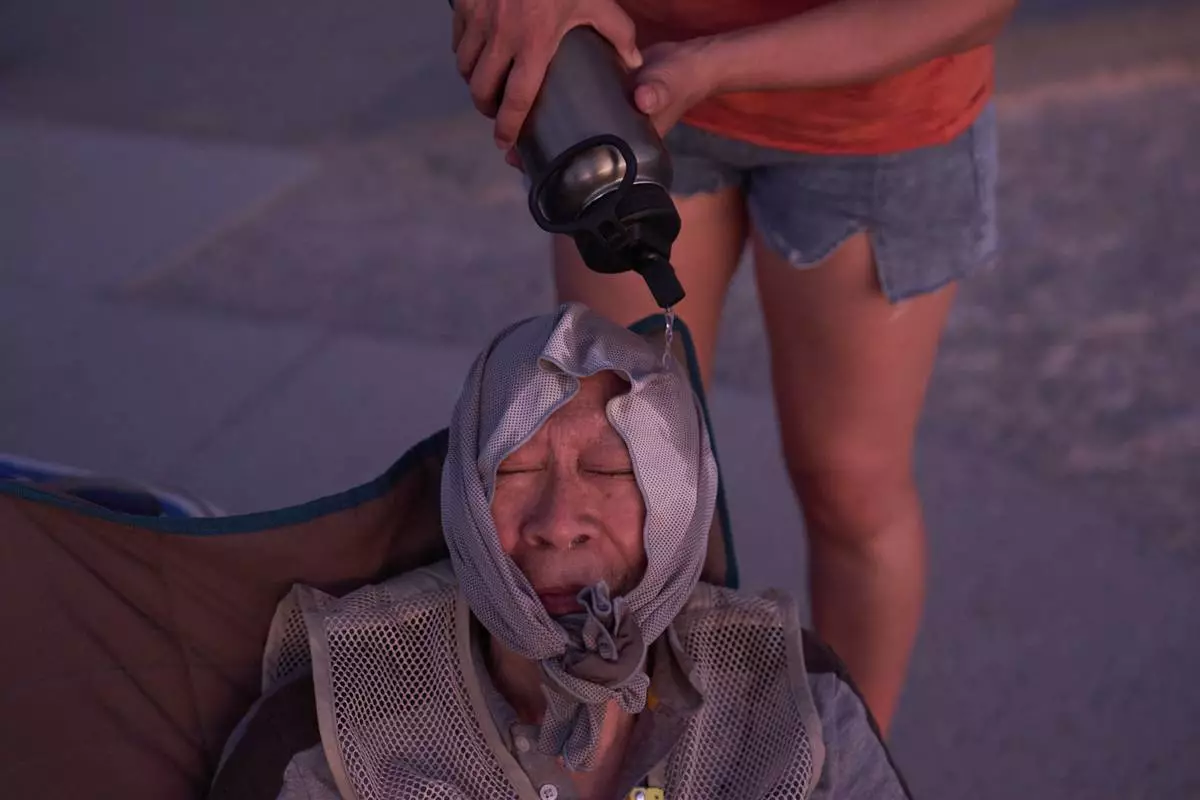
Grace Chyuwei pours water on Joe Chyuwei to help with the heat Sunday, Aug. 3, 2025, in Death Valley National Park, Calif. (AP Photo/John Locher)
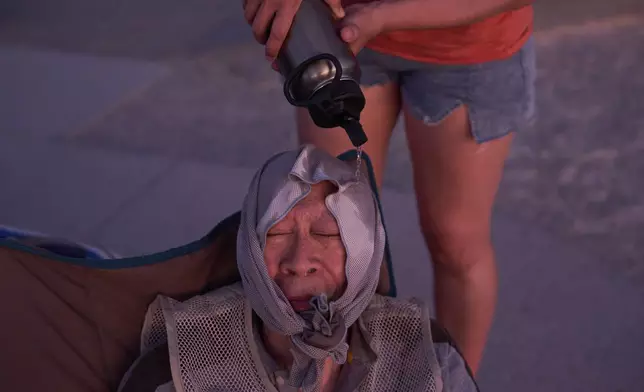
Grace Chyuwei pours water on Joe Chyuwei to help with the heat Sunday, Aug. 3, 2025, in Death Valley National Park, Calif. (AP Photo/John Locher)

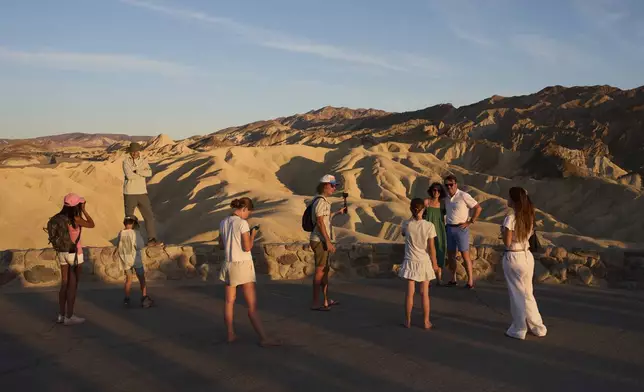
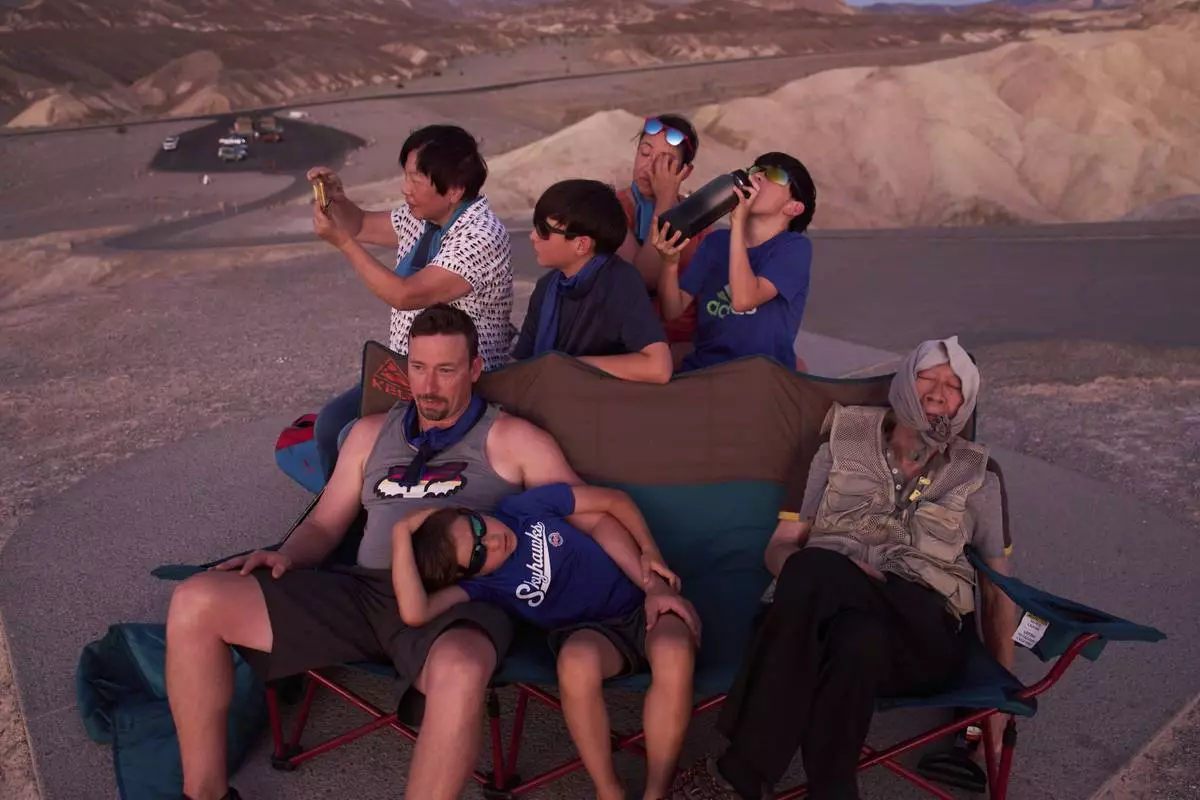
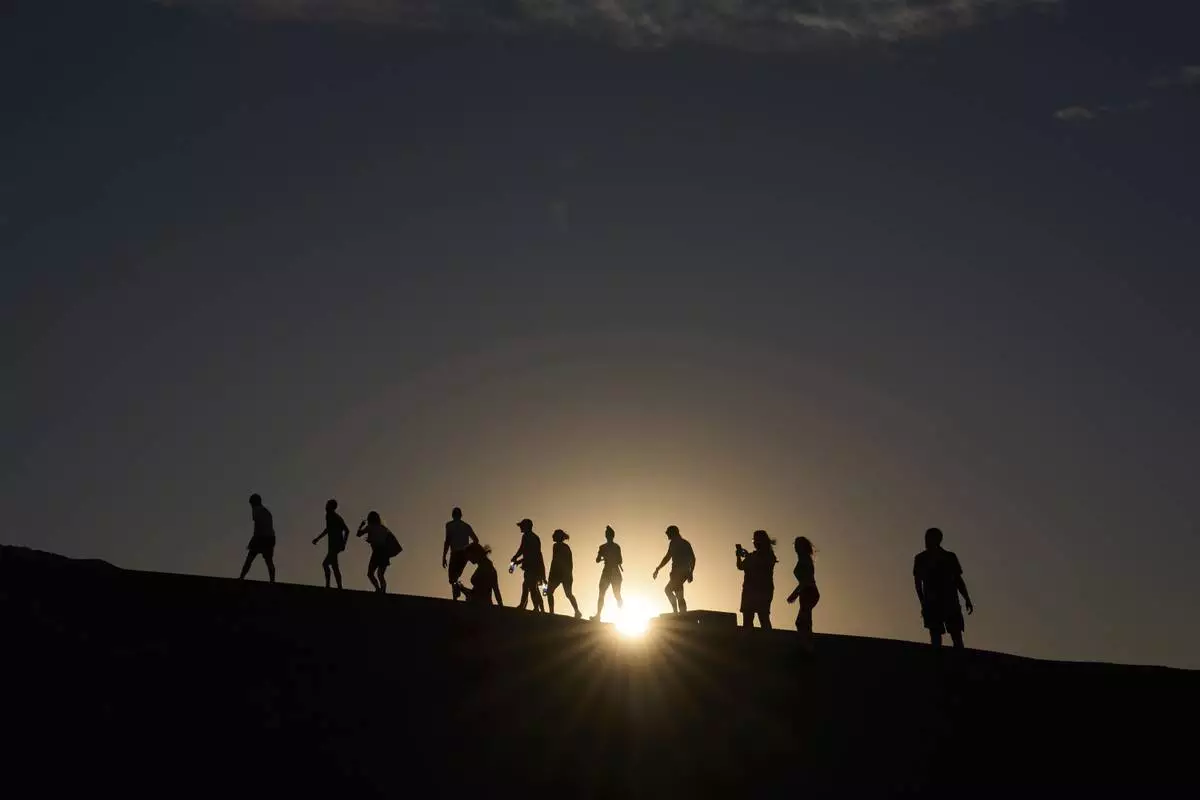
Joe Chyuwei, right, Addison Black, front center, James Black, front left, and back row from left, Helen Chyuwei, Jameson Black, Grace Chyuwei and Grayson Black watch the sunset in the heat at Zabriskie Point, Sunday, Aug. 3, 2025, in Death Valley National Park, Calif. (AP Photo/John Locher)
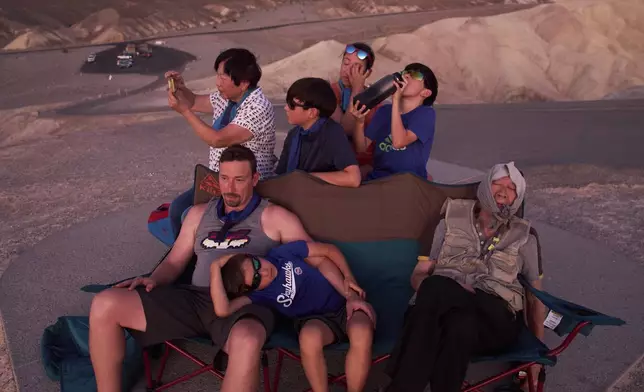
Joe Chyuwei, right, Addison Black, front center, James Black, front left, and back row from left, Helen Chyuwei, Jameson Black, Grace Chyuwei and Grayson Black watch the sunset in the heat at Zabriskie Point, Sunday, Aug. 3, 2025, in Death Valley National Park, Calif. (AP Photo/John Locher)

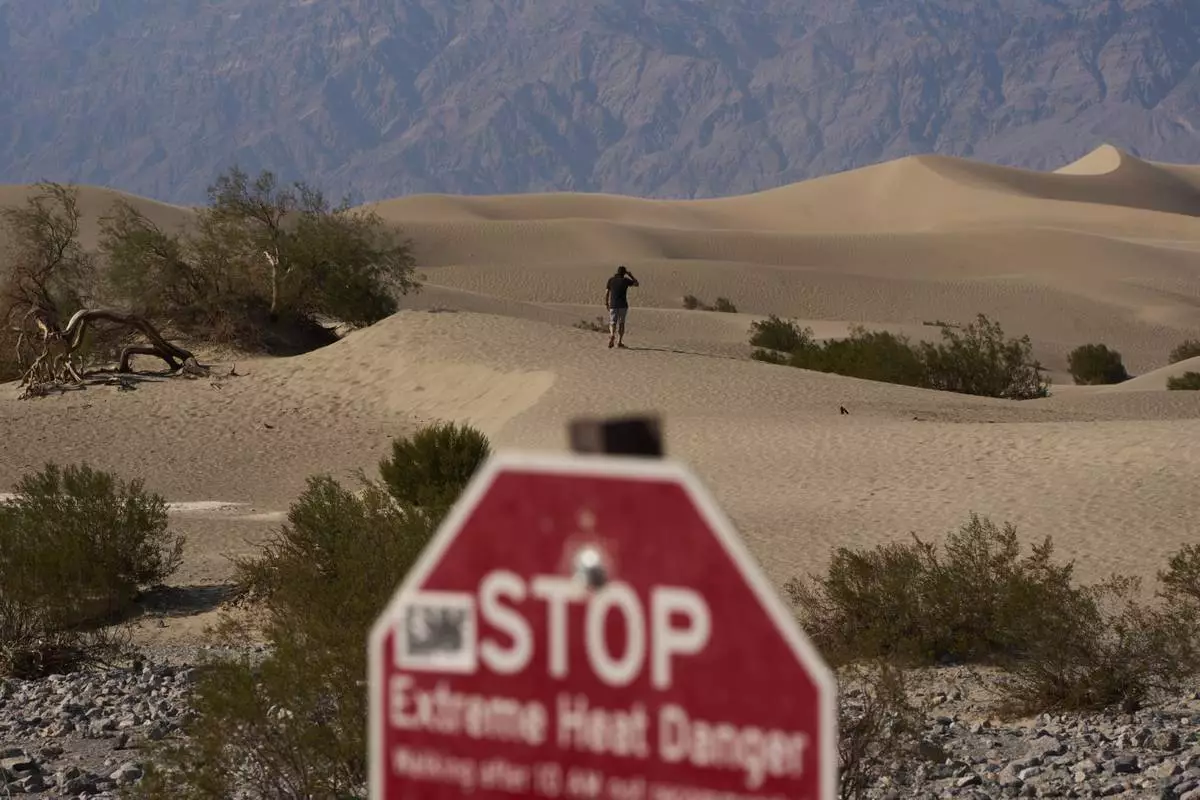
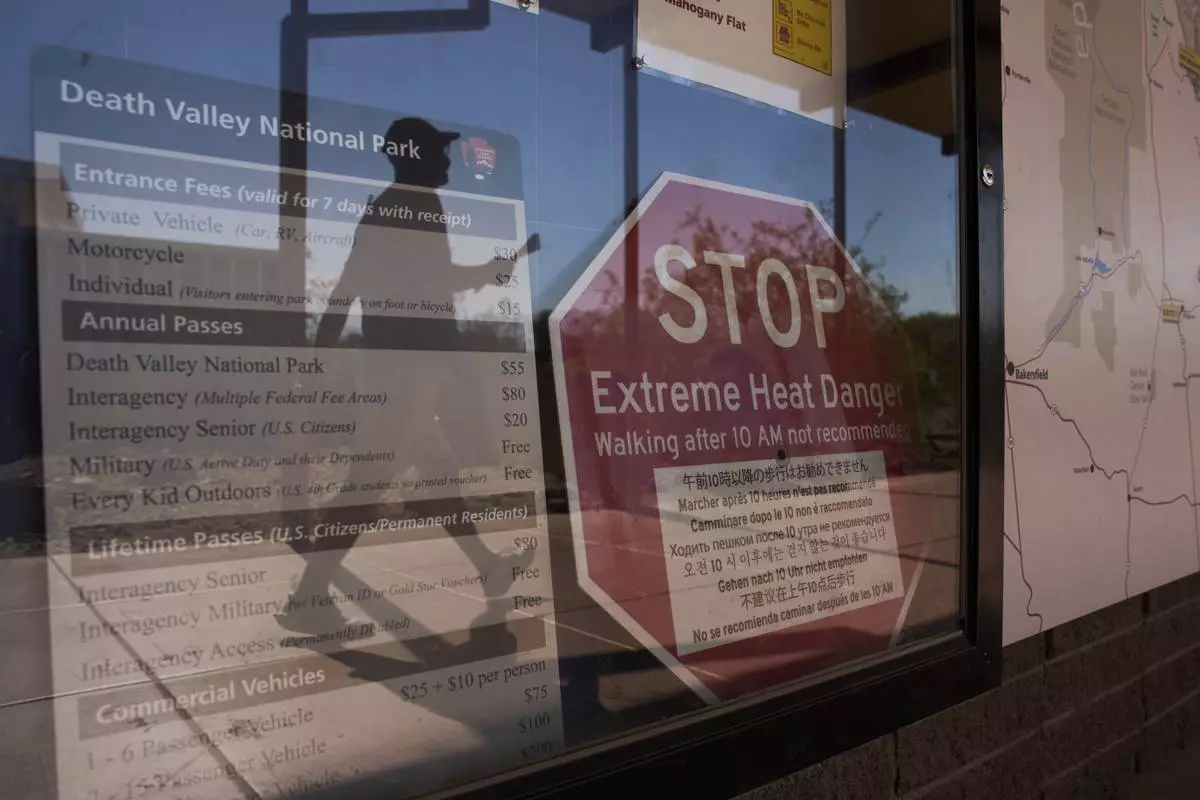
A person walks by a sign warning of extreme heat danger at the Furnace Creek Visitor Center, Sunday, Aug. 3, 2025, in Death Valley National Park, Calif. (AP Photo/John Locher)
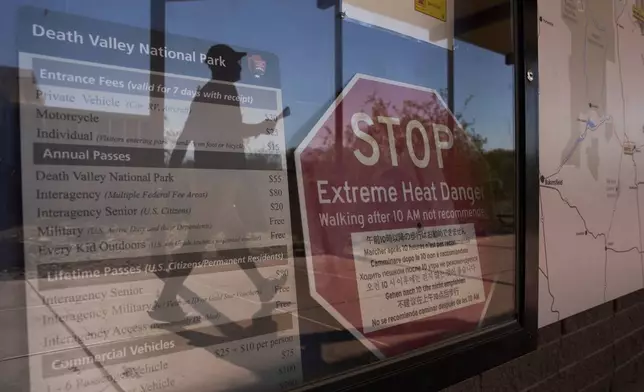
A person walks by a sign warning of extreme heat danger at the Furnace Creek Visitor Center, Sunday, Aug. 3, 2025, in Death Valley National Park, Calif. (AP Photo/John Locher)

Tourists visit Zabriskie Point, Sunday, Aug. 3, 2025, in Death Valley National Park, Calif. (AP Photo/John Locher)
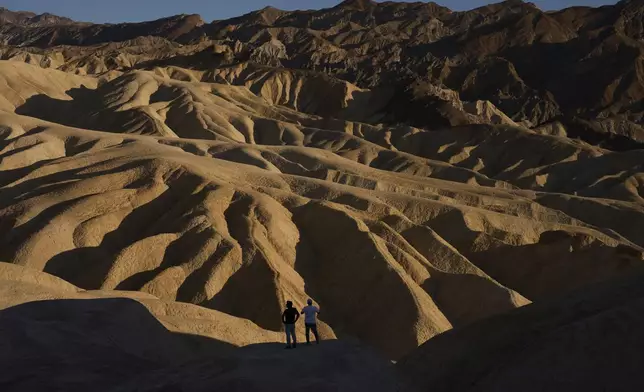
Tourists visit Zabriskie Point, Sunday, Aug. 3, 2025, in Death Valley National Park, Calif. (AP Photo/John Locher)
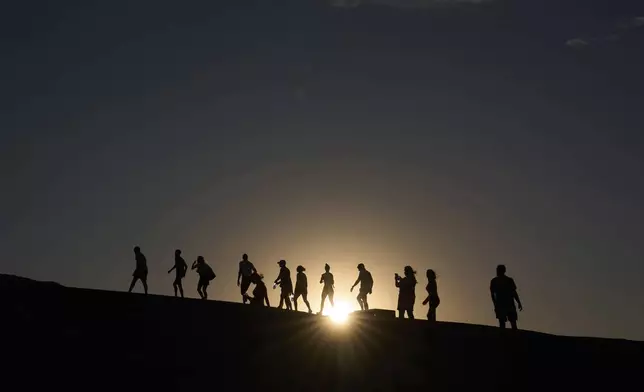
People look at the landscape at Zabriskie Point, Sunday, Aug. 3, 2025, in Death Valley National Park, Calif. (AP Photo/John Locher)

People look at the landscape at Zabriskie Point, Sunday, Aug. 3, 2025, in Death Valley National Park, Calif. (AP Photo/John Locher)

People walk up to an overlook at Zabriskie Point, Sunday, Aug. 3, 2025, in Death Valley National Park, Calif. (AP Photo/John Locher)

People walk up to an overlook at Zabriskie Point, Sunday, Aug. 3, 2025, in Death Valley National Park, Calif. (AP Photo/John Locher)

The extreme temperatures in this stretch of California desert attract visitors every year, some determined to finish a grueling, multiday race, others just curious about the sizzling heat and the landscape's vast beauty. Yet despite the warnings, the heat kills one to three people annually, and park rangers respond to overheated visitors multiple times per week, making communication about heat safety a priority for the National Park Service.

But that's easier said than done.

“It’s very easy to underestimate how dangerous heat is," said Abby Wines, the park's acting deputy superintendent. “People are usually used to thinking of heat as something that makes them uncomfortable," and that they can tough it out.

“This type of heat will kill,” she said.

Death Valley holds the record for the hottest temperature ever officially recorded — 134 F (56.67 C) in July 1913 — although some experts have disputed it and say the real record was 130 F (54.4 C) there in July 2021.

In the U.S., heat kills more people than other weather events combined, according to the National Oceanic and Atmospheric Administration. If planet-warming greenhouse gas emissions, which come from burning fuels like oil and coal, continue at their current pace, more places could experience broiling temperatures. That makes it crucial to communicate the dangers of extreme heat and safety precautions, as both can influence who lives and dies.

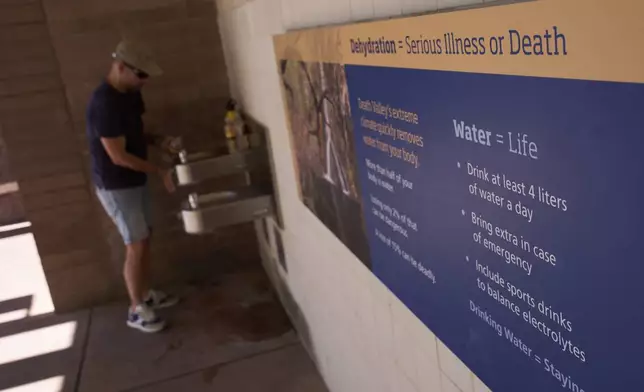
Throughout this desert are stark warnings of the deadly heat: “Stop. Extreme heat danger. Walking after 10 a.m. not recommended,” one sign says. “HEAT KILLS!” warns another. On bathroom walls there are reminders to hydrate in the form of charts displaying the color of pee — the darker the urine, the more you need to drink water.

Another sign warns visitors that helicopters for medical emergencies can’t safely fly amid extreme temperatures. Ambulances can often deploy in extreme heat but are not a guarantee. The safety of emergency responders is always considered.

Baruch Fischhoff, professor at Carnegie Mellon University who studies decision-making, said evidence shows that people generally underestimate risk when they have a sense of control. Information that explicitly says rescue might not be an option if it’s too hot “takes away that sense of the control that can lead to underestimating risk.”

Failing to recognize those risks can be deadly. Last summer, a helicopter was unable to fly to a rescue because of 128 F (53.33 C) temperatures. A group of visitors were traveling on motorcycles when one died from the heat, and another was treated for severe heat illness and transported to a hospital.

Rescue options are even more limited for hikers lost on a trail. Unless it’s a short distance and rescuers know where the person is, they’ll likely wait until sunset if it’s above 115 F (46.11 C). “Depending on their situation,” Wines said, that's “probably too late.”

Two of the park's busiest months are in the summer, and it sees a small bump in visitors when temperatures are expected to hit the high 120s or 130s F (48.89s to 54.44s C). But it's the moderate temperatures that tend to get people into more trouble.

“We actually have a harder time communicating our concerns about heat to the public when they visit and it’s only 100 to 115," Wines said. The dryness evaporates sweat almost instantly, so many people don't realize how much they're actually sweating.

Then there's the vastness. Death Valley has more than 50 entrances, so many visitors aren't seeing rangers who can relay important information. Instead, they place heat warning signs in the hottest and most popular spots. But they discovered that people responded less to heat warning signs that looked permanent compared to those that seemed temporary.

For Marc Green, an expert in experimental psychology, that finding is “100% predictable.”

“People judge what to do based on specific information,” he said. If a warning sign is up all the time, even when conditions are good, it contains no useful information. “That's why people disregard it.”

Jennifer Marlon, senior research scientist at the Yale School of the Environment, has studied public perceptions of the health risks of extreme heat across the U.S. How people perceive heat and other climate risks varies by factors like age, race, gender, income level and where they live. Older white men, for instance, tend to have lower risk perceptions across the board, whereas women have higher risk perceptions than men.

“The challenge, though, is that the level of worry or risk perception doesn’t necessarily translate into action,” Marlon said. Optimism bias could also falsely make a person believe the heat won’t personally affect them. While studies show that experience with heat increases people’s concern, it is short-lived.

“You get a bump for like a year or so after a really big event and then it just goes right back to the baseline,” she said.

Marlon said to be specific. Don't just tell people that heat can be lethal, tell them what could happen to their bodies and what to do to stay safe.

Death Valley park does this. On site and online, park officials tell visitors to avoid hiking at low elevations after 10 a.m., to stay on paved roads and near their cars. They say to drink and carry plenty of water, and to seek shade and hydrate if you feel dizzy, nauseous or have a headache.

And while this isn't something the park would initiate, if scientists gave names to heat waves, similar to how hurricanes are named, that could better grab people’s attention because human brains are attuned to novelty, Marlon said.

The messenger is also important. If friends, family and neighbors are worried and nudging you to do something, that can be more powerful than reading information online. Community leaders modeling appropriate behavior — like saying they’re evacuating their family ahead of a hurricane or that they carry extra water in their trunk — can also go a long way.

Marlon also suggested communicating how extreme heat can impair the ability to think clearly. When communicating with images, show people drinking water, putting on cold wet towels or resting in shade.

“Whatever the recommended behavior is, show them pictures of that behavior because we’re incredibly and fundamentally social animals, and body language is so much of how we communicate,” Marlon said.

———

Associated Press photographer John Locher contributed to this report from Death Valley National Park.

———

The Associated Press receives support from the Walton Family Foundation for coverage of water and environmental policy. The AP is solely responsible for all content. For all of AP’s environmental coverage, visit https://apnews.com/hub/climate-and-environment.

A hiker rests in the shade near Zabriskie Point, Sunday, Aug. 3, 2025, in Death Valley National Park, Calif. (AP Photo/John Locher)

A hiker rests in the shade near Zabriskie Point, Sunday, Aug. 3, 2025, in Death Valley National Park, Calif. (AP Photo/John Locher)

Pedro Luque, of Spain, fills up water bottles at the Furnace Creek Visitor Center, Sunday, Aug. 3, 2025, in Death Valley National Park, Calif. (AP Photo/John Locher)
Pedro Luque, of Spain, fills up water bottles at the Furnace Creek Visitor Center, Sunday, Aug. 3, 2025, in Death Valley National Park, Calif. (AP Photo/John Locher)

A person walks on sand dunes Sunday, Aug. 3, 2025, in Death Valley National Park, Calif. (AP Photo/John Locher)
A person walks on sand dunes Sunday, Aug. 3, 2025, in Death Valley National Park, Calif. (AP Photo/John Locher)

Grace Chyuwei pours water on Joe Chyuwei to help with the heat Sunday, Aug. 3, 2025, in Death Valley National Park, Calif. (AP Photo/John Locher)
Grace Chyuwei pours water on Joe Chyuwei to help with the heat Sunday, Aug. 3, 2025, in Death Valley National Park, Calif. (AP Photo/John Locher)

Joe Chyuwei, right, Addison Black, front center, James Black, front left, and back row from left, Helen Chyuwei, Jameson Black, Grace Chyuwei and Grayson Black watch the sunset in the heat at Zabriskie Point, Sunday, Aug. 3, 2025, in Death Valley National Park, Calif. (AP Photo/John Locher)
Joe Chyuwei, right, Addison Black, front center, James Black, front left, and back row from left, Helen Chyuwei, Jameson Black, Grace Chyuwei and Grayson Black watch the sunset in the heat at Zabriskie Point, Sunday, Aug. 3, 2025, in Death Valley National Park, Calif. (AP Photo/John Locher)

A person walks by a sign warning of extreme heat danger at the Furnace Creek Visitor Center, Sunday, Aug. 3, 2025, in Death Valley National Park, Calif. (AP Photo/John Locher)

A person walks by a sign warning of extreme heat danger at the Furnace Creek Visitor Center, Sunday, Aug. 3, 2025, in Death Valley National Park, Calif. (AP Photo/John Locher)

Tourists visit Zabriskie Point, Sunday, Aug. 3, 2025, in Death Valley National Park, Calif. (AP Photo/John Locher)
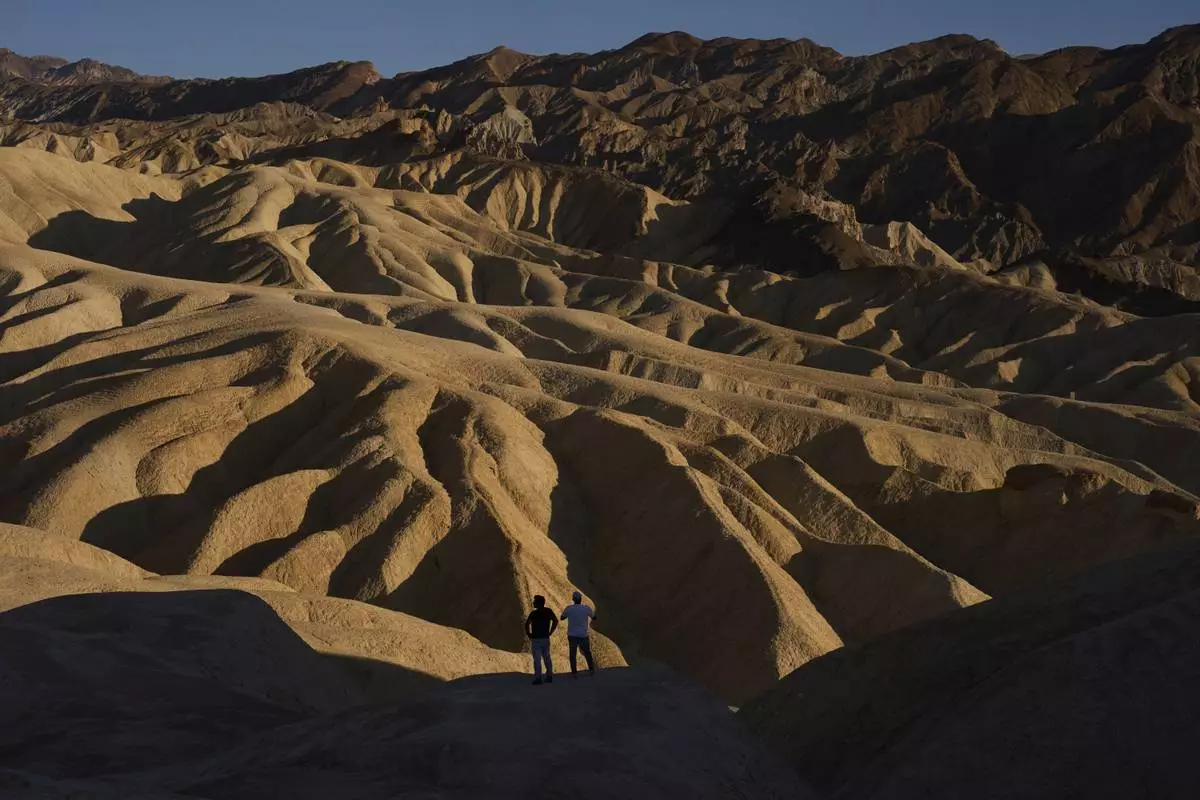
Tourists visit Zabriskie Point, Sunday, Aug. 3, 2025, in Death Valley National Park, Calif. (AP Photo/John Locher)
People look at the landscape at Zabriskie Point, Sunday, Aug. 3, 2025, in Death Valley National Park, Calif. (AP Photo/John Locher)
People look at the landscape at Zabriskie Point, Sunday, Aug. 3, 2025, in Death Valley National Park, Calif. (AP Photo/John Locher)

People walk up to an overlook at Zabriskie Point, Sunday, Aug. 3, 2025, in Death Valley National Park, Calif. (AP Photo/John Locher)

People walk up to an overlook at Zabriskie Point, Sunday, Aug. 3, 2025, in Death Valley National Park, Calif. (AP Photo/John Locher)
NUUK, Greenland (AP) — A bipartisan U.S. congressional delegation on Saturday sought to reassure Denmark and Greenland of their support following President Donald Trump's threat to punish countries with tariffs if they don’t back the U.S. taking over the strategic Arctic island.

Delegation leader Sen. Chris Coons, a Delaware Democrat, said the current rhetoric around Greenland is causing concern across the Danish kingdom. He said he wants to de-escalate the situation.

“I hope that the people of the Kingdom of Denmark do not abandon their faith in the American people,” Coons said in Copenhagen, adding that the U.S. has respect for Denmark and NATO “for all we’ve done together.”

Meanwhile, Danish Major Gen. Søren Andersen, leader of the Joint Arctic Command, told The Associated Press that Denmark does not expect the U.S. military to attack Greenland, or any other NATO ally, and that European troops were recently deployed to Nuuk for Arctic defense training.

He said the goal isn’t to send a message to the Trump administration, even through the White House hasn’t ruled out taking the territory by force.

“I will not go into the political part, but I will say that I would never expect a NATO country to attack another NATO country,” he told the AP on Saturday aboard a Danish military vessel docked in Nuuk. “For us, for me, it’s not about signaling. It is actually about training military units, working together with allies.”

The Danish military organized a planning meeting Friday in Greenland with NATO allies, including the U.S., to discuss Arctic security on the alliance’s northern flank in the face of a potential Russian threat. The Americans were also invited to participate in Operation Arctic Endurance in Greenland in the coming days, Andersen said.

In his 2 1/2 years as a commander in Greenland, Andersen said he has not seen any Chinese or Russian combat vessels or warships despite Trump's claims that they were off the island's coast.

But in the unlikely event of American troops using force on Danish soil, Andersen confirmed a Cold War-era law governing Danish rules of engagement.

“But you are right that it is Danish law that a Danish soldier, if attacked, has the obligation to fight back,” he said.

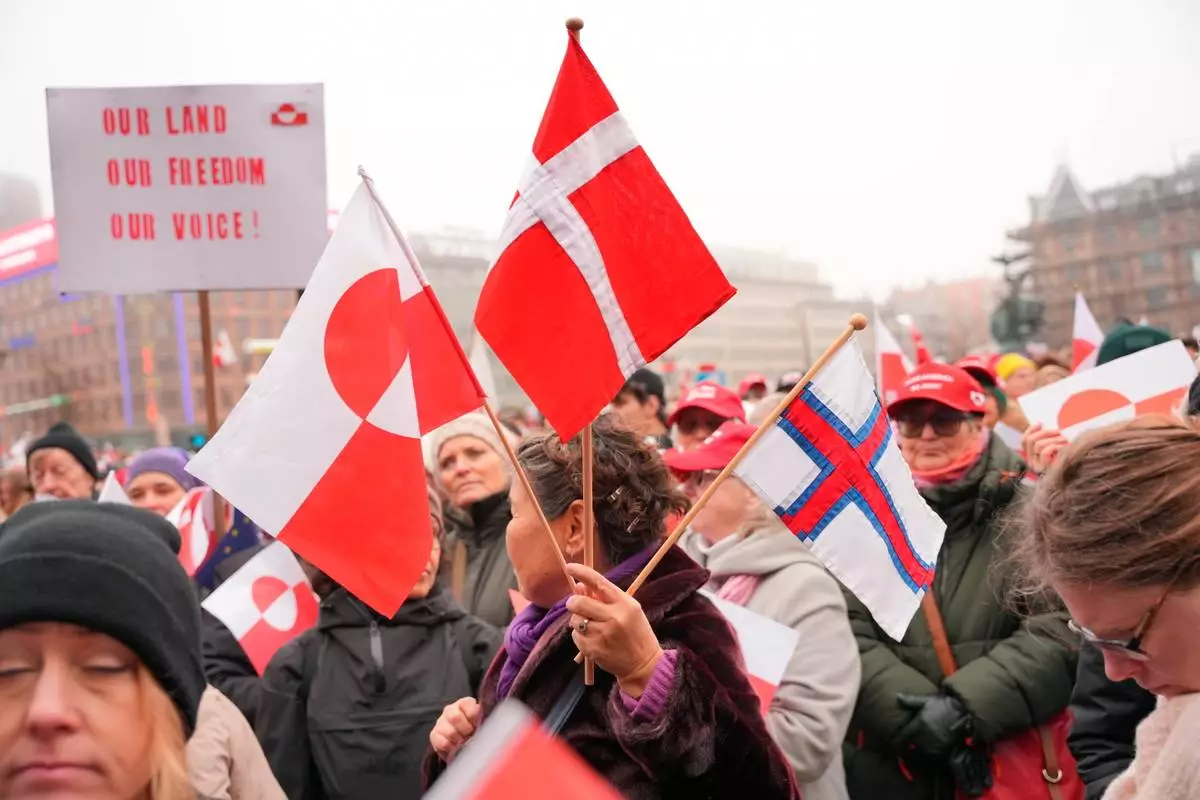
Thousands of people marched through Copenhagen, many of them carrying Greenland’s flag, on Saturday afternoon in support of the self-governing island. Others held signs with slogans like “Make America Smart Again” and “Hands Off.”

“This is important for the whole world,” Danish protester Elise Riechie told The Associated Press as she held Danish and Greenlandic flags. “There are many small countries. None of them are for sale.”

Other rallies were planned in Nuuk, the Greenlandic capital, and elsewhere in the Danish kingdom.

Coons’ comments contrasted with that emanating from the White House. Trump has sought to justify his calls for a U.S. takeover by repeatedly claiming that China and Russia have their own designs on Greenland, which holds vast untapped reserves of critical minerals. The White House hasn’t ruled out taking the territory by force.

“There are no current security threats to Greenland,” Coons said.

Trump for months has insisted that the U.S. should control Greenland, a semiautonomous territory of NATO ally Denmark, and said earlier this week that anything less than the Arctic island being in U.S. hands would be “unacceptable.”

During an unrelated event at the White House about rural health care, he recounted Friday how he had threatened European allies with tariffs on pharmaceuticals.

“I may do that for Greenland, too,” Trump said. “I may put a tariff on countries if they don’t go along with Greenland, because we need Greenland for national security. So I may do that,” he said.

He had not previously mentioned using tariffs to try to force the issue.

Earlier this week, the foreign ministers of Denmark and Greenland met in Washington with U.S. Vice President JD Vance and Secretary of State Marco Rubio.

That encounter didn’t resolve the deep differences, but did produce an agreement to set up a working group — on whose purpose Denmark and the White House then offered sharply diverging public views.

European leaders have insisted it is only for Denmark and Greenland to decide on matters concerning the territory, and Denmark said this week that it was increasing its military presence in Greenland in cooperation with allies.

“There is almost no better ally to the United States than Denmark,” Coons said. “If we do things that cause Danes to question whether we can be counted on as a NATO ally, why would any other country seek to be our ally or believe in our representations?”

__

Niemann reported from Copenhagen, Denmark. Associated Press writer Stefanie Dazio in Berlin contributed to this report.

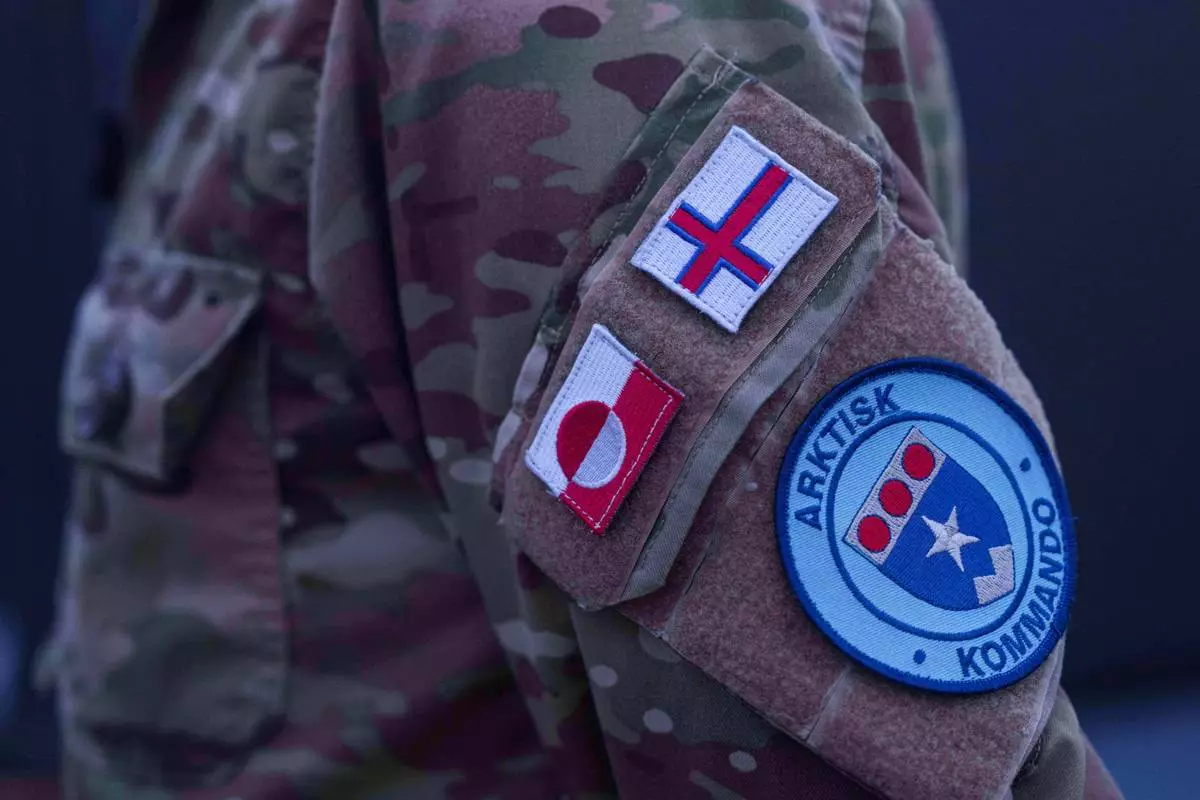
A patch of the Joint Arctic Command is seen on o jacket of Major General Søren Andersen standing onboard a military vessel HDMS Knud Rasmussen of the Royal Danish Navy docked in Nuuk, Greenland, on Saturday, Jan. 17, 2026. (AP Photo/Evgeniy Maloletka)

A patch of the Joint Arctic Command is seen on o jacket of Major General Søren Andersen standing onboard a military vessel HDMS Knud Rasmussen of the Royal Danish Navy docked in Nuuk, Greenland, on Saturday, Jan. 17, 2026. (AP Photo/Evgeniy Maloletka)

People gather for a pro- Greenlanders demonstration, in Copenhagen, Denmark, Saturday, Jan. 17, 2026. (Emil Helms/Ritzau Scanpix via AP)

People gather for a pro- Greenlanders demonstration, in Copenhagen, Denmark, Saturday, Jan. 17, 2026. (Emil Helms/Ritzau Scanpix via AP)

People gather for a pro- Greenlanders demonstration, in Copenhagen, Denmark, Saturday, Jan. 17, 2026. (Emil Helms/Ritzau Scanpix via AP)

People gather for a pro- Greenlanders demonstration, in Copenhagen, Denmark, Saturday, Jan. 17, 2026. (Emil Helms/Ritzau Scanpix via AP)

People march during a pro- Greenlanders demonstration, in Copenhagen, Denmark, Saturday, Jan. 17, 2026. (Emil Helms/Ritzau Scanpix via AP)

People march during a pro- Greenlanders demonstration, in Copenhagen, Denmark, Saturday, Jan. 17, 2026. (Emil Helms/Ritzau Scanpix via AP)

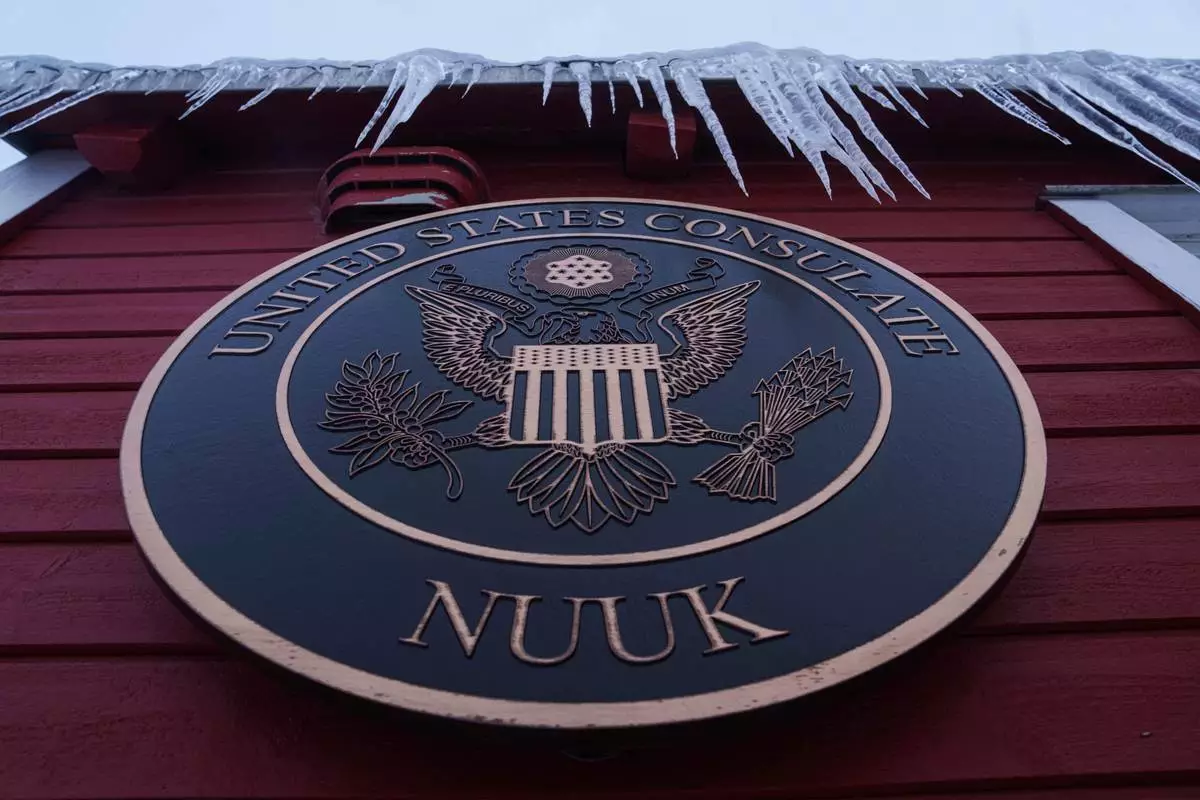
Icicles hang from the roof of the US consulate in Nuuk, Greenland, on Friday, Jan. 16, 2026. (AP Photo/Evgeniy Maloletka)

Icicles hang from the roof of the US consulate in Nuuk, Greenland, on Friday, Jan. 16, 2026. (AP Photo/Evgeniy Maloletka)

A Danish serviceman walks in front of Joint Arctic Command center in Nuuk, Greenland, on Friday, Jan. 16, 2026. (AP Photo/Evgeniy Maloletka)

A Danish serviceman walks in front of Joint Arctic Command center in Nuuk, Greenland, on Friday, Jan. 16, 2026. (AP Photo/Evgeniy Maloletka)

Senator Chris Coons from the Democratic Party speaks during a press conference with the American delegation, consisting of senators and members of the House of Representatives, in Copenhagen, Denmark, Saturday, Jan. 17, 2026. (Ida Marie Odgaard/Ritzau Scanpix via AP)

Senator Chris Coons from the Democratic Party speaks during a press conference with the American delegation, consisting of senators and members of the House of Representatives, in Copenhagen, Denmark, Saturday, Jan. 17, 2026. (Ida Marie Odgaard/Ritzau Scanpix via AP)

Recommended Articles