WASHINGTON (AP) — A year after being lauded for its plan to replace thousands of aging, gas-powered mail trucks with a mostly electric fleet, the U.S. Postal Service is facing congressional attempts to strip billions in federal EV funding.
In June, the Senate parliamentarian blocked a Republican proposal in a major tax-and-spending bill to sell off the agency's new electric vehicles and infrastructure and revoke remaining federal money. But efforts to halt the fleet’s shift to clean energy continue in the name of cost savings.
Click to Gallery
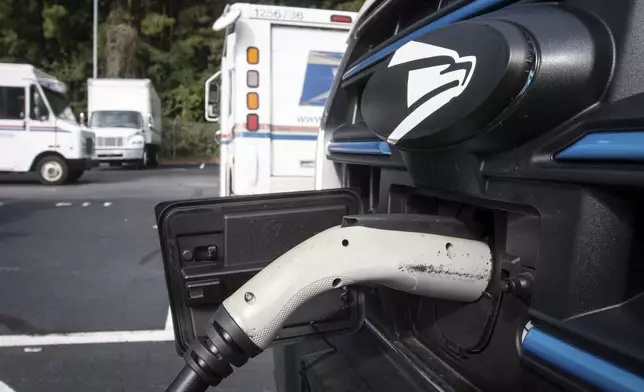
FILE - Mail delivery vehicles are charged at a post office in Athens, Ga., Thursday, Sept. 5, 2024. (AP Photo/Ron Harris, File)
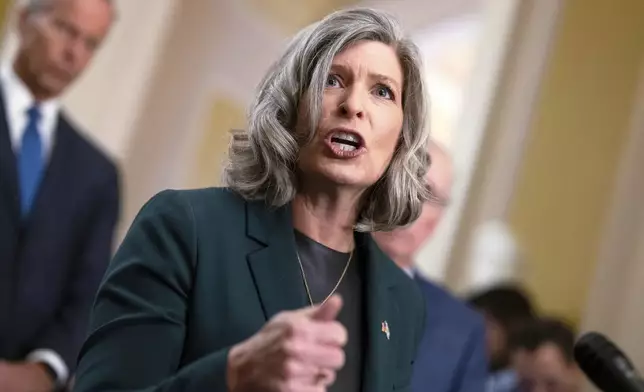
FILE - Sen. Joni Ernst, R-Iowa, speak to reporters after a closed-door meeting with fellow Republicans, at the Capitol in Washington, Sept. 24, 2024. (AP Photo/J. Scott Applewhite, File)
FILE - American Postal Workers Union President Mark Dimondstein speaks at a rally, Oct. 8, 2018, in Washington. (AP Photo/Andrew Harnik)
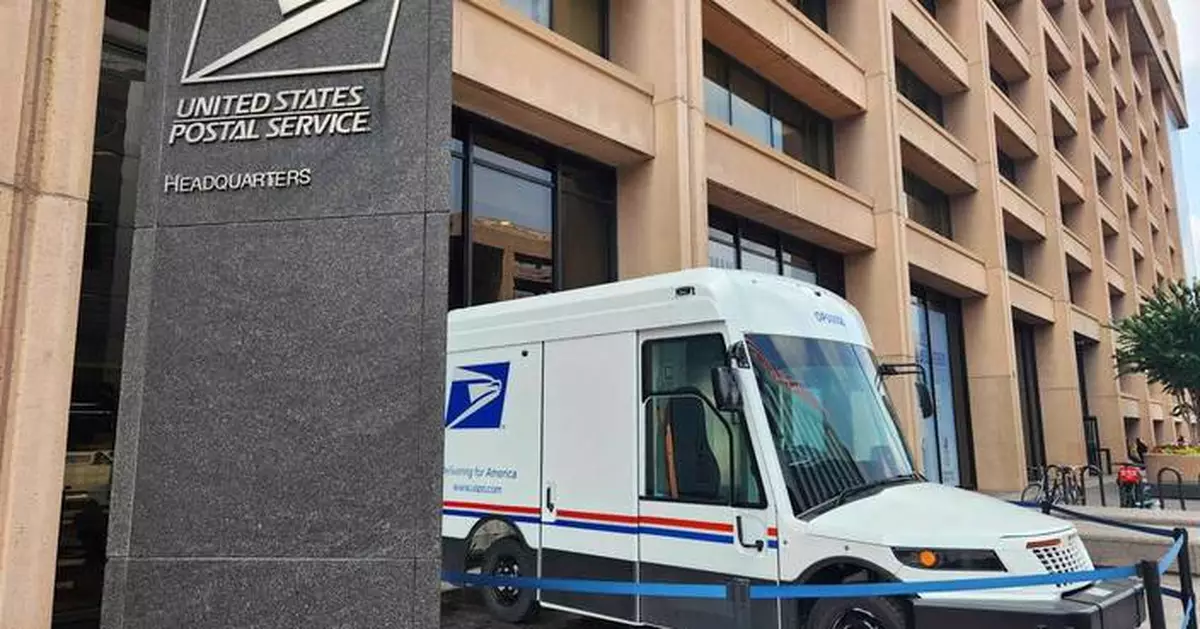
One of the U.S. Postal Service's new zero-emission electric Next Generation Delivery Vehicles (NGDV) is displayed in front of the organization's headquarters in Washington, on Aug. 7, 2025. (AP Photo/Susan Haigh)
One of the U.S. Postal Service's new zero-emission electric Next Generation Delivery Vehicles (NGDV) is displayed in front of the organization's headquarters in Washington, on Aug. 7, 2025. (AP Photo/Susan Haigh)
Donald Maston, president of the National Rural Letter Carriers’ Association, said canceling the program now would have the opposite effect, squandering millions of dollars.
“I think it would be shortsighted for Congress to now suddenly decide they’re going to try to go backwards and take the money away for the EVs or stop that process because that’s just going to be a bunch of money on infrastructure that’s been wasted," he said.
Beyond that, many in the scientific community fear the government could pass on an opportunity to reduce carbon emissions that contribute to global warming when urgent action is needed.
A 2022 University of Michigan study found the new electric postal vehicles could cut total greenhouse gas emissions by up to 20 million tons over the predicted, cumulative 20-year lifetime of the trucks. That's a fraction of the more than 6,000 million metric tons emitted annually in the United States, said professor Gregory A. Keoleian, co-director of the university's Center for Sustainable Systems. But he said the push toward electric vehicles is critical and needs to accelerate, given the intensifying impacts of climate change.
“We’re already falling short of goals for reducing emissions,” Keoleian said. “We’ve been making progress, but the actions being taken or proposed will really reverse decarbonization progress that has been made to date.”
Many GOP lawmakers share President Donald Trump's criticism of the Biden-era green energy push and say the Postal Service should stick to delivering mail.
Sen. Joni Ernst, R-Iowa, said “it didn't make sense for the Postal Service to invest so heavily in an all-electric force." She said she will pursue legislation to rescind what is left of the $3 billion from the Inflation Reduction Act allocated to help cover the $10 billion cost of new postal vehicles.
Ernst has called the EV initiative a “boondoggle” and "a textbook example of waste,” citing delays, high costs and concerns over cold-weather performance.
“You always evaluate the programs, see if they are working. But the rate at which the company that’s providing those vehicles is able to produce them, they are so far behind schedule, they will never be able to fulfill that contract," Ernst said during a recent appearance at the Iowa State Fair, referring to Wisconsin-based Oshkosh Defense.
“For now,” she added, "gas-powered vehicles — use some ethanol in them — I think is wonderful.”
Corn-based ethanol is a boon to Iowa's farmers, but the effort to reverse course has other Republican support.
Rep. Michael Cloud, R-Texas, a co-sponsor of the rollback effort, has said the EV order should be canceled because the project "has delivered nothing but delays, defective trucks, and skyrocketing costs.”
The Postal Service maintains that the production delay of the Next Generation Delivery Vehicles, or NGDVs, was “very modest" and not unexpected.
“The production quantity ramp-up was planned for and intended to be very gradual in the early months to allow time for potential modest production or supplier issues to be successfully resolved,” spokesperson Kim Frum said.
The independent, self-funded federal agency, which is paid for mostly by postage and product sales, is in the middle of a $40 billion, 10-year modernization and financial stabilization plan. The EV effort had the full backing of Democratic President Joe Biden, who pledged to move toward an all-electric federal fleet of car and trucks.
The “Deliver for America” plan calls for modernizing the ground fleet, notably the Grumman Long Life Vehicle, which dates back to 1987 and is fuel-inefficient at 9 mpg. The vehicles are well past their projected 24-year lifespan and are prone to breakdowns and even fires.
“Our mechanics are miracle workers,” said Mark Dimondstein, president of the American Postal Workers Union. “The parts are not available. They fabricate them. They do the best they can.”
The Postal Service announced in 2022 it would deploy at least 66,000 electric vehicles by 2028, including commercial off-the-shelf models, after years of deliberation and criticism it was moving too slowly to reduce emissions. By 2024, the agency was awarded a Presidential Sustainability Award for its efforts to electrify the largest fleet in the federal government.
In 2021, Oshkosh Defense was awarded a contract for up to 165,000 battery electric and internal combustion engine Next Generation vehicles over 10 years.
The first of the odd-looking trucks, with hoods resembling a duck’s bill, began service in Georgia last year. Designed for greater package capacity, the trucks are equipped with airbags, blind-spot monitoring, collision sensors, 360-degree cameras and antilock brakes.
There's also a new creature comfort: air conditioning.
Douglas Lape, special assistant to the president of the National Association of Letter Carriers and a former carrier, is among numerous postal employees who have had a say in the new design. He marvels at how Oshkosh designed and built a new vehicle, transforming an old North Carolina warehouse into a factory along the way.
“I was in that building when it was nothing but shelving,” he said. “And now, being a completely functioning plant where everything is built in-house — they press the bodies in there, they do all of the assembly — it’s really amazing in my opinion.”
The agency has so far ordered 51,500 NGDVs, including 35,000 battery-powered vehicles. To date, it has received 300 battery vehicles and 1,000 gas-powered ones.
Former Postmaster General Louis DeJoy said in 2022 the agency expected to purchase chiefly zero-emissions delivery vehicles by 2026. It still needs some internal combustion engine vehicles that travel longer distances.
Frum, the Postal Service spokesperson, said the planned NGDV purchases were "carefully considered from a business perspective” and are being deployed to routes and facilities where they will save money.
The agency has also received more than 8,200 of 9,250 Ford E-Transit electric vehicles it has ordered, she said.
Ernst said it's fine for the Postal Service to use EVs already purchased.
“But you know what? We need to be smart about the way we are providing services through the federal government,” she said. “And that was not a smart move.”
Maxwell Woody, lead author of the University of Michigan study, made the opposite case.
Postal vehicles, he said, have low average speeds and a high number of stops and starts that enable regenerative braking. Routes average under 30 miles and are known in advance, making planning easier.
“It’s the perfect application for an electric vehicle," he said, “and it’s a particularly inefficient application for an internal combustion engine vehicle.”
Associated Press writer Hannah Fingerhut in Des Moines, Iowa, contributed to this report.
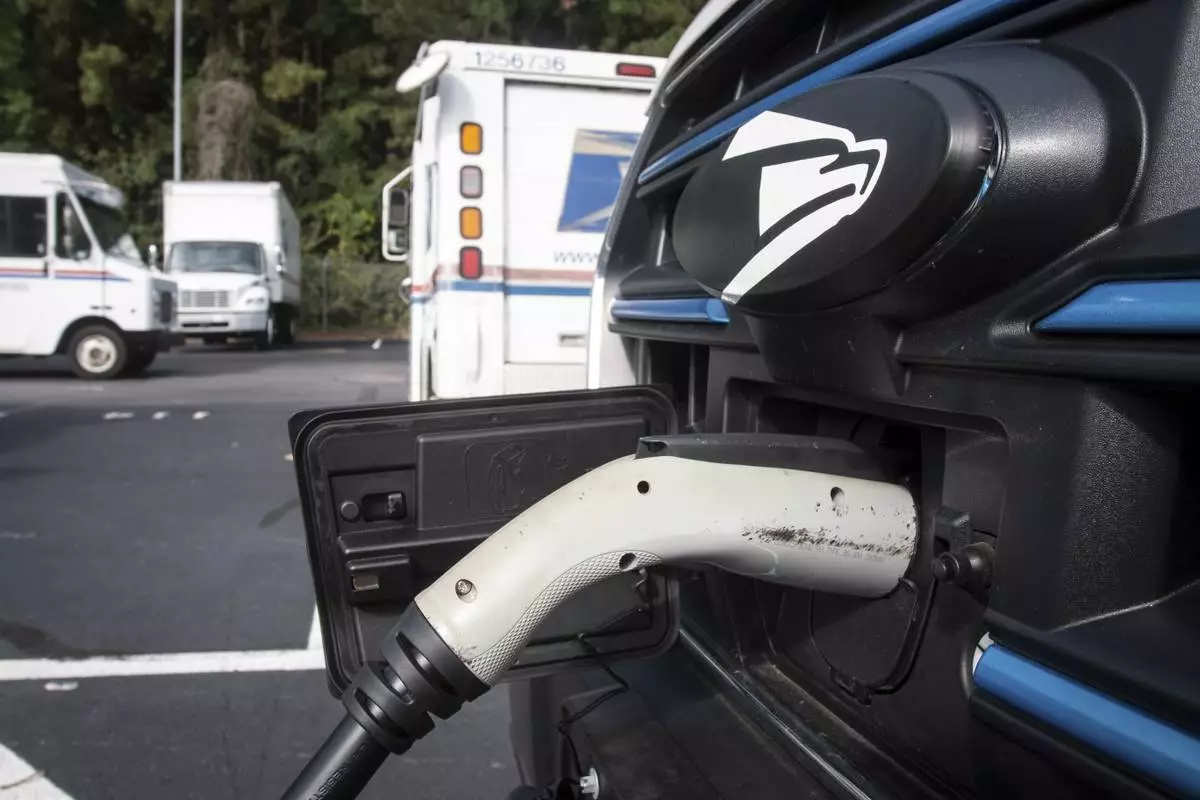
FILE - Mail delivery vehicles are charged at a post office in Athens, Ga., Thursday, Sept. 5, 2024. (AP Photo/Ron Harris, File)
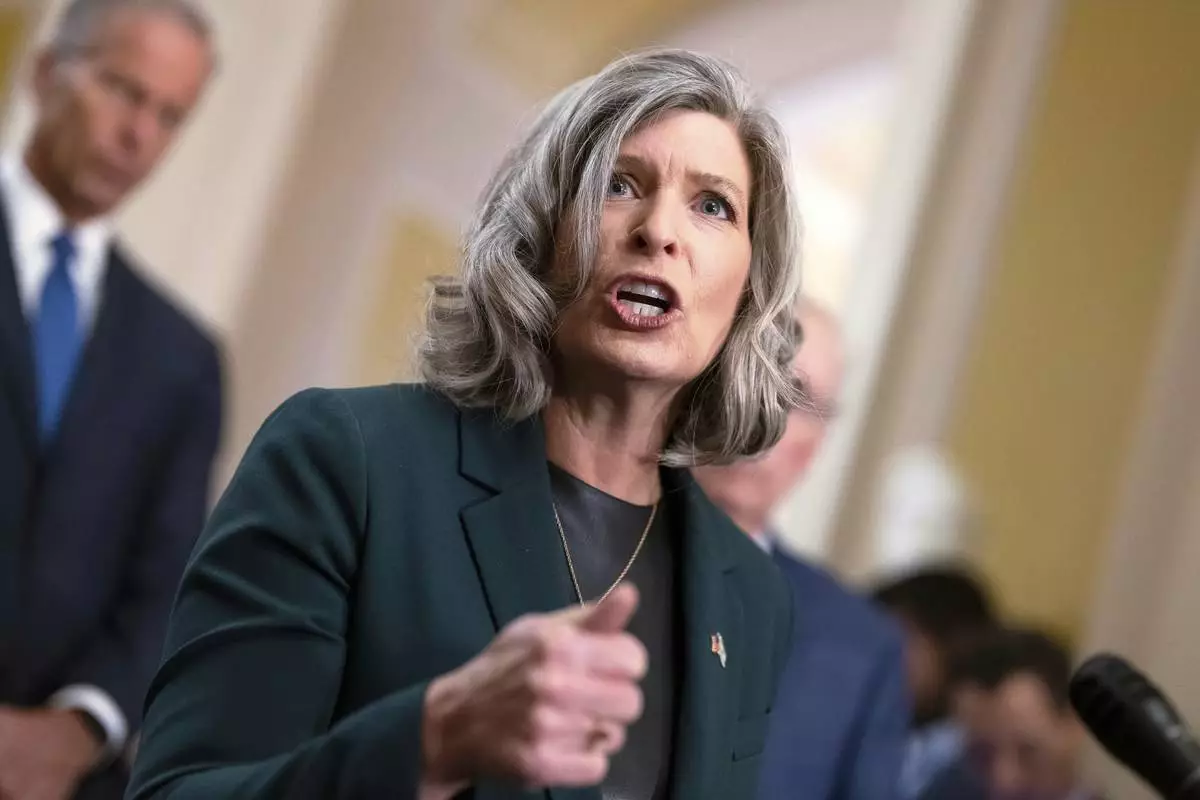
FILE - Sen. Joni Ernst, R-Iowa, speak to reporters after a closed-door meeting with fellow Republicans, at the Capitol in Washington, Sept. 24, 2024. (AP Photo/J. Scott Applewhite, File)

FILE - American Postal Workers Union President Mark Dimondstein speaks at a rally, Oct. 8, 2018, in Washington. (AP Photo/Andrew Harnik)

One of the U.S. Postal Service's new zero-emission electric Next Generation Delivery Vehicles (NGDV) is displayed in front of the organization's headquarters in Washington, on Aug. 7, 2025. (AP Photo/Susan Haigh)
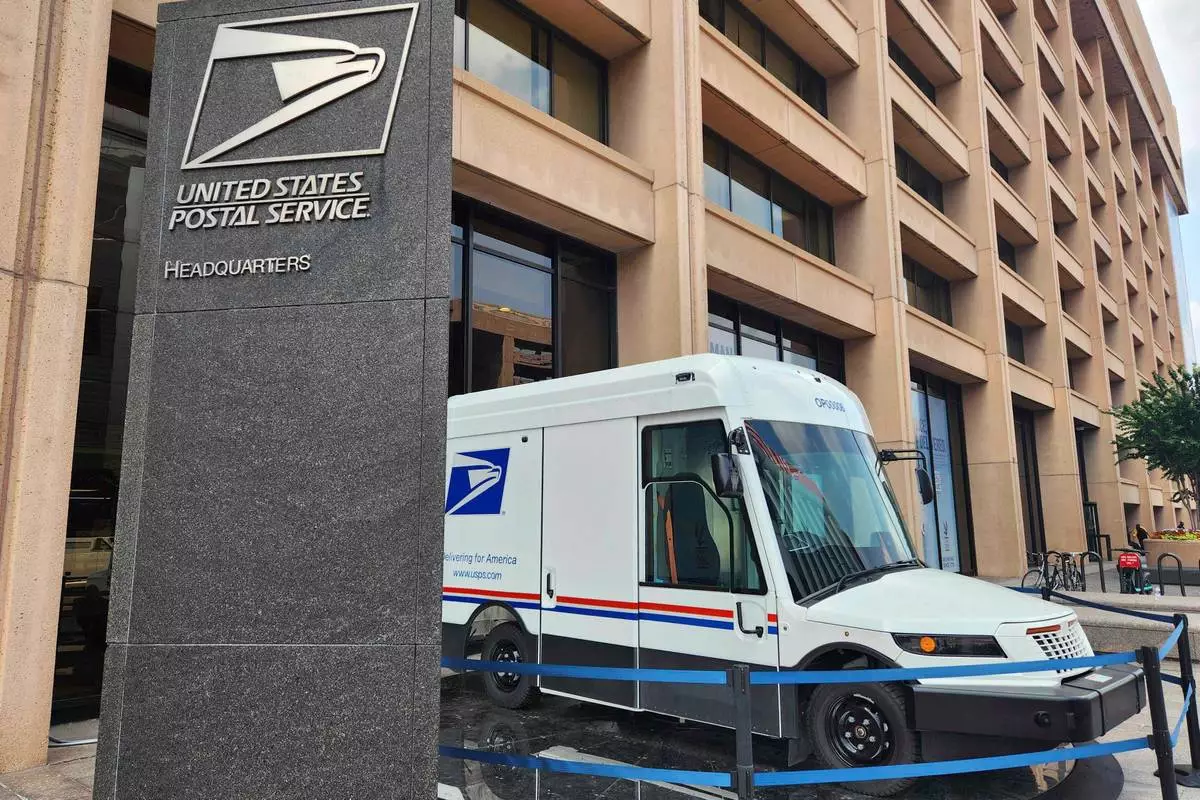
One of the U.S. Postal Service's new zero-emission electric Next Generation Delivery Vehicles (NGDV) is displayed in front of the organization's headquarters in Washington, on Aug. 7, 2025. (AP Photo/Susan Haigh)
The U.N. Security Council scheduled an emergency meeting Thursday to discuss Iran's deadly protests at the request of the United States, even as President Donald Trump left unclear what actions he would take against the Islamic Republic.
Tehran appeared to make conciliatory statements in an effort to defuse the situation after Trump threatened to take action to stop further killing of protesters, including the execution of anyone detained in Tehran’s bloody crackdown on nationwide protests.
White House press secretary Karoline Leavitt said, “All options remain on the table for the president.”
Iran’s crackdown on the demonstrations has killed at least 2,615, the U.S.-based Human Rights Activists News Agency reported. The death toll exceeds any other round of protest or unrest in Iran in decades and recalls the chaos surrounding the country’s 1979 Islamic Revolution.
The sound of gunfire faded Thursday in the capital, Tehran. The country closed its airspace to commercial flights for hours without explanation early Thursday and some personnel at a key U.S. military base in Qatar were advised to evacuate. The U.S. Embassy in Kuwait also ordered its personnel to “temporary halt” travel to the multiple military bases in the small Gulf Arab country.
Here is the latest:
White House press secretary Karoline Leavitt said that U.S. President Donald Trump and his team had communicated to Iranian officials that there would be “grave consequences” if killing continues against protesters in Iran.
“The president understands today that 800 executions that were scheduled and supposed to take place yesterday, were halted,” she said.
But Trump continues closely watching the situation, she said.
“All options remain on the table for the president,” Leavitt said.
Abdul Malik al-Houthi, leader of the Iran-backed Yemeni rebel group, said on Thursday that “criminal gangs” were responsible for the situation in Iran, accusing them of carrying out an “American-Israeli” scheme.
“Criminal gangs in Iran killed Iranian citizens, security forces and burned mosques,” he said without providing evidence. “What’s being committed by criminal gangs in Iran is horrific, bearing an American stamp as it includes slaughter and burning some people alive.”
He also said that the U.S. imposed economic sanctions on Iran to create a crisis leading to the current issues in the country with the end goal of controlling Iran.
Yet he said the U.S. has “failed in Iran” and that Iranians “will not yield to America.”
The president of the European Union’s executive arm says the 27-member bloc is looking to strengthen sanctions against Iran as ordinary Iranians continue their protests against Iran’s theocratic government.
Commission President Ursula von der Leyen said Thursday following a meeting of the EU’s commissioners in Limassol, Cyprus that current sanctions against Iran are “weakening the regime.”
Von der Leyen said that the EU is looking to sanction individual Iranians —apart from those who belong to Iran’s Islamic Revolutionary Guard — who “are responsible for the atrocities.”
She added that the people of Iran who are “bravely fighting for a change” have the EU’s “full political support.”
Canada’s foreign minister says a Canadian citizen has died in Iran “at the hands of the Iranian authorities.”
“Peaceful protests by the Iranian people — asking that their voices be heard in the face of the Iranian regime’s repression and ongoing human rights violations — has led the regime to flagrantly disregard human life,” Canadian Foreign Affairs Minister Anita Anand posted on social media Thursday.
“This violence must end. Canada condemns and calls for an immediate end to the Iranian regime’s violence,” she added.
Anand said consular officials are in contact with the victim’s family in Canada. She did not provide details.
The International Federation of Red Cross and Red Crescent Societies announced Thursday that a local staff member was killed and several others were wounded during the deadly protests in Iran over the weekend.
Amir Ali Latifi, an Iranian Red Crescent Society worker, was working in the country’s Gillan province on Jan. 10 when he was killed “in the line of duty,” the organization said in a statement.
“The IFRC is deeply concerned about the consequences of the ongoing unrest on the people of Iran and is closely monitoring the situation in coordination with the Iranian Red Crescent Society,” the statement continued.
U.S. President Donald Trump has hailed as “good news” reports that the death sentence has been lifted for an Iranian shopkeeper arrested in a violent crackdown on protests.
Relatives of 26-year-old Erfan Soltani had said he faced imminent execution.
Trump posed Thursday on his Truth Social site: “FoxNews: ‘Iranian protester will no longer be sentenced to death after President Trump’s warnings. Likewise others.’ This is good news. Hopefully, it will continue!”
Iranian state media denied Soltani had been condemned to death. Iranian judicial authorities said Soltani was being held in a detention facility outside of the capital. Alongside other protesters, he has been accused of “propaganda activities against the regime,” state media said.
Trump sent tensions soaring this week by pledging that “help is on its way” to Iranian protesters and urging them to continue demonstrating against authorities in the Islamic Republic.
On Wednesday Trump signaled a possible de-escalation, saying he had been told that “the killing in Iran is stopping.”
In a joint statement, the foreign ministers of Canada, France, Germany, Italy, Japan, the United Kingdom, the United States and the European Union’s main foreign policy chief said the G7 members were “gravely concerned” by the developments surrounding the protests, and that they “strongly oppose the intensification of the Iranian authorities’ brutal repression of the Iranian people.”
The statement, published on the EU’s website Thursday, said the G7 were “deeply alarmed at the high level of reported deaths and injuries” and condemned “the deliberate use of violence” by Iranian security forces against protesters.
The G7 members “remain prepared to impose additional restrictive measures if Iran continues to crack down on protests and dissent in violation of international human rights obligations,” the statement said.
China’s Foreign Minister Wang Yi has spoken with his counterpart in Iran, who said the situation was “now stable,” China’s Ministry of Foreign Affairs said.
Abbas Araghchi said “he hoped China will play a greater role in regional peace and stability” during the talks, according to the statement from the ministry.
“China opposes imposing its will on other countries, and opposes a return to the ‘law of the jungle’,” Wang said.
“China believes that the Iranian government and people will unite, overcome difficulties, maintain national stability, and safeguard their legitimate rights and interests,” he added. “China hopes all parties will cherish peace, exercise restraint, and resolve differences through dialogue. China is willing to play a constructive role in this regard.”
“We are against military intervention in Iran,” Turkish Foreign Minister Hakan Fidan told journalists in Istanbul on Thursday. “Iran must address its own internal problems… They must address their problems with the region and in global terms through diplomacy so that certain structural problems that cause economic problems can be addressed.”
Ankara and Tehran enjoy warm relations despite often holding divergent interests in the region.
Fidan said the unrest in Iran was rooted in economic conditions caused by sanctions, rather than ideological opposition to the government.
Iranians have been largely absent from an annual pilgrimage to Baghdad, Iraq, to commemorate the death of Imam Musa al-Kadhim, one of the twelve Shiite imams.
Many Iranian pilgrims typically make the journey every year for the annual religious rituals.
Streets across Baghdad were crowded with pilgrims Thursday. Most had arrived on foot from central and southern provinces of Iraq, heading toward the shrine of Imam al-Kadhim in the Kadhimiya district in northern Baghdad,
Adel Zaidan, who owns a hotel near the shrine, said the number of Iranian visitors this year compared to previous years was very small. Other residents agreed.
“This visit is different from previous ones. It lacks the large numbers of Iranian pilgrims, especially in terms of providing food and accommodation,” said Haider Al-Obaidi.
Europe’s largest airline group said Thursday it would halt night flights to and from Tel Aviv and Jordan's capital Amman for five days, citing security concerns as fears grow that unrest in Iran could spiral into wider regional violence.
Lufthansa — which operates Swiss, Austrian Airlines, Brussels Airlines and Eurowings — said flights would run only during daytime hours from Thursday through Monday “due to the current situation in the Middle East.” It said the change would ensure its staff — which includes unionized cabin crews and pilots -- would not be required to stay overnight in the region.
The airline group also said its planes would bypass Iranian and Iraqi airspace, key corridors for air travel between the Middle East and Asia.
Iran closed its airspace to commercial flights for several hours early Thursday without explanation.
A spokesperson for Israel’s Airport Authority, which oversees Tel Aviv’s Ben Gurion Airport, said the airport was operating as usual.
Iranian state media has denied claims that a young man arrested during Iran’s recent protests was condemned to death. The statement from Iran’s judicial authorities on Thursday contradicted what it said were “opposition media abroad” which claimed the young man had been quickly sentenced to death during a violent crackdown on anti-government protests in the country.
State television didn’t immediately give any details beyond his name, Erfan Soltani. Iranian judicial authorities said Soltani was being held in a detention facility outside of the capital. Alongside other protesters, he has been accused of “propaganda activities against the regime,” state media said.
New Zealand’s Foreign Minister Winston Peters said Thursday that his government was “appalled by the escalation of violence and repression” in Iran.
“We condemn the brutal crackdown being carried out by Iran’s security forces, including the killing of protesters,” Peters posted on X.
“Iranians have the right to peaceful protest, freedom of expression, and access to information – and that right is currently being brutally repressed,” he said.
Peters said his government had expressed serious concerns to the Iranian Embassy in Wellington.
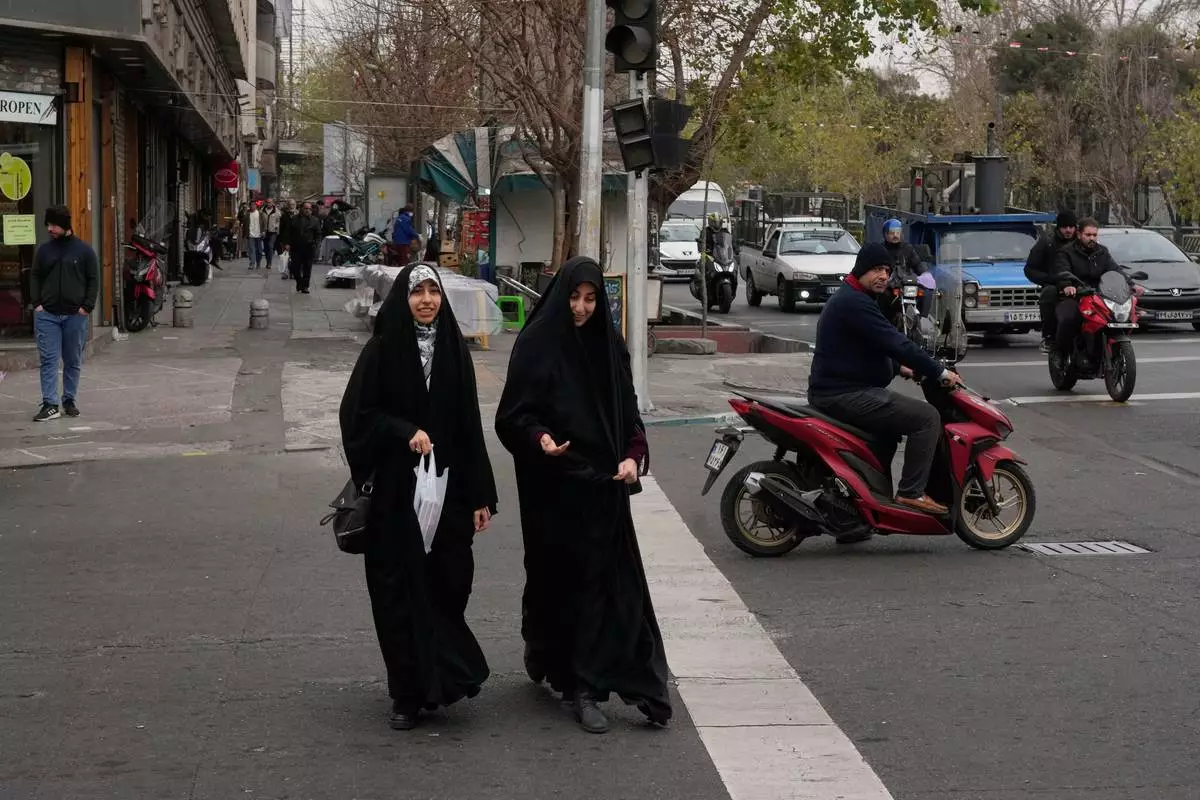
Women cross an intersection in downtown Tehran, Iran, Thursday, Jan. 15, 2026. (AP Photo/Vahid Salemi)
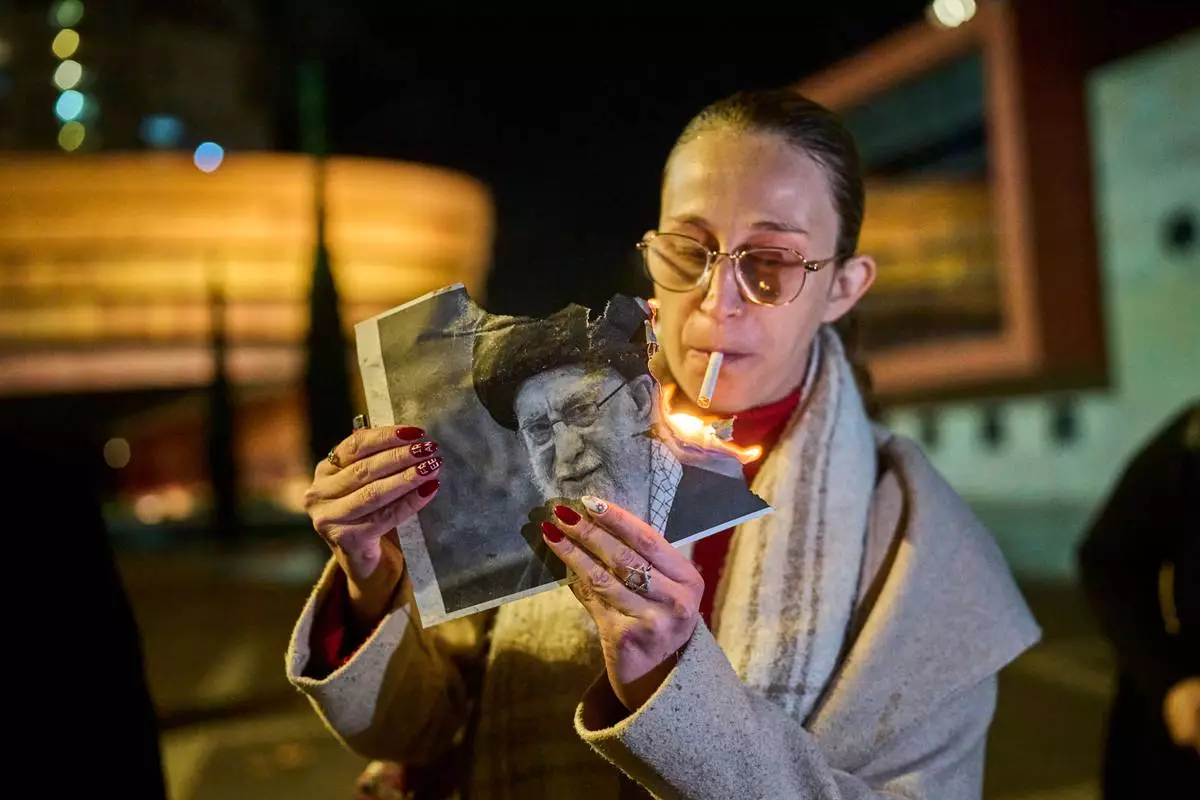
A demonstrator lights a cigarette with a burning poster depicting Supreme Leader Ayatollah Ali Khamenei during a rally in support of Iran's anti-government protests, in Holon, Israel, Wednesday, Jan. 14, 2026. (AP Photo/Ohad Zwigenberg)
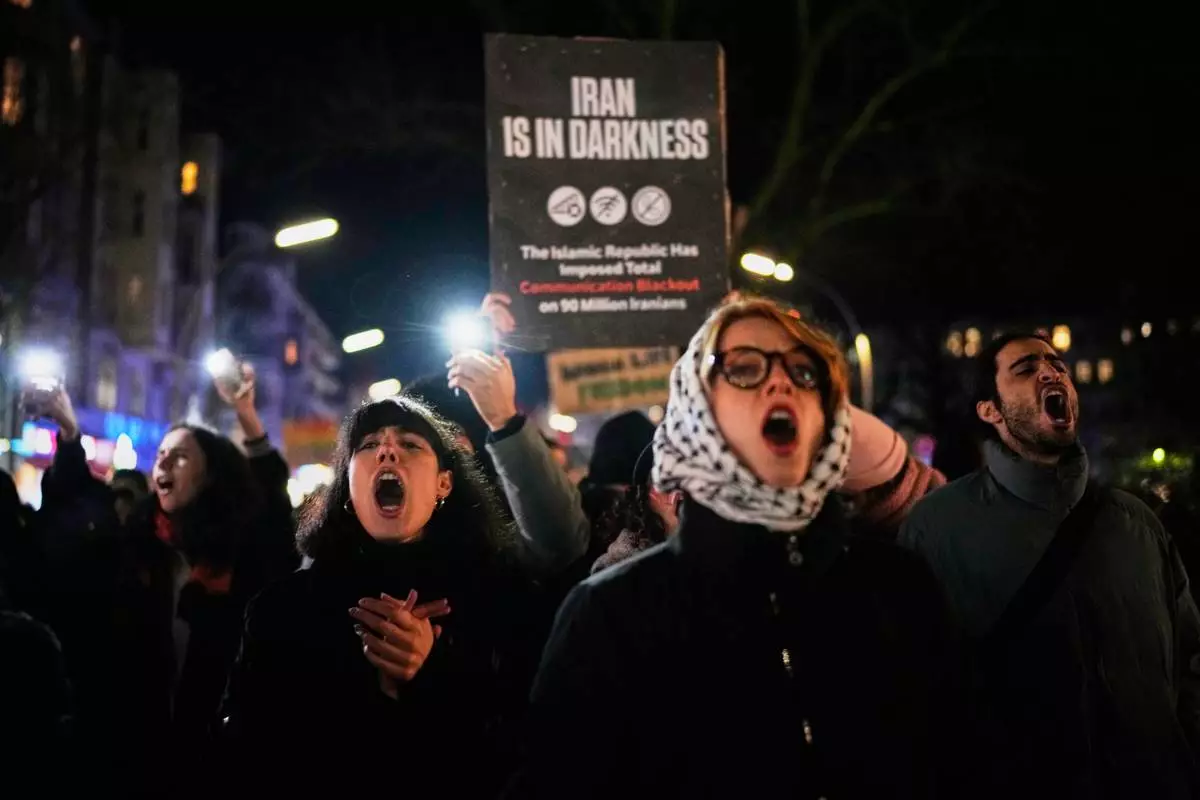
Protesters participate in a demonstration in support of the nationwide mass protests in Iran against the government, in Berlin, Germany, Wednesday, Jan. 14, 2026. (AP Photo/Ebrahim Noroozi)
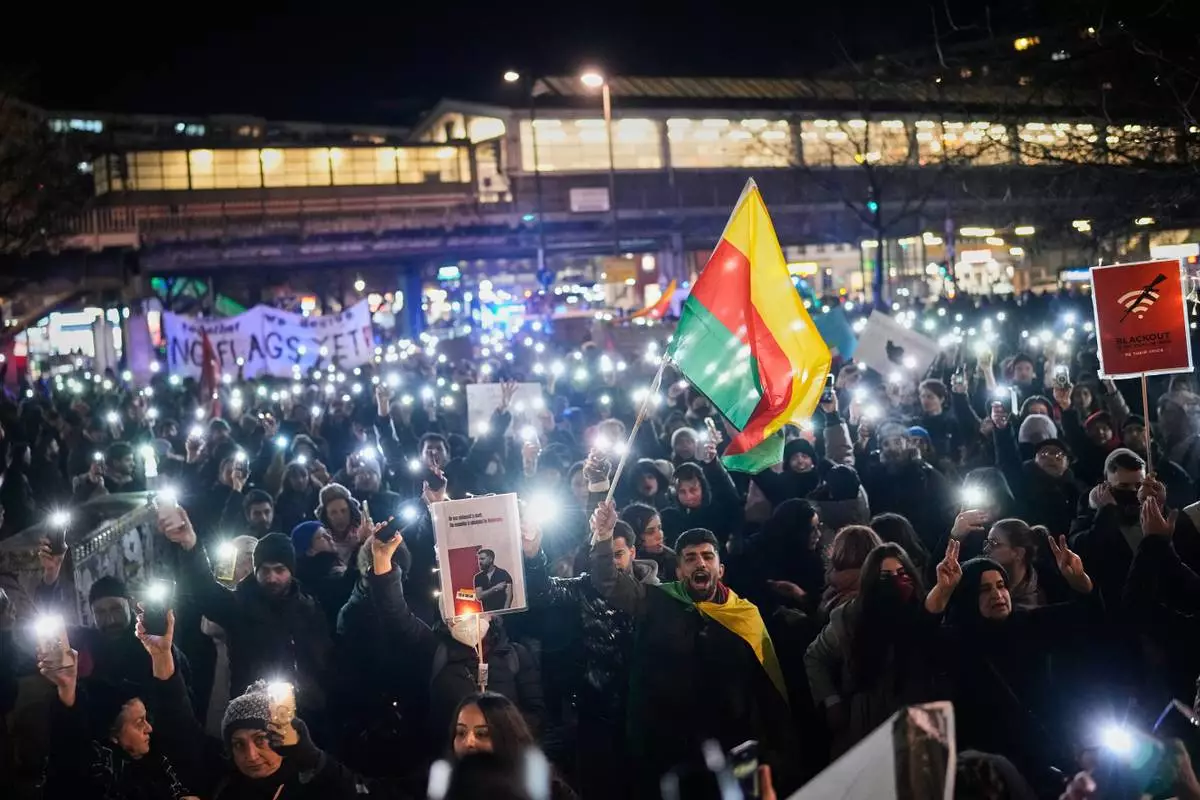
Protesters participate in a demonstration in support of the nationwide mass protests in Iran against the government, in Berlin, Germany, Wednesday, Jan. 14, 2026. (AP Photo/Ebrahim Noroozi)