China's giant panda population in the wild has nearly doubled since the 1980s, rising from around 1,100 to 1,900 today, thanks to decades of rigorous conservation and wild training programs.
In the giant panda wild training fields of Tiantai Mountain within Wolong National Nature Reserve in southwest China's Sichuan Province, three pairs of mother and cub giant pandas are being trained across its one-square-kilometer expanse.
During the training, panda cubs learn essential survival skills from their mothers. At the same time, keepers disguise themselves to prevent dependence on humans. To monitor the pandas, keepers patrol the area daily, providing nutritious supplements and conducting health check-ups.
Before release, the cubs must master foraging, evading predators, and adapting to the wild.
"First, the panda must be healthy. Second, it should have learned various survival skills from its mother. Then, the mother needs to be separated from the cub for a period of time, allowing it to live independently in the wild for a few months. After that, we will monitor it to determine if the panda is ready for release," said Mu Shijie, a giant panda keeper.
If the evaluation shows they aren't ready, the pandas will return to captive care.
So far, the China Conservation and Research Center for the Giant Panda has released 11 captive pandas, with nine surviving. This gives a survival rate of over 81.8 percent, which is notably higher than the global success rate for rewilding large wild animals.

China's wild giant panda population soars to nearly 1,900
Iran's Minister of Science, Research and Technology Hossein Simaei-Sarraf on Saturday condemned the United States and Israel for attacking Iranian academic institutions and research facilities, saying that more than 30 universities across the country have been directly targeted since the war started in late February.
The official made the condemnation when speaking to reporters at the site of the damaged Shahid Beheshti University in the Iranian capital Tehran.
Simaei-Sarraf said five university professors and more than 60 students had been killed in the strikes so far, describing attacks on Iranian infrastructure as "crimes against humanity."
Those killed include Saeed Shamghadri, an associate professor at the Iran University of Science and Technology. "Since the war started, five university professors, including Professor Shamghadri, and more than 60 university students have been killed. As I mentioned before, more than 30 universities in Iran have been attacked. It is unbelievable that in an era when democratic values, rights, international law, and human rights are being promoted, the most obvious of these rights are being trampled, violated, and attacked," said Simaei-Sarraf.
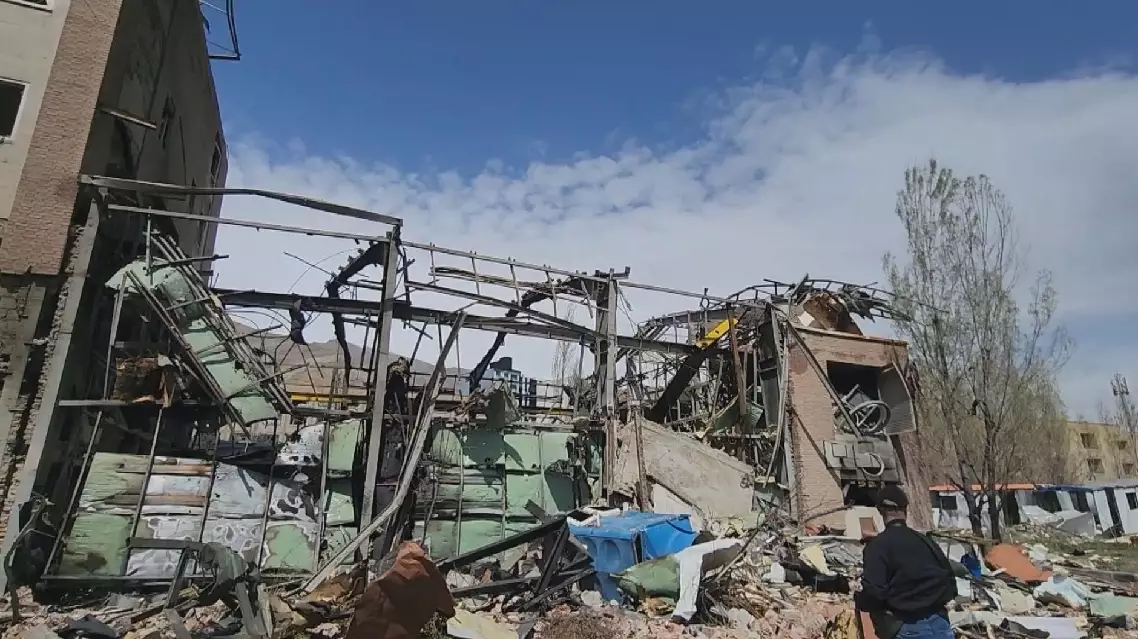
An U.S.-Israeli air raid hit the laser and plasma research center of the Shahid Beheshti University on Friday, destroying the interior of the entire building and shattering all the windows. The force of the strike also shattered almost all the windows on another building about 100 meters away from the explosion site.
A researcher at the university said it is incomprehensible that such a facility could become a target of attacks.
"You can see that there's neither any military personnel or military activity here. This is a place where only research was being conducted. Why did it become a target of attacks? What was the motive for this crime?" Azimi, the researcher, said in an interview with China Media Group.
Since the U.S.-Israeli strikes against Iran started, the Iranian government has repeatedly denounced the two countries for targeting the country's academic institutions and research facilities, calling such attacks serious war crimes.
Iranian official condemns U.S.-Israeli strikes on universities