DEEP Robotics, a Hangzhou-based company known for its innovation in robotics, has been creating sophisticated four-legged machines capable of an increasing number of real-world applications as new technologies enhance their reliability, while keeping an open mind for global collaboration in this high-tech field.
In an interview with China Global Television Network (CGTN), a staff member at the company, also known as Hangzhou Yunshenchu Technology, provided insights into the usual work purposes for advanced robots at the company. These cutting-edge machines are already being utilized across various sectors.
As technology continues to evolve, the role of advanced robots in everyday work is becoming more pivotal, reshaping industries and improving overall operational effectiveness, he said as he introduced the company's full robot family lineup.
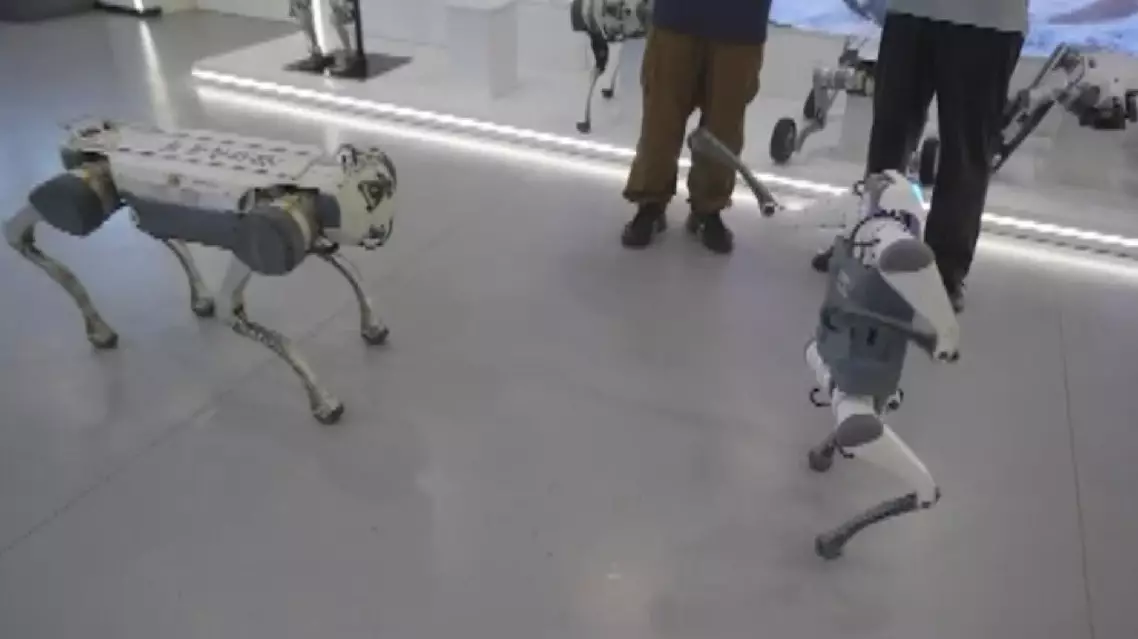
Among the models is a humanoid robot, for now mainly used in education and research. The X30 quadruped robot is primarily used for dangerous tasks such as industrial firefighting, emergency rescue and power inspection. It is equipped with IP67 protection, meaning it is fully resistant to interference from solid particles and is waterproof when immersed in up to a meter of water.
The newly-released LYNX M20 is fitted not just with four legs, but with four wheels, allowing it to quickly on flat surfaces, and with its legs, it can also climb over rough terrain, the company employee explained.
Wang Shixing, overseas sales director at DEEP Robotics, stressed that researchers must strive to improve robots' abilities to work together with humans.
"The keywords here are two. One is reliability, because they need the robot to replace or collaborate with human beings to improve the efficiency and reduce the cost. And the other keyword is accuracy," said Wang.
On the company's vision for the future, Zhou Yanxin, the research and development director of DEEP Robotics, emphasized that the company has been actively seeking collaborators to build a thriving ecosystem in this high-tech field.
"We are open minded to have more cooperation with other different companies and partners and we are open to build this ecosystem, not to against someone, to make a small group. We are open and we want to make this robot to really benefit human beings to some, especially for some dangerous environments," said Zhou.
The first experience that many people have with a quadraped robot may be in receiving a package delivery, as the technology has ample potential to solve the "last-mile" problem in logistics -- that is, completing deliveries after packages have already traveled long distances via truck, train or air.
According to Zhou, the quadraped robots will also be used in many ways behind the scenes of everyday life.
"First of all, as we have more applications than the last-mile application, so for the inspection and rescue mission, surveillance and so many other applications. And normally like this, we first develop the body, the platform, normally for the locomotion and perception, this is the body side. And second our partners. They will integrate their application or some software platform on our platform. So together we can make a whole solution for the end users," he said.
Both Wang and Zhou said the company is highly optimistic about the growth of robotics around the world, sticking firmly to the belief that greater connectivity in the world will inevitably lead to progress.
"Nowadays the information transfer much faster than 20 years ago, so there's no way to stop the globalization," said Wang.
"The trade or the cooperation will make the market or the business bigger. So I think (if) cooperation is open, not disconnected, it is better for the world. We, especially for the young people and for (people) like me, the technicians, for the developers, we really need to cooperate and to communicate, not disconnect," said Zhou.
Chinese robotics firm advances sophisticated machines, eyes global cooperation